
Financial
AUD changed on RBA monetary policy decision – What To Expect


The pair is trading little changed around 0.6790 at the moment as the RBA offered little in terms of anything new for traders and investors on the day.
They mentioned that monetary policy is set to remain accommodative for as long as required while keeping their forward guidance on rates and the yields target unchanged.
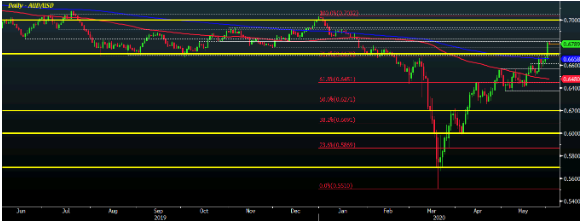
That perhaps gives them room to scale back on some recent policy actions if need be, but ultimately they would still prefer it to be accompanied by progress in the labor market and inflation. For some context, the RBA had already stopped QE for a few weeks now:
Overall, I think what was not said is perhaps more important than what was said.
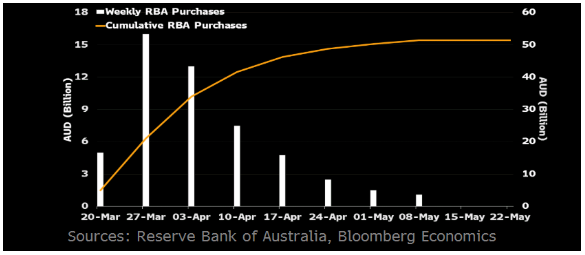
The RBA made no special mention to the recent rise in the Aussie – the currency has gained by over 5% against the dollar since its May meeting – and that may provide buyers with some relative comfort that the central bank doesn’t see it as being a pressing issue yet.
Back to the AUD/USD chart, the 0.6800 level is offering some daily resistance at the moment as the risk mood is keeping more tepid to start the day, but technically there is little stopping a move back towards 0.7000 potentially given the recent run.
A lot will come down to headline risks and how stocks perform, but so far, there hasn’t been any significant hiccup with US-China tensions from last week being brushed aside for now.
The civil unrest in the US remains a wildcard, but it is also the case for the US dollar.

Blockchain
Re Protocol (RE) Brings a $1 Trillion Reinsurance Market On-Chain — But the Token Needs More Than a Good Thesis


Re Protocol has done something genuinely novel: it has tokenized reinsurance risk and made it accessible to DeFi capital for the first time at institutional scale. Before the RE token launched around June 18, 2026, the protocol had already underwritten over $500 million in insurance premiums across 35-plus insurance companies covering more than 700,000 policyholders. That’s not a roadmap item. It’s a running business that predates the token — a rare and meaningful distinction in a market where most protocols launch tokens first and find customers later.
RE hit an all-time high of $1.06 on June 20, 2026, just two days after its TGE, before pulling back to around $0.59 at the time of writing — a 44% decline from peak that reflects a combination of broader market weakness and the post-launch supply dynamics typical of newly issued tokens.
The Asset That Actually Generates the Yield
The most important thing to understand about Re Protocol is that RE, the governance token, is a separate instrument from where the real value accrues. Re Protocol’s native token has a fixed supply of one billion units and serves exclusively as a community governance instrument, granting no rights over yields or position in the loss cascade. The yield-bearing instruments are reUSD and reUSDe — dollar-denominated assets that reflect insurance-linked yield mechanics.
Re Protocol’s reUSDe product offers a 15.49% fixed APY backed by $500 million in real reinsurance premiums. That yield figure deserves context: reinsurance yield is uncorrelated with crypto market cycles. A DeFi protocol crashing doesn’t affect whether a hurricane hits Florida or whether a shipping cargo claim is paid out. As one market observer put it precisely: “A depression or a hurricane, the Fed raised interest rates or Bitcoin crashed — it doesn’t happen.” The yield is structurally independent of the volatility that governs most DeFi returns.
DeFiLlama showed reUSD near $1.09 with a native yield around 6.17% as of July 12, 2026, while reUSD is also integrated with major DeFi protocols including Aave and Compound — expanding its reach beyond Re Protocol’s native interface into the broader DeFi ecosystem.
The Loss Cascade Structure That Protects reUSD Holders
Losses are absorbed in strict order: first the protocol’s own capital, estimated at approximately $77 million by June 2026, then reUSDe, and finally reUSD. That waterfall structure means reUSD holders sit at the senior end of the loss cascade — protected by $77 million in protocol capital and the junior reUSDe tranche before any losses reach them. For institutional capital evaluating reUSD as a treasury asset, that structural protection is a meaningful differentiator from other yield-bearing stablecoin products.
The Binance Listing and What It Changed
Binance officially listed RE on its spot platform following the June 18 TGE, with zero listing fees, carrying the Seed Tag designation indicating early-stage volatility risk. With trading previously featured on Binance Alpha, RE is now accessible to a much broader global audience. The listing drove significant volume in the first 48 hours — hundreds of millions of dollars according to early reports — before normalizing to the $30 to $100 million daily range as the initial excitement faded.
The initial float matters significantly. Per the project website, 159.6 million RE were liquid at TGE out of 1 billion total, with a 48-month vesting runway for the remainder. That schedule implies periodic unlocks that can pressure price if demand does not match new supply. With only 15.96% of tokens currently circulating, the 48-month vesting timeline represents years of potential dilution that buyers at current prices are implicitly betting against through sustained protocol growth.
Re Protocol raised $21 million ahead of its TGE — a number that, combined with the $500 million in underwritten premiums already on the books, gives the protocol a credibility baseline that most newly launched RWA tokens simply don’t have. Whether RE’s governance role can develop additional utility mechanisms that create demand beyond pure speculation — staking, fee distribution rights, or priority access to reinsurance pools — will be the defining factor in how the token performs through its 48-month vesting window.
The thesis is real. The market being targeted is genuinely enormous. The gap between where RE trades and what the underlying protocol generates is the opportunity — if you believe the protocol’s underwriting track record scales.
Crypto
Origin Protocol (OGN) Outperforms Market by 14% in a Week as Revenue Buybacks and ARM Vaults Drive a Quiet DeFi Comeback

Origin Protocol doesn’t generate the kind of headlines that newer projects command. It’s been running since 2018 — ancient history by crypto standards — and has quietly evolved from an NFT marketplace infrastructure company into one of Ethereum’s more disciplined yield-focused DeFi protocols. OGN is up 14.2% over the past seven days, outperforming both the global crypto market at 7% and comparable Ethereum ecosystem tokens at 12.7%. The token is trading around $0.022, with a market cap in the low double-digit millions — a valuation that the protocol’s own revenue generation arguably doesn’t justify.
The July 6 community call covered ARM Vaults, OUSD, OGN, and new integrations — a regular cadence that reflects a team that’s building consistently rather than chasing headlines. For a protocol that has been running weekly OGN buybacks funded entirely by protocol revenue, consistency is the product.
The Buyback Mechanism That Actually Matters
Origin’s DAO voted in July 2025 to double weekly buybacks to approximately $200,000 per week, funded by protocol revenue and treasury assets. In the first full month of protocol-funded buybacks, over 7 million OGN were repurchased — a pace that drove protocol yields toward approximately 40% variable APY for stakers at peak.
That number deserves unpacking. A 40% APY funded by actual protocol revenue — not token emissions — is a materially different yield proposition than the inflationary staking rewards that drove the DeFi summer boom and subsequent collapse. Origin is buying OGN from the open market with real cash flows generated by OUSD, OETH, and ARM Vaults — creating a direct link between yield product adoption and OGN token demand.
The protocol is targeting $10 million in annual protocol revenue to fuel ongoing buybacks and staker rewards — a concrete, measurable goal that sits at the center of Origin’s value proposition for OGN holders.
ARM Vaults and the Multichain Yield Expansion
The ARM — Automated Rate Maker — Vault is Origin’s most recently highlighted product, providing automated yield optimization across DeFi lending markets. The July community call covered ARM Vault updates specifically, suggesting active development and integration work is underway.
The February 2026 expansion to Base Chain via Morpho markets extended Origin’s stablecoin infrastructure beyond Ethereum mainnet for the first time, giving OUSD and OETH access to Base’s growing DeFi ecosystem and lower transaction costs. That multichain expansion is directionally important — yield products that are gas-cost competitive attract more users at the margin, and Base’s growing user base represents a distribution channel that Ethereum mainnet alone doesn’t provide.
OETH received a cryptographic proof of solvency upgrade that makes staking rewards faster and trust-minimized — meaning users can verify reserves cryptographically rather than relying on periodic attestations. That kind of institutional-grade transparency upgrade directly addresses the concern that yield-bearing products carry hidden counterparty risk.
Pendle Integration and Structured Yield
Origin Protocol’s integration with Pendle — the yield tokenization protocol — gives OETH holders access to fixed-yield structures and leveraged yield positions. That integration was specifically highlighted in an AMA discussing new Pendle markets and current trends in decentralized lending alongside Ripe Finance. Pendle’s framework allows sophisticated yield strategies that traditional DeFi lending doesn’t support — and Origin’s position as a yield-generating protocol makes its assets natural candidates for Pendle’s principal and yield token splitting mechanism.
The Structural Picture for OGN
OGN’s staking model allows locking for one month to one year, with xOGN granted relative to the amount staked and lock duration. xOGN carries both voting rights and economic entitlement to protocol revenue — a clean alignment between governance participation and yield capture.
The technical picture remains bearish on longer timeframes — the 50-day and 200-day moving averages are both falling and sitting above the current price, suggesting that the 14% weekly outperformance is a bounce within a larger downtrend rather than a confirmed reversal. A weekly close above $0.025 to $0.030 would begin to change that longer-term technical read.
What Origin has going for it is rare in a market saturated with token emission-funded APYs: genuine protocol revenue, a transparent buyback mechanism, a consistent community engagement cadence, and a product suite that has been running long enough to build a credibility track record that newer protocols simply can’t replicate.
Blockchain
DAOBase (BEE) Builds the Operating System for Intelligent DAOs as AI Governance Agents Enter the Spotlight
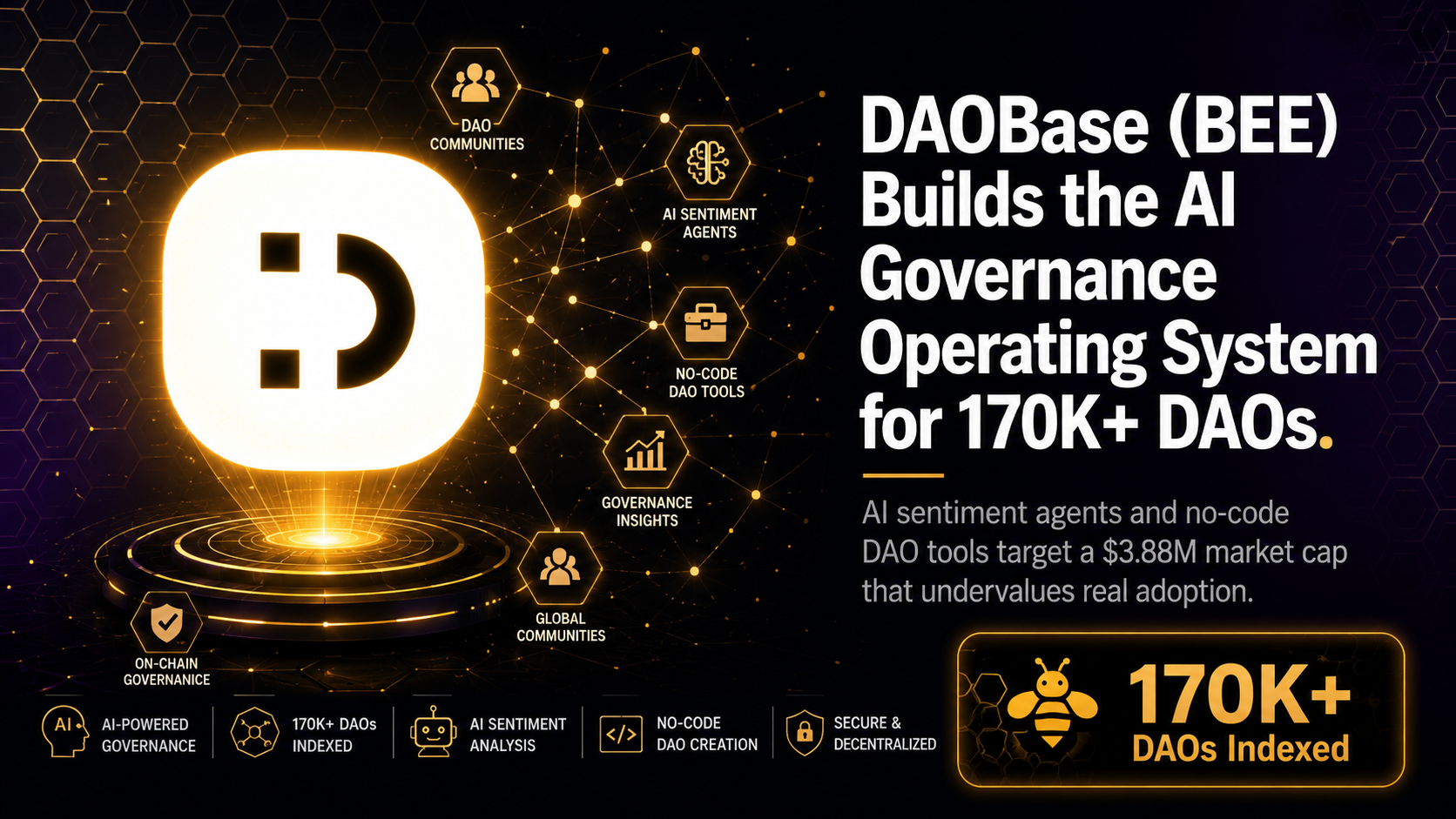
DAOBase has spent four years quietly building infrastructure that the rest of the crypto industry is only now beginning to demand urgently. As AI agents become a central topic across every corner of Web3 — from DeFi protocols to tokenized asset management — DAOBase’s positioning as an AI-native platform for creating, governing, and scaling decentralized autonomous organizations has moved from niche to timely.
BEE, the platform’s native token, is currently trading around $0.02 with a market cap of approximately $3.88 million — a modest valuation for a platform that aggregates data from over 170,000 DAOs and more than 6 million voters, trusted by 400-plus communities including MakerDAO and Sandbox DAO. That gap between operational scale and market cap is either a significant oversight by the market or a reflection of the challenges the platform faces in converting infrastructure reach into token demand.
What DAOBase Actually Does
Founded in 2021 as ThePASS before rebranding, DAOBase is best described as an AI-native DAO operating system — a platform that handles the full DAO lifecycle through no-code tools, modular infrastructure, and AI-powered automation. Token issuance, governance proposal management, treasury tracking, on-chain reputation systems, and analytics are all integrated into a single interface rather than requiring communities to stitch together multiple tools.
The AI governance agent layer is the platform’s most distinctive feature and its most relevant product in the current market environment. Rather than requiring DAO members to manually track proposals and voting histories across fragmented platforms, DAOBase’s AI agents can read community sentiment before a vote happens — analyzing on-chain activity, social signals, and historical governance patterns to surface insights that help communities make more informed decisions. The framing on DAOBase’s X account captures it directly: DAOs that don’t just listen, they understand.
AI-powered sentiment analysis for governance decisions represents a meaningful upgrade from the current state of DAO participation, where low voter turnout and whale dominance consistently undermine the decentralization these structures are supposed to provide. A platform that can surface genuine community sentiment before proposals reach formal voting stages could meaningfully improve governance quality across hundreds of communities simultaneously.
The $6M Raise and the Based APAC Expansion
DAOBase raised $6 million in 2024 from LD Capital and SevenX Ventures — two funds with track records in early-stage DeFi infrastructure. That raise funded the BEE token launch in June 2025 and the AI enhancement roadmap that has been building since.
The team is actively expanding its APAC presence, with Based APAC Show Episode 2 scheduled for July 31 — a community engagement initiative that signals the team is building regional developer and community relationships rather than relying purely on token market dynamics for growth. That kind of community infrastructure work rarely generates short-term price movement, but it consistently shows up in user growth and integration pipelines months later.
The H2 2026 Roadmap and What It Targets
DAOBase’s roadmap for the second half of 2026 focuses on three areas that directly expand the platform’s total addressable market. Enabling XDC-native project IDOs in Q3 2026 adds a fundraising dimension to what has primarily been a governance and analytics platform — creating a new revenue stream and bringing project founders into the ecosystem as customers rather than just observers. Multi-chain ecosystem support expansion in H2 adds blockchain integrations that broaden reach beyond current supported networks. And enhanced platform governance and security improvements address the trust foundation that any platform handling community treasuries must maintain.
RWA tokenization integration is also cited as a key trend shaping DAOBase’s path forward — DAOs increasingly manage real-world asset treasuries that require the same governance rigor as DeFi-native structures, and DAOBase’s analytics infrastructure is well-positioned to serve that emerging use case.
The BEE Token and the Conversion Problem
BEE’s market cap of roughly $3.88 million reflects a token that hasn’t yet demonstrated a clear mechanism for converting platform usage — which is real and measurable — into token demand. The platform charges for premium analytics and governance tools, but the fee-to-token-value pipeline isn’t transparently documented in a way that institutional allocators can model.
The AI governance agent narrative is the most compelling near-term catalyst for renewed market attention. Every DAO that struggles with low voter participation and whale-dominated governance is a potential DAOBase customer — and that addressable market is significantly larger than the current market cap suggests.

Aptos brings Encrypted Mempool to mainnet in move aimed at lowering MEV risk

RWA WEEK Singapore Announces New Wave of Institutional Speakers as October Event Draws Closer

Bittensor SN10 Work Tied to Pareto AI and Engy AI at Exploit Summit

BNB Chain Agent Studio v4 adds NodeOpsHQ for prompt-to-agent deployment

BNB Chain releases Agent Studio v4 with simplified AI agent deployment and stablecoin support

ChainUp Brings The Institutional Ark to TOKEN2049 Singapore, Focusing on Digital Asset Infrastructure and High-Value Deal Flow

Cardalonia Aiming To Become The Biggest Metaverse Project On Cardano

P2P2C BREAKTHROUGH CREATES A CONNECTION BETWEEN ETM TOKEN AND THE SUPER PROFITABLE MARKET

WOM Protocol partners with CoinPayments, the world’s largest cryptocurrency payments processor

ETHERSMART DEVELOPER’S VISION MADE FINTECH COMPANY BECOME DUBAI’S TOP DIGITAL BANK

Project Quantum – Decentralised AAA Gaming

WOM Protocol Recommended by Premier Crypto Analyst as only full featured project for August
-
 Crypto4 years ago
Cardalonia Aiming To Become The Biggest Metaverse Project On Cardano
-
 Press Release6 years ago
P2P2C BREAKTHROUGH CREATES A CONNECTION BETWEEN ETM TOKEN AND THE SUPER PROFITABLE MARKET
-
 Blockchain6 years ago
WOM Protocol partners with CoinPayments, the world’s largest cryptocurrency payments processor
-
 Press Release6 years ago
ETHERSMART DEVELOPER’S VISION MADE FINTECH COMPANY BECOME DUBAI’S TOP DIGITAL BANK
-
 Press Release5 years ago
Project Quantum – Decentralised AAA Gaming
-
 Blockchain6 years ago
WOM Protocol Recommended by Premier Crypto Analyst as only full featured project for August
-

 Press Release6 years ago
ETHERSMART DEVELOPER’S VISION MADE FINTECH COMPANY BECOME DUBAI’S TOP DIGITAL BANK
-
 Blockchain6 years ago
1.5 Times More Bitcoin is purchased by Grayscale Than Daily Mined Coins