
Press Release
Bictory Finance- Deploys its Holistic Financial Products on Concordium Network

What makes up Bitcory Finance Ecosystem?
Decentralized Exchange
The Bictory network introduces a decentralized exchange platform leveraging Proactive Market Maker systems to complete trades, swaps, and exchanges. Bictory’s DEX introduction provides a more affordable and faster trading and transaction completion mechanism. They leverage the technological framework of Concordium blockchain to offer transactions at very cheap charges. Its proactive market-making tool allows less slippage on trading; thus, making the DEX even more affordable. Bictory’s DEX will create bridges across other smart chains like Polkadot, Ethereum, and BSC to ensure utter chain interoperability. It will be simple for assets to cross chains into DEXes like Uniswap, Sushiswap, Pancakeswap, and Polkadex etc.The Decentralized Crowdfunding Platform
In addition, a crowdfunding platform would be built on the Concordium blockchain to provide all upcoming projects with opportunities to thrive. This crypto launchpad is one in a kind, introducing simplicity, reliability, and convenience. One unique thing about Bictory’s launchpad is its decentralized nature; it allows projects to set cross-chain swap-pools using a fixed buying price for tokens. In most launchpads, only a few people participate in IDOs. Although they set maximums per wallet, they don’t have a maximum number of wallets per individual. Therefore, very few investors, each with multiple wallets, participate in the IDO. However, Bictory finance implants some unique KYC protocols and Anti-bot policies to ensure that only one wallet per person can participate in IDO. This platform has a protocol-level identity layer system that interacts with all wallets participating in the launchpad for identity verification. All projects which launch via Bitcory’s launchpad will automatically be listed on their Decentralized and Centralized exchanges.Centralized Exchange
Bictory Finance has been building a centralized exchange for the Concordium Ecosystem. Just like its decentralized counterpart, it will provide effective trade transactions for mainly projects within the Concordium ecosystem and other networks. The centralized custodial exchange platform offers services like spot and margin trading options. Bictory centralized exchange is usable by both beginner and pro-level traders. For instance, it provides different trading modes for starters and experienced traders to select based on their level of experience. Moreover, this exchange platform provides a wide range of portfolio management tools to help traders manage their investments. Orders in Bictory exchange would be executed fast and near-instant, yet transaction fees will remain very low as compared to other exchanges. By setting custodial policies, Bictory guarantees users of trading and asset security. Security is a huge concern and this CEX according to the team has been built with robust security measures to ensure the safety of funds of users. Early investors would have the opportunity to test the platform when the Alpha version of the CEX is launched in about 3 weeks from now.Benefits of The Platform
Since the mainnet launch, Bictory network will thrive over its other CEX and DEX competitors. Among the benefits of using this new platform include;- Fast Transactions- Bictory platform will foster transactions at unmatched speed. Generally, the platform’s hub, Concordium blockchain, is highly scalable thus will process all its transactions at lightning speed.
- Scalability and Interoperability- Concordium leverages sharding intercommunication to ensure great interoperability with other chains. The CEX and DEX will be interoperable to provide even better services.
- Privacy and security- The concordium blockchain developers have always kept the users’ privacy and security at top priority.
- Protocol-level Identity Layer- Concordium has an identity system that will help in providing simpler and freer whitelisting and registration.
The BT Token
Bictory introduces the BT token to power its ecosystem. BT token is a Concordium blockchain-based asset, which will be issued very soon when Concordium launches the Mainnet. The presale and IEO of the BT token will leverage the Bitcory launchpad. BT tokens will be the fee payment mechanism in Bictory and its products. Moreover, trading BT tokens in the Bictory exchange will bring great discounts for the trader. Holders of the BT token will participate in the platform’s governance by voting for any necessary changes. Projects using the launchpad will pay all the listing fees in BT. There is an ongoing Private Sale and interested users can reach out through the financial team via business@bictory.ioFinal Word
The Bictory platform introduces a holistic product on the Concordium blockchain network. This hybrid exchange comprising a CEX and DEX will interact to maximize the users’ benefits especially with the launch of Moreover, the platform commits to ensuring the blockchain space benefits from new projects and solutions. As such, Bictory launches a decentralized launchpad platform which will, in the beginning, work on Concordium, but later on other blockchain networks. The combination of a DEX, CEX, and launchpad makes Bictory a platform to watch out for in the future. More information on Bictory’s advancements is available on their social media pages like Twitter.
Press Release
RWA WEEK Singapore Announces New Wave of Institutional Speakers as October Event Draws Closer

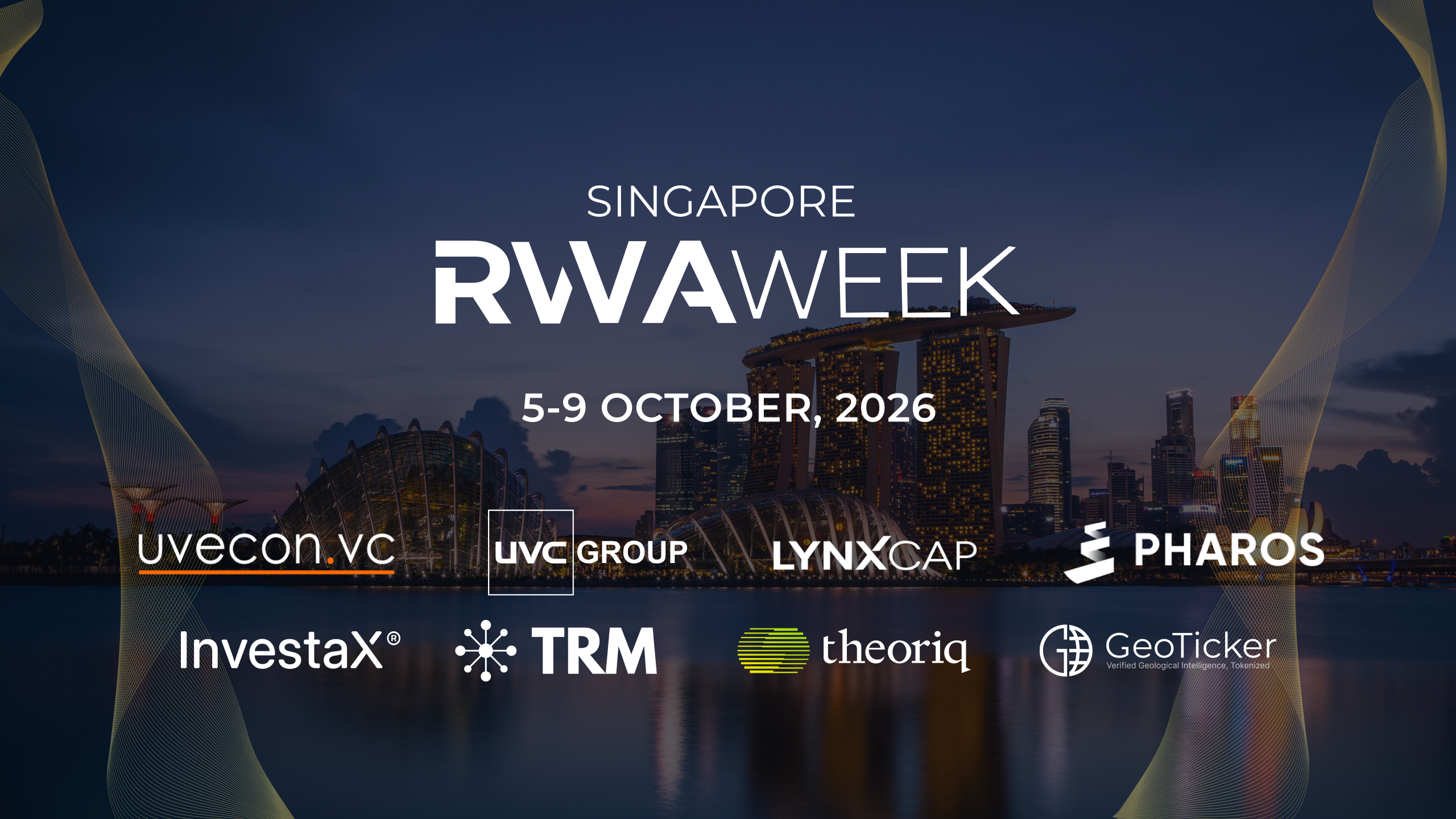
Singapore, October 6, 2026 — With less than a month to go until RWA WEEK Singapore, the organizers have announced a new wave of confirmed speakers and further details of the week-long program, which will bring together leading institutional investors, regulators, financial infrastructure providers, asset managers, family offices, blockchain founders, and Web3 companies in Singapore from October 5–9, 2026.
RWA WEEK Singapore is set to become one of the region’s key gatherings focused on the rapidly developing real-world asset tokenization economy, bringing together the traditional financial sector and the global digital asset industry at a time when institutional interest in tokenized assets continues to accelerate. The five-day program will feature a series of high-level events, curated investor meetings, private networking opportunities, and institutional discussions culminating in the flagship RWA Summit Singapore on October 9 at Marina One West Tower.
The RWA WEEK program will open on October 5 with THE DEALFLOW, a dedicated gathering for investors, asset managers, family offices, and capital allocators focused on curated networking, investment opportunities, and deal-making. The event is co-hosted by KundaBox. On October 6, TOKENISED VIP Singapore will bring together a highly curated group of institutional investors, RWA SUMMIT speakers, financial institutions, asset managers, family offices, founders, and senior digital asset executives for discussions around real-world tokenization use cases and institutional blockchain adoption. The week will culminate with RWA Summit Singapore on October 9, bringing together the wider RWA ecosystem for a full day of discussions, insights, networking, and business opportunities. The flagship summit is expected to attract more than 1,500 attendees, over 70 speakers, and upwards of 200 investors shaping the future of asset tokenization.
The organizers have also announced a new group of confirmed speakers who will join the previously revealed lineup. The latest additions include Adriel Wong, Head of Private Sector – APAC at TRM Labs; Yalini Isweran, Executive Director, Innovation Strategy at DTCC Digital Assets; Huong T Tran, Founder & Managing Partner at 6igma Ventures; and Melody He, Co-Founder & Partner at Spartan Group; Charles d’Haussy, CEO at dYdX Foundation; Pei Chen, CEO of Theoriq; Peter Kadish, Managing Director at LynxCap Investments.
The new speakers bring together expertise spanning financial regulation, institutional policy, financial market infrastructure, blockchain intelligence, investment, venture capital, decentralized infrastructure, and digital asset adoption. Their participation further strengthens the institutional focus of the Singapore edition as the RWA sector moves from early experimentation toward practical implementation across global financial markets.
They join an already strong lineup of confirmed speakers, including Yat Siu, Executive Chairman of Animoca Brands; Viv Diwakar, Head of Foundation at Canton; Edwin Mata, Co-Founder & CEO at Brickken; Julian Kwan, Co-Founder & CRO at IXS;
The growing speaker lineup reflects the broader evolution of the RWA market, where conversations are increasingly moving beyond the concept of tokenization itself toward the infrastructure, regulation, compliance, liquidity, custody, investment structures, and institutional frameworks required for tokenized assets to scale. The presence of senior representatives from organizations such as the Monetary Authority of Singapore, DTCC Digital Assets, and TRM Labs highlights the growing intersection between traditional financial infrastructure and the digital asset ecosystem.
RWA WEEK has also continued to expand its network of strategic partners supporting the Singapore edition. LYNXCAP Investments, dYdX, InvestaX, GeoTicker, Pharos and Theoriq are among the strategic partners of RWA WEEK Singapore, while TRM Labs joins the program specifically as Co-Host of TOKENISED VIP Singapore. The event is produced by UVECON.VC, a company of UVC GROUP.
RWA WEEK has established a growing international presence across major financial and digital asset hubs including Hong Kong, Dubai, Abu Dhabi, Seoul, and Singapore. Previous editions of RWA Summit have attracted hundreds of participants and leading voices from finance, digital assets, investment, and regulation. The Hong Kong edition welcomed more than 750 attendees and over 50 speakers, while the Dubai edition brought together representatives from leading Web3 companies, investment funds, exchanges, and regulatory organizations.
Singapore represents a particularly important destination for the next edition of RWA WEEK given the city’s position as a global financial center and its role in the development of digital asset regulation, financial innovation, and institutional blockchain infrastructure. As banks, asset managers, investment firms, and technology companies increasingly explore tokenized funds, securities, private credit, real estate, and other real-world assets, Singapore is emerging as one of the key markets where traditional finance and blockchain-based infrastructure are converging.
“We are witnessing the RWA market transition from experimentation to real institutional integration,” said Ivan V. Ivanov, Co-Founder of UVECON.VC, UVC GROUP and RWA WEEK. “RWA WEEK is designed to bring together the different sides of this market — institutional capital, financial infrastructure, regulators, technology providers, and Web3 innovators — and create an environment where meaningful partnerships, capital allocation, and real-world tokenization use cases can emerge. The strength of the Singapore lineup demonstrates how quickly this sector is developing.”
With only weeks remaining before RWA WEEK Singapore, preparations for the event are now entering their final stage. Interest from institutional participants, investors, founders, and industry professionals continues to build as the October program approaches, with attendees encouraged to secure their access ahead of the event.
RWA WEEK Singapore will take place October 5–9, 2026, with RWA Summit Singapore taking place on October 9 at Marina One West Tower.
More information:
Press Release
ChainUp Brings The Institutional Ark to TOKEN2049 Singapore, Focusing on Digital Asset Infrastructure and High-Value Deal Flow
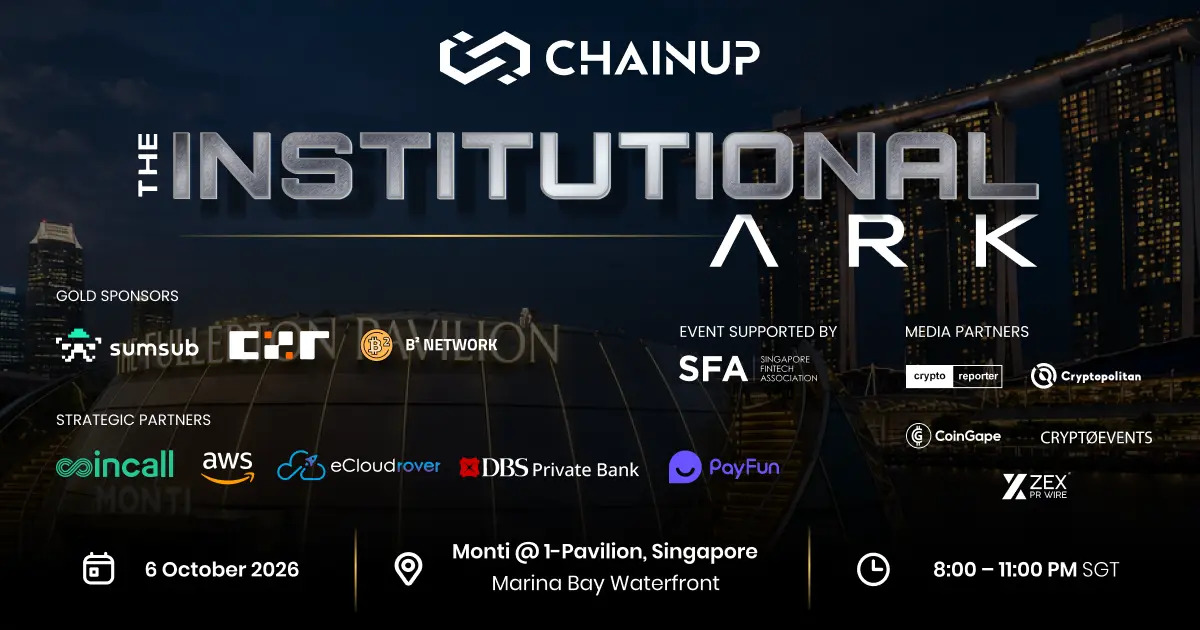
Singapore, Sep 17, 2026 — ChainUp announces the return of its flagship pre-TOKEN2049 event, focusing on institutional infrastructure, enterprise scale, and direct dealmaking.
- ChainUp‘s exclusive pre-TOKEN2049 event, The Institutional Ark, returns on October 6, 2026, at Monti at 1-Pavilion for C-suite leaders, capital allocators, and fintech builders.
- Backed by award-winning event execution recognized at the Marketing Events Awards, the evening provides a closed-door, high-signal setting away from conference hall noise.
- Designed for direct commercial outcomes, the gathering connects institutional peers over drinks, canapés, and panoramic Marina Bay views.
As institutional crypto shifts from hype to execution, ChainUp’s exclusive pre-TOKEN2049 gathering, The Institutional Ark, returns on October 6, 2026, at Monti at 1-Pavilion.
Bypassing public panels for a closed-door, high-signal setting, this invite-only evening brings together a handpicked room of senior executives, capital allocators, and infrastructure builders for real deal flow, drinks, canapés, and panoramic Marina Bay views
Addressing the Digital Asset Infrastructure Gap
Amid surging demand for compliant, scalable digital asset architecture, ChainUp highlights its core enterprise blockchain solutions:
- Scalable Trading Infrastructure: High-performance matching engines and unified liquidity management for high-throughput institutional trading.
- Institutional Custody: Advanced Multi-Party Computation (MPC) and Hardware Security Module (HSM) frameworks to secure large-scale asset management.
- Automated Compliance Suites: Real-time KYC and AML transaction monitoring built for tightening global crypto regulations.
- Real-World Asset Tokenization Architecture: Secure enterprise platforms facilitating the full lifecycle of real-world asset tokenization.
The Institutional Ark (Pre-TOKEN2049 Executive Networking Party)
- Date/Time: October 6, 2026 | 8:00 PM – 11:00 PM SGT
- Venue: Monti at 1-Pavilion, Marina Bay Waterfront, Singapore
- Registration Link: https://luma.com/xn1chytf
Strategic Partnership Opportunities
Limited partnership slots are open for brands looking to connect with global infrastructure buyers and capital allocators. To request the partnership deck or press credentials, contact marketing@chainup.com.
About ChainUp
Founded in 2019 and headquartered in Singapore, ChainUp is the industry’s sole comprehensive provider of compliant digital asset SaaS infrastructure. Serving 700+ enterprise clients globally, ChainUp provides SOC 2-certified turnkey and white-label software for crypto exchanges, stablecoin payment systems, tokenization exchanges, prediction markets, and institutional MPC custody. Learn more at www.chainup.com.
For media queries, please contact:
Yeo Xue Zhen
Senior Marketing Manager, ChainUp
xuezhen@chainup.com
+65 9325 6483
Blockchain
Orochi Network (ON) Builds the Verifiable Data Layer for Web3 as zkPass Partnership and 49-Chain Expansion Signal Growing Infrastructure Reach


Orochi Network has been doing one of the harder things in crypto: building serious cryptographic infrastructure and waiting for the market to care. The wait is beginning to pay off. ON is currently trading around $0.119, up 96.24% from its all-time low of $0.06074 reached on February 10, 2026, with a market cap of approximately $17.2 million and a 24-hour trading volume of $6.7 million. The token sits 72.6% below its all-time high of $0.416 from October 2025 — but the direction of travel over the past five months has been consistently upward from the February floor.
Orochi Network operates as a blockchain-agnostic and proof-system-agnostic Verifiable Data Infrastructure, using three core cryptographic primitives — Zero-Knowledge Proofs, Fully Homomorphic Encryption, and Trusted Execution Environments — to make data operations trustless, provable, and private. That three-layer cryptographic stack is what separates Orochi from single-mechanism privacy protocols — it doesn’t bet on one cryptographic approach, it deploys all three depending on what each specific use case requires.
The Product Suite That’s Already Running
Orochi’s flagship product, zkDatabase, is the world’s first provable NoSQL database. Every data query generates a Zero-Knowledge Proof automatically, enabling auditors, regulators, and smart contracts to verify data correctness without ever accessing sensitive content. For enterprise and institutional use cases — financial compliance, healthcare data, government records — the ability to prove data integrity without revealing the underlying data is the precise capability that has prevented blockchain adoption in regulated industries. zkDatabase solves that at the infrastructure level.
Orand provides a Verifiable Random Function for trustless randomness, while Orocle delivers verifiable oracle feeds without relying on trusted nodes. The oracle market is dominated by Chainlink, but Orochi’s verifiable oracle approach — where every feed is accompanied by a cryptographic proof of origin rather than relying on a reputation-based trusted node network — offers a technically differentiated alternative that’s gaining traction in ZK-native ecosystems where proof composability matters.
Orand and Orocle services are integrated across 49-plus blockchains, while zkDatabase has been adopted by 20-plus blockchains. Cross-chain infrastructure that runs on 49 networks without being tied to any single chain’s success or failure is a meaningful structural advantage — especially as the multi-chain landscape continues to fragment.
The zkPass Partnership and Verifiable Identity
The collaboration with zkPass — building a new foundation for verifiable, privacy-protected data in Web3 — is among the more strategically aligned partnerships in Orochi’s ecosystem. zkPass handles identity verification through zero-knowledge proofs, allowing users to prove attributes about themselves without revealing underlying credentials. Orochi’s verifiable data infrastructure is the natural complement — once identity is verified, every subsequent data interaction that user has on-chain can be provably correct through Orochi’s zkDatabase layer.
That combination of verifiable identity and verifiable data integrity represents the foundational stack that regulated Web3 applications — particularly in RWA tokenization, DeFi compliance, and institutional finance — have been waiting for.
Backed by over $20 million in funding from the Ethereum Foundation, Mina Protocol, Web3 Foundation, and BNB Chain alongside leading venture capital firms, Orochi has grown to support 145-plus partners with more than 160 million transactions processed to date. Grants from protocol foundations rather than purely venture capital is a meaningful signal — it indicates that other blockchain ecosystems view Orochi’s infrastructure as genuinely valuable to their own development rather than simply making a financial bet.
The Supply Structure Worth Understanding
Only 14.4% of the 1 billion maximum ON supply is currently circulating — 144.28 million tokens — with a fully diluted valuation of approximately $81.3 million against the current $17.2 million market cap. With 85.6% of total supply still locked, ON is operating in a very early distribution phase. The gap between FDV and market cap implies either that the market believes the supply will create significant dilution pressure as it unlocks, or that adoption hasn’t yet reached the scale needed to justify the full supply value.
The Binance Alpha and Binance Alpha Airdrops tags on CoinMarketCap reflect a listing pathway that has brought broader retail attention to ON beyond its core technical audience. A trading call citing 25x leverage entry zones on KCEX reflects the speculative layer that sits above the infrastructure fundamentals — ON attracts both audiences simultaneously, which amplifies volatility in both directions.
Orochi’s 2026 goal is to solidify its position as the foundational verifiable data layer for Web3 and institutional finance, scaling zkDatabase, zkDA Layer, Orocle, and Orand modules across global markets to enable secure, auditable data infrastructure for RWA, stablecoins, AI, DeFi, and more. That ambition is coherent and directionally aligned with where institutional Web3 capital is flowing. A $17 million market cap for infrastructure already running on 49 chains with Ethereum Foundation backing is either a significant market oversight or a fair reflection of how early the verifiable data layer category still is.

RWA WEEK Singapore Announces New Wave of Institutional Speakers as October Event Draws Closer

Bittensor SN10 Work Tied to Pareto AI and Engy AI at Exploit Summit

BNB Chain Agent Studio v4 adds NodeOpsHQ for prompt-to-agent deployment

BNB Chain releases Agent Studio v4 with simplified AI agent deployment and stablecoin support

ChainUp Brings The Institutional Ark to TOKEN2049 Singapore, Focusing on Digital Asset Infrastructure and High-Value Deal Flow

NEAR AI Cloud API Adds OpenAI Compatibility and Tiered Privacy

Cardalonia Aiming To Become The Biggest Metaverse Project On Cardano

P2P2C BREAKTHROUGH CREATES A CONNECTION BETWEEN ETM TOKEN AND THE SUPER PROFITABLE MARKET

WOM Protocol partners with CoinPayments, the world’s largest cryptocurrency payments processor

ETHERSMART DEVELOPER’S VISION MADE FINTECH COMPANY BECOME DUBAI’S TOP DIGITAL BANK

Project Quantum – Decentralised AAA Gaming

WOM Protocol Recommended by Premier Crypto Analyst as only full featured project for August
-
 Crypto4 years ago
Cardalonia Aiming To Become The Biggest Metaverse Project On Cardano
-
 Press Release6 years ago
P2P2C BREAKTHROUGH CREATES A CONNECTION BETWEEN ETM TOKEN AND THE SUPER PROFITABLE MARKET
-
 Blockchain6 years ago
WOM Protocol partners with CoinPayments, the world’s largest cryptocurrency payments processor
-
 Press Release6 years ago
ETHERSMART DEVELOPER’S VISION MADE FINTECH COMPANY BECOME DUBAI’S TOP DIGITAL BANK
-
 Press Release5 years ago
Project Quantum – Decentralised AAA Gaming
-
 Blockchain6 years ago
WOM Protocol Recommended by Premier Crypto Analyst as only full featured project for August
-
 Press Release6 years ago
ETHERSMART DEVELOPER’S VISION MADE FINTECH COMPANY BECOME DUBAI’S TOP DIGITAL BANK
-
 Blockchain6 years ago
1.5 Times More Bitcoin is purchased by Grayscale Than Daily Mined Coins