
Recent Updates
Finland Bitcoin Mining, Boosts District Heating


Finland Bitcoin Mining, boosts district heating integration, proves to be an innovative synergy between bitcoin mining operations and district heating systems, and can serve as a precedent for sustainable energy solutions.
This method maximizes energy use and represents an important step toward environmentally friendly technology applications in the crypto-mining sector.
The integration harnesses excess heat from Bitcoin mining to boost the efficiency of district heating networks, offering a model that could inspire similar initiatives globally.
Exploring Finland’s Bitcoin Mining and Heating Integration
The Bitcoin mining integration with district heating in Finland represents a ground-breaking approach to sustainable energy use, fostering synergy that could set a precedent for future projects worldwide.
Understanding District Heating and Bitcoin Mining
District heating, a prevalent method in Finland’s urban infrastructure, involves centrally producing and distributing heat via a network of pipes to multiple buildings.
District Heating Overview
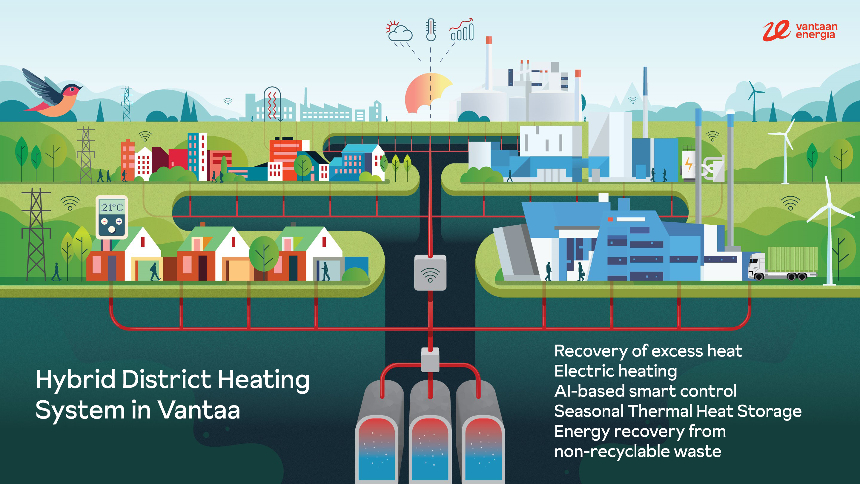
The system and the idea of district heating can be highly efficient in densely populated areas, which is part of Finland’s commitment to sustainable energy practices.
Over 90% of residents in larger Finnish cities benefit from this system, which is now evolving to incorporate more renewable energy sources and innovative technologies like heat recovery from various processes.
Bitcoin Mining Basics
Bitcoin mining involves the validation of transactions and the creation of new coins through complex computational processes. This operation is energy-intensive, owing primarily to the computational power required.
District heating systems in Finland can become more efficient by utilizing surplus heat from mining operations in combination with district heating.
Integration Mechanics
The synergy between Bitcoin mining and district heating in Finland exemplifies a pioneering approach to sustainable energy use.
Miners benefit from an additional revenue stream by selling excess heat to district heating providers, which contributes to a reduction in their operational and environmental costs.
This model provides economic benefits and positions Finland as a leader in using blockchain technology for sustainable practices.
Benefits of Merging Bitcoin Mining with Heating Homes
According to Statistics Finland, as of 2021, nonrenewable energy sources account for 69% of total consumption.
These sources included wood (30%), oil (19%), coal (6%), natural gas (5%), and peat (3%).
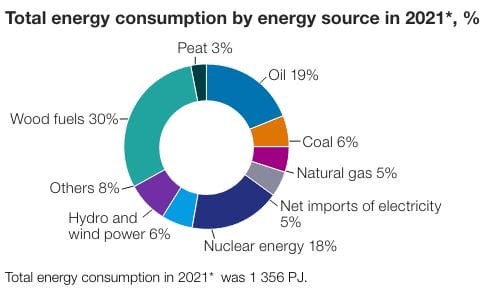
The integration of Bitcoin mining with district heating significantly reduces environmental impact.
Some of the benefits are:
Environmental Impact Reduction
This model reduces reliance on fossil fuels while also helping to reduce greenhouse gas emissions by utilizing excess heat generated by mining operations for heating.
The advanced heat recovery systems ensure that the heat produced during mining does not go to waste but instead supports the heating needs of local communities.
Economic Advantages for Local Communities in Finland
Economically, this integration offers substantial benefits.
District heating systems can be more cost-effective by using waste heat from Bitcoin mining, resulting in lower heating bills for customers.
Additionally, Bitcoin miners gain a stable income from selling the excess heat, enhancing the financial viability of mining operations in regions with high energy costs.
Cases of Success in using Cryptocurrency Mining as a renewable energy technology in Finland
Finland’s advancement in renewable energy technologies, including significant increases in nuclear and wind power capacities, supports the viability of such integrations.
These developments ensure a stable and abundant energy supply, making the region particularly attractive for energy-intensive operations like Bitcoin mining.
This synergy between renewable energy advancements and Bitcoin mining is helping to establish a precedent for other regions to follow, potentially transforming energy use in industries worldwide.
These examples provide a blueprint for replication in other regions, showcasing the potential for scalable and sustainable energy solutions worldwide.
Challenges and Solutions for Finland Bitcoin Mining and District Heating Integration
Integrating Bitcoin mining with district heating systems poses several technical challenges, primarily related to the efficient transfer and utilization of heat.
Advanced engineering solutions are required to capture and transport the heat produced during cryptocurrency mining.
Robust system controls and monitoring are also necessary to ensure constant operational standards to manage the varied heat output from mining activities.
Innovative Solutions Implemented
Finland has implemented innovative solutions that enhance energy efficiency and system reliability.
These include advanced thermal storage technologies, which allow heat to be stored and used during peak demand, and smart grid technologies, for more flexible and efficient energy distribution.
The integration of renewable energy sources like wind and solar has been optimized to complement the heat generated from mining, stabilize the energy supply, and reduce carbon emissions.
These solutions can help mitigate the technical hurdles but also, pave the way for expanding this model to other regions, potentially transforming how cities worldwide approach energy production and consumption in a blockchain-enabled world.
Future Outlook and Potential Replications
Finland’s model of integrating Bitcoin mining with district heating holds significant potential for scalability.
Scalability of the Model
Thanks to the country’s advancements in renewable energy and district heating technologies, this model can be replicated in colder regions with substantial heating demands.
The success of these initiatives in Finland serves as a promising blueprint for other nations looking to enhance their energy efficiency and sustainability.
Potential Global Impact and Adoption
The global impact of such integrations could be profound, reducing carbon footprints and operational costs across multiple sectors.
As more countries adopt this innovative approach, it could lead to widespread changes in how energy-intensive industries, like cryptocurrency mining, are perceived and utilized in the context of national energy strategies.
This forward-thinking approach promises not only environmental and economic benefits but also positions Finland as a leader in the innovative use of technology for sustainable development.
FAQs
1. How does the integration of Bitcoin mining with district heating work? The process involves capturing the excess heat generated from Bitcoin mining operations and redirecting it into the district heating system. This heat, otherwise wasted, is used to warm residential and commercial buildings, enhancing energy efficiency and sustainability.
2. What are the environmental benefits of integrating Bitcoin mining with district heating?
This integration significantly reduces the environmental impact by lowering the reliance on fossil fuels for heating, thus decreasing greenhouse gas emissions. It leverages renewable energy sources and heat recovery systems to provide a more sustainable heating solution.
3. Can this integrated model be applied in other countries?
Yes, the model has potential for global replication, particularly in colder regions where district heating is essential. Its scalability depends on local energy infrastructure and the availability of renewable energy sources.
4. What economic impacts does this integration have on local communities?
Local communities benefit economically from reduced heating costs and additional revenue streams for Bitcoin miners through the sale of excess heat. This model also promotes local technological and energy sector growth.
5. What are the main challenges in implementing this integrated system, and how are they addressed?
Key challenges include managing the variable heat output from mining operations and integrating it effectively into the heating system. Solutions involve advanced engineering, thermal storage technologies, and smart grid systems to enhance energy distribution and system efficiency.


Zama has spent years solving the technical side of financial privacy. On July 21, 2026, it addressed the institutional side — announcing a partnership with Elliptic, the global leader in blockchain intelligence, to integrate compliance screening directly into its confidential financial applications.
The announcement landed two days before ZAMA hit its all-time high, and the timing isn’t coincidental. The collaboration integrates Elliptic’s blockchain intelligence capabilities into Zama’s confidential financial applications, supporting compliance screening processes while maintaining the confidentiality protections of Zama’s FHE technology for applications built on public blockchains.
For a protocol whose primary value proposition is financial privacy, building compliance directly into the architecture rather than treating it as an afterthought is the most important signal the team could send to institutional capital.
The Problem the Partnership Solves
The fundamental tension in confidential finance has always been the same: regulators and financial institutions require the ability to identify illicit activity, while users require privacy. Most privacy protocols have chosen one side of that equation or the other. Zama is attempting to hold both simultaneously.
As the first step in the collaboration, Elliptic will support wallet risk screening for the confidential vaults powered by Zama — identifying high-risk wallets before a transaction proceeds while keeping balances and transfer amounts confidential. That sequencing matters. The screening happens at the entry point, before a transaction is executed, rather than requiring post-hoc surveillance of encrypted activity. Risk is assessed without exposing what’s inside.
Elliptic supports more than 700 institutions globally and analyzes more than $90 million in digital asset activity every day. That operational scale means Zama’s confidential vaults inherit compliance infrastructure that’s already trusted by the institutions Zama is trying to attract — rather than asking those institutions to evaluate an unproven compliance layer alongside an already unfamiliar cryptographic technology.
Zama CEO Rand Hindi framed the partnership’s philosophy directly: “Financial institutions shouldn’t have to choose between protecting sensitive financial information and meeting compliance obligations. Confidential finance must deliver both.”
Why This Matters More Than a Typical Partnership Announcement
The Elliptic integration directly addresses the regulatory risk that CoinMarketCap’s analysis flagged as Zama’s primary institutional adoption headwind — court-ordered stablecoin freezes on Zama highlighting a compliance gap. By embedding Elliptic’s wallet risk screening into the vault architecture, Zama is responding to that specific concern with infrastructure rather than statements.
As financial institutions move beyond experimentation toward real-world blockchain adoption, they require infrastructure that combines financial confidentiality with the compliance controls expected in regulated markets. The confidential USDC vault launched with Morpho and Steakhouse Financial in June was the first live product. The Elliptic integration is the compliance layer that makes that product deployable by regulated institutions without requiring a compliance exception or regulatory carve-out.
Combined with the Dfns custody integration in April 2026 — enabling encrypted transactions for over 400 enterprise banking clients — Zama is methodically building a compliance infrastructure stack that makes confidential finance accessible to the institutional market that previously had no pathway into it.
ZAMA hit its all-time high of approximately $0.05 on July 23 with a 30% weekly gain and an RSI of 83.38 — reflecting a market that is beginning to price in the institutional thesis rather than just the technical one. The Elliptic partnership is the clearest signal yet that the thesis has a structural foundation behind it.
Crypto
Hemi (HEMI) Trades Near All-Time Lows as BTCS Liquidity Partnership and Protocol V2 Target a Bitcoin DeFi Turnaround


Hemi Network has one of the more technically ambitious architectures in the Bitcoin Layer 2 space — a modular supernetwork that embeds a full Bitcoin node inside an Ethereum Virtual Machine, enabling developers to build applications that natively leverage both blockchain ecosystems simultaneously. The token tells a different story. HEMI is trading around $0.0047, down more than 90% from its all-time high of roughly $0.073, with a market cap of approximately $4.6 million against a total supply of 10 billion tokens — only about 5.4% of which is currently circulating.
That supply structure is the most important number in HEMI’s entire story right now. With 90% of total supply still locked, the token’s price is operating in a thin, early market that amplifies both upside and downside moves while obscuring what genuine demand actually looks like.
The Architecture That Sets Hemi Apart
Hemi’s core innovation is the Hemi Virtual Machine — an EVM environment with a full Bitcoin node running inside it. The result is an execution layer where developers can write smart contracts that directly read Bitcoin state, verify Bitcoin transactions, and interact with Bitcoin assets without bridges or external oracles. Applications built on Hemi — called hApps — can leverage Bitcoin’s security and liquidity alongside Ethereum’s programmability in a single unified environment.
The Proof of Proof consensus mechanism adds another layer of security differentiation. Rather than relying solely on its own validator set, Hemi periodically publishes its state to both Bitcoin and Ethereum, inheriting security from both networks simultaneously. That dual-anchoring approach is designed to make Hemi more resistant to attacks than a standard L2 that anchors to only one chain.
Cross-chain asset movement runs through Tunnels — Hemi’s native bridge infrastructure — while the Hemi Bitcoin Kit provides developer-friendly tooling for integrating Bitcoin functionality into hApps without requiring deep Bitcoin protocol knowledge.
The BTCS Partnership and Institutional Interest
The most significant recent fundamental development was a liquidity partnership with BTCS S.A. — a publicly traded company — which committed 50 to 100 BTC to Hemi’s liquidity program in exchange for a guaranteed yield. The partnership followed a 2025 collaboration with Dominari Securities to develop regulated treasury and ETF platforms on Hemi’s infrastructure.
Both partnerships reflect a consistent theme in Hemi’s go-to-market approach: targeting regulated, publicly accountable institutions rather than purely crypto-native capital. For a network trying to bridge Bitcoin’s institutional credibility with Ethereum’s programmability, that institutional focus makes strategic sense — but it also means adoption cycles are longer and less reflexive than pure retail-driven narratives.
TVL reached over $1.2 billion in 2025 according to Hemi’s own figures — a number that, if accurate, represents meaningful protocol usage relative to the current $4.6 million market cap.
Protocol V2 and the Economic Model Roadmap
Hemi’s Protocol V2 was in final testnet stages with mainnet deployment targeted for Q2 2026 — a stable upgraded network foundation critical for supporting more complex DeFi applications and institutional activity. The upgrade reduces technical risk for builders and creates the infrastructure base that the subsequent stages of the Hemi Economic Model depend on.
The Economic Model, launched in October 2025, is a multi-stage plan designed to create a sustainable flywheel. Future stages will introduce a Protocol-Owned Liquidity treasury, a decentralized vote market, and dual staking combining HEMI and hemiBTC — Hemi’s Bitcoin liquid staking derivative. The POL treasury is designed to generate sustainable yield from protocol fees and reduce reliance on inflationary emissions — a meaningful structural improvement for long-term token holders who want fee-driven yield rather than inflationary staking rewards.
The July 29 unlock of 154.6 million tokens combined — 103 million community and 51.6 million foundation — arrives at a moment when daily trading volume is just $3.51 million. That’s a supply event worth roughly $730,000 at current prices landing into a thin order book. Recurring monthly unlocks of this scale will be the primary near-term headwind until Protocol V2 and POL attract enough new TVL to generate offsetting demand.
Backed by YZi Labs — formerly Binance Labs — and launched via Binance Wallet IDO, Hemi has the institutional credentials to attract serious attention when market conditions improve. The Bitcoin DeFi narrative is gaining momentum as institutional capital looks for ways to put BTC to work on-chain without custodial risk. Hemi’s architecture is designed precisely for that use case. The question is whether the token can survive its own supply schedule long enough for that adoption cycle to arrive.
Blockchain
BUILDon (B) Pulls Back 34% in a Week as WLFI-Backed Launchpad Vision Faces a Liquidity Reality Check

BUILDon has had one of the more turbulent weeks in its short trading history. The token is currently trading at $0.1129, down 33.6% over the past seven days and sitting roughly 85% below its all-time high of $0.73 reached in August 2025. With a circulating supply of 1 billion B tokens and a market cap of approximately $113 million, BUILDon occupies an unusual position in crypto — part memecoin, part politically adjacent DeFi infrastructure play, and entirely dependent on the continued momentum of the World Liberty Financial ecosystem it’s attached itself to.
The week’s decline arrived just days after a sharp 52.18% surge in a single four-hour candle on July 8, driven by $114,840 in short liquidations as forced covering propelled price back toward the $0.172 former support zone. That kind of liquidity-driven move is a double-edged signal — it produces explosive momentum in the short term but offers little information about whether genuine demand has returned.
The WLFI Connection That Defines the Token
BUILDon’s entire narrative is anchored to a single, extraordinary credential: it is the first memecoin to receive investment from World Liberty Financial — the crypto project backed by the family of US President Donald Trump. On May 22, 2025, WLFI announced it had purchased B tokens, with on-chain data from Arkham confirming 636,000 B tokens in WLFI’s wallet valued at approximately $172,000 at the time of purchase.
WLFI’s own statement captured what BUILDon is positioning itself as within the ecosystem: “Love seeing projects choose USD1 as their base pair — faster settlement, deeper liquidity, and growing every day. We hope to see more tokens make the switch.” BUILDon uses USD1, WLFI’s stablecoin, as its primary trading pair — a design choice that creates direct structural linkage between B token liquidity and USD1 adoption. As USD1 grows, BUILDon’s liquidity infrastructure benefits proportionally.
From Memecoin to Launchpad — The Infrastructure Pivot
The most significant strategic development is BUILDon’s pivot from pure memecoin to genuine DeFi infrastructure. The project is developing a dedicated launchpad designed to incubate early-stage projects within the USD1 and WLFI ecosystems, offering vetting services and multi-chain fundraising options. If executed, that positions BUILDon not just as a token that benefits from WLFI’s growth but as the primary onboarding infrastructure for new projects entering the ecosystem.
The B Purchases cross-chain tool adds another layer of genuine utility. The tool allows users to pay with a stablecoin on one blockchain and instantly receive B or other tokens on another chain within a single transaction — eliminating manual bridging. The tool is currently in beta, with ongoing refinement, but represents a real backend infrastructure upgrade rather than a marketing feature.
BUILDon’s intelligent investment platform, built on an Agent-to-Agent architecture, is designed to automate research and investment activities by processing on-chain data and performing asset analysis — an AI-native layer that aligns the project with the autonomous agent narrative that has been generating significant market attention throughout 2026.
WEEX Futures Doubles Leverage to 100x
On July 8, WEEX Futures increased maximum leverage for B from 50x to 100x — a move that amplifies both potential gains and risks for derivatives traders. Higher leverage availability tends to increase open interest and price volatility in both directions, and the timing coincided with the short squeeze that produced the 52% intraday spike. With 100x leverage now available, even modest price moves translate into dramatic position changes — a dynamic that benefits active traders but increases the systemic risk of cascading liquidations during adverse moves.
The CertiK security score of 4.0 and publicly verified smart contract provide baseline technical credibility, though the anonymous team structure remains a meaningful risk factor for institutional participants evaluating the project.
For a token that started at $0.001494 in April 2025 and now trades near $0.11 — an 11,452% appreciation from its all-time low — BUILDon has already delivered extraordinary returns for early holders. Whether the launchpad vision and USD1 integration can justify the current $113 million market cap through actual platform revenue rather than political adjacency is the question the next few months will answer.

RWA WEEK Singapore Announces New Wave of Institutional Speakers as October Event Draws Closer

Bittensor SN10 Work Tied to Pareto AI and Engy AI at Exploit Summit

BNB Chain Agent Studio v4 adds NodeOpsHQ for prompt-to-agent deployment

BNB Chain releases Agent Studio v4 with simplified AI agent deployment and stablecoin support

ChainUp Brings The Institutional Ark to TOKEN2049 Singapore, Focusing on Digital Asset Infrastructure and High-Value Deal Flow

NEAR AI Cloud API Adds OpenAI Compatibility and Tiered Privacy

Cardalonia Aiming To Become The Biggest Metaverse Project On Cardano

P2P2C BREAKTHROUGH CREATES A CONNECTION BETWEEN ETM TOKEN AND THE SUPER PROFITABLE MARKET

WOM Protocol partners with CoinPayments, the world’s largest cryptocurrency payments processor

ETHERSMART DEVELOPER’S VISION MADE FINTECH COMPANY BECOME DUBAI’S TOP DIGITAL BANK

Project Quantum – Decentralised AAA Gaming

WOM Protocol Recommended by Premier Crypto Analyst as only full featured project for August
-
 Crypto4 years ago
Cardalonia Aiming To Become The Biggest Metaverse Project On Cardano
-
 Press Release6 years ago
P2P2C BREAKTHROUGH CREATES A CONNECTION BETWEEN ETM TOKEN AND THE SUPER PROFITABLE MARKET
-
 Blockchain6 years ago
WOM Protocol partners with CoinPayments, the world’s largest cryptocurrency payments processor
-
 Press Release6 years ago
ETHERSMART DEVELOPER’S VISION MADE FINTECH COMPANY BECOME DUBAI’S TOP DIGITAL BANK
-
 Press Release5 years ago
Project Quantum – Decentralised AAA Gaming
-
 Blockchain6 years ago
WOM Protocol Recommended by Premier Crypto Analyst as only full featured project for August
-
 Press Release6 years ago
ETHERSMART DEVELOPER’S VISION MADE FINTECH COMPANY BECOME DUBAI’S TOP DIGITAL BANK
-
 Blockchain6 years ago
1.5 Times More Bitcoin is purchased by Grayscale Than Daily Mined Coins