
Recent Updates
Bitcoin Surpasses $1 Trillion Market Cap


Bitcoin has reached a significant milestone, surpassing a $1 trillion Market Cap and attaining a two-year high price.
This surge reflects a growing FOMO among investors, along with optimistic predictions spurred by upcoming influential events.
The Rise to a $1 Trillion Market Cap
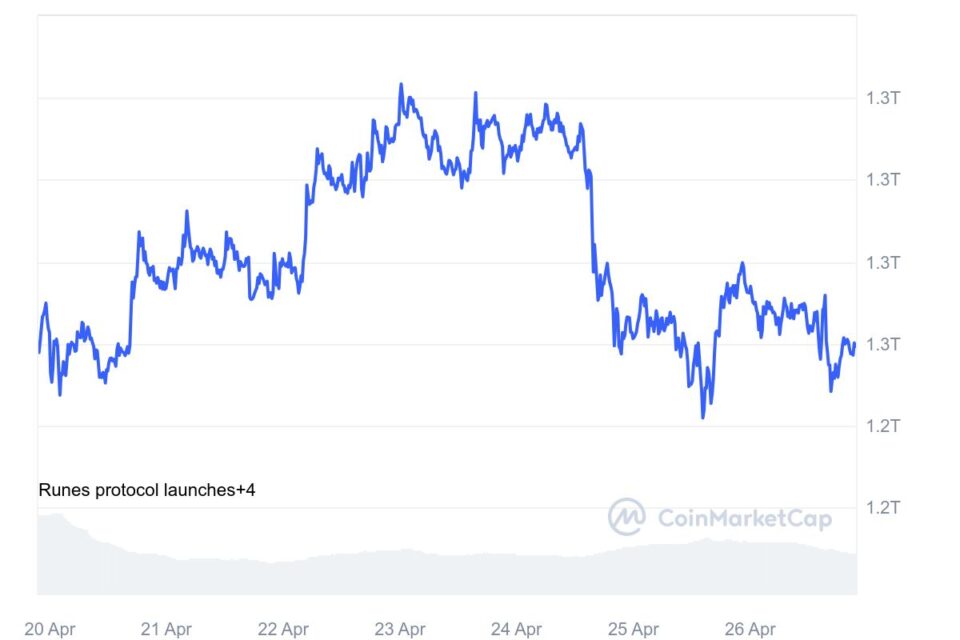
Bitcoin’s recent price surge has catapulted its market cap over the $1 trillion mark, signaling a major shift in investor confidence and market dynamics.
This leap to over $63,000 per Bitcoin comes amid high expectations surrounding new financial products and major events in the crypto world.
Factors Driving Bitcoin Price Surge
The significant surge in Bitcoin’s value, propelling its market cap beyond $1 trillion, can be attributed to a confluence of impactful developments and market dynamics.
The Impact of Investor FOMO
Investor FOMO (“Fear of Missing Out”) has played a pivotal role in the recent price increases.
As Bitcoin’s price began to climb, more investors, afraid of missing out on potential gains, began pouring into the market, further fueling the price surge.
Anticipated US Election Outcomes
The anticipation surrounding the upcoming US elections has also stirred the market.
Investors often speculate on how different election outcomes might affect regulatory frameworks and economic policies related to cryptocurrencies, influencing Bitcoin’s price.
The Bitcoin Halving Event
The impending Bitcoin halving event scheduled for April, which has been in effect since Friday, April 19, is one of the main factors driving the recent surge in the price of Bitcoin.
In the past, halving—which reduces the reward for mining new blocks by half—has raised the price of Bitcoin and decreased its supply.
Investor interest has grown in anticipation of this upcoming event, as lower mining rewards are expected to result in a smaller supply of new Bitcoin, potentially raising prices due to scarcity.
Historical Context and Future Expectations
Exploring Bitcoin’s historical price trends provides context for its recent surge and insight into what to expect in the future.
Historical Price Movements
Bitcoin has seen a pattern of dramatic rises and sharp corrections over its history.
Following each significant increase, the cryptocurrency market experienced regulatory changes, technological advancements, or macroeconomic factors that attracted more institutional investors.
Expert Predictions for Bitcoin’s Future – The 1 Trillion Market Cap Trend!
Experts are increasingly optimistic about Bitcoin’s future price trajectory. Analysts from major financial institutions suggest that the $1 trillion market cap could be just the beginning if current trends continue.
For instance, a senior analyst at JPMorgan has hinted at a potential rise to $75,000 by the end of the year, citing increased institutional investment and limited supply as key drivers.
Another expert from Bloomberg expects that the post-halving scarcity and ongoing financial product innovations like ETFs could push prices even higher.
Recent market trends and upcoming events have reignited the optimism of Bitcoin experts who are convinced of the cryptocurrency’s bright future.
Notably, financial analysts have offered several forecasts:
- Goldman Sachs has predicted that Bitcoin could reach as high as $100,000, citing its growing acceptance as a ‘digital gold’ and a hedge against inflation.
- Michael Novogratz, a well-known crypto fan and investor, suggests that Bitcoin might stabilize around $60,000–70,000 before attempting new highs, especially if the crypto continues the combination with traditional financial systems.
- Cathie Wood of Ark Invest projects even more dramatic growth, predicting that Bitcoin could exceed $500,000 by 2025 if more companies continue to convert their cash reserves to Bitcoin as Tesla did.
- Bloomberg Intelligence has projected a price target of $80,000 for Bitcoin by the end of the year, emphasizing the role of quantitative easing and extensive fiscal stimuli as catalysts.
These forecasts underscore a consensus among many experts that, while volatile, Bitcoin’s trajectory might continue upward, especially with structural changes like halving and increased institutional adoption.
If you’re looking to invest in a promising asset that has the potential to deliver sizable returns, Bitcoin’s upward momentum is a strong indicator that it’s worth considering.
Bitcoin Investment Strategies for Current and New Investors
Navigating investment strategies in the volatile landscape of Bitcoin requires both caution and insight.
Here’s how both seasoned and new investors can approach their investments:
Strategies for Veteran Investors
For veterans in the Bitcoin market, diversification within the crypto sector can help manage risk. Investing in other blockchain technologies or sectors, such as DeFi (decentralized finance) and NFTs (non-fungible tokens), which may benefit from Bitcoin’s rise, is advisable.
Additionally, using advanced trading techniques like algorithmic trading or futures contracts can enhance returns while managing exposure.
Tips for New Bitcoin Investors
New investors should start by educating themselves on the basics of blockchain and Bitcoin.
Given the price volatility of Bitcoin, it is essential to only invest what one can afford to lose.
Starting with small, regular investments—a strategy known as dollar-cost averaging—can reduce the risk of market timing.
Furthermore, choosing reputable exchanges and wallets for purchasing and storing Bitcoin is essential for security.
Both groups should stay updated with market trends and regulatory changes, as these can significantly impact Bitcoin’s market dynamics.
Final Conclusion and FAQ
The significant rise in Bitcoin’s market cap to over $1 trillion showcases its increasing acceptance and potential as a mainstream financial asset.
Investors are paying close attention to the market for new opportunities with the upcoming US election and halving event.
The current climate offers challenges and opportunities, urging seasoned and new investors to adapt their strategies accordingly.
FAQ
- What does a $1 trillion market cap signify for Bitcoin?
- It signifies increased investor confidence and mainstream acceptance of Bitcoin as a viable investment.
- How does the US election affect Bitcoin’s price?
- Election outcomes can influence regulatory and economic policies impacting Bitcoin and the broader crypto market.
- What is a Bitcoin-halving event?
- A halving event reduces the reward for mining new Bitcoin blocks, historically leading to decreased supply and increased prices.
- What investment strategies should new Bitcoin investors consider?
- New investors should educate themselves, use dollar-cost averaging, and keep a careful eye on using reputable platforms.
- Can Bitcoin’s price volatility be managed?
- Yes, through strategies like diversification, using futures contracts, and staying informed about market trends.

U.S. prosecutors are seeking a 12-year prison sentence for Terraform Labs founder Do Kwon, arguing that the collapse of Terra and Luna amounted to one of the largest frauds in crypto history. The request, filed in the Southern District of New York, highlights the scale of losses tied to TerraUSD (UST) and Luna’s algorithmic failure—an implosion that erased more than $40 billion and triggered widespread contagion across the digital asset sector.
In their filing, prosecutors said Kwon spent years misleading investors about TerraUSD’s stability, artificially inflating its perceived safety and contributing to the system’s eventual collapse. They argued that the fallout extended far beyond market volatility, calling Terra’s unraveling “a defining moment” that reshaped global regulatory scrutiny of crypto markets.
Kwon’s defense team has pushed for a significantly lighter sentence—up to five years—claiming that coordinated trading activity from third parties and broader market stress helped accelerate TerraUSD’s depeg. They cited research, including Chainalysis data, suggesting that external actors exploited structural weaknesses rather than Kwon deliberately engineering the collapse.
Kwon pleaded guilty in August to wire fraud and conspiracy charges. His criminal case stems from a March 2023 indictment that included commodities fraud, securities fraud, wire fraud and market manipulation allegations. The core of the case centers on TerraUSD, the algorithmic stablecoin designed to maintain a $1 peg through a balancing mechanism with its sister token, Luna. When that mechanism failed in May 2022, both assets collapsed rapidly, wiping out tens of billions in value and triggering insolvencies across multiple crypto firms.
Prosecutors are not seeking restitution, citing the complexity of calculating losses across global bankruptcy cases already underway. Instead, they requested forfeiture of roughly $19 million, noting that compensation efforts for victims will primarily be handled through restructuring processes tied to firms affected by Terra’s collapse.
Kwon’s legal challenges span multiple countries. After being arrested in Montenegro in March 2023 for attempting to travel on forged documents, he was extradited to the United States in December 2024 following competing requests by both the U.S. and South Korea. He also previously lost a civil case brought by the U.S. Securities and Exchange Commission, where a jury found that Terraform Labs and Kwon misled investors about TerraUSD’s mechanics and backing.
Sentencing is scheduled for December 11, marking a key moment in one of crypto’s most consequential legal sagas. While the ruling will conclude Kwon’s federal criminal case, numerous bankruptcy, civil and creditor proceedings tied to Terra’s collapse remain ongoing.
Crypto Currency
Celo Foundation and Opera Deepen Partnership to Accelerate MiniPay’s Global Stablecoin Expansion


MiniPay’s explosive growth continues as the Celo Foundation and Opera strengthen their partnership to scale real-time stablecoin payments worldwide. With more than 11 million activated wallets and Celo now leading Ethereum Layer-2 networks in daily stablecoin activity, the collaboration marks a major step toward making mobile-first digital money accessible across emerging and global markets.
MiniPay, built exclusively on Celo’s low-cost EVM chain, has surpassed 300 million transactions since launching in 2023. As adoption accelerates, Celo’s network now serves over 700,000 daily active users, including more than 3 million weekly users of USD₮, solidifying its position as a leading payments-focused blockchain. Integrations with Binance, Transak, Transfi and others have further strengthened MiniPay’s cross-market reach.
The partnership is expanding even more through early integrations with Mercado Pago in Argentina and PIX in Brazil. These features introduce direct stablecoin-to-fiat conversions, reducing the friction typically associated with off-ramping and setting the stage for broader international expansion over the coming year.
Celo Foundation President Rene Reinsberg called MiniPay “crypto’s killer use case,” emphasizing how Celo’s infrastructure enables everyday, real-world stablecoin utility. The collaboration between Opera and Celo has evolved far beyond a browser integration and is now one of the fastest-growing Web3 financial applications globally.
Looking ahead to 2026, MiniPay is preparing to roll out a number of major upgrades. One key enhancement includes deeper integration of real-world assets such as Tether Gold (XAUt0), which has already attracted nearly 30,000 users seeking inflation-resistant savings options. Plans are also underway for stablecoin-backed cards and enhanced payment tools, positioning MiniPay as a unified gateway to both traditional finance and on-chain utilities.
To support its growing ecosystem, Celo and Opera will launch a global Mini App Roadshow across Asia and South America in early 2026. This initiative aims to onboard more developers in markets with rapidly expanding Web3 adoption. Opera EVP Mobile Jørgen Arnesen highlighted that MiniPay’s mission is to offer a stablecoin wallet that works reliably “no matter where people are,” and the expanded partnership gives builders new opportunities to innovate on top of MiniPay’s infrastructure.
As Celo and Opera continue to broaden access to stablecoin payments, MiniPay is quickly emerging as a critical tool for global users seeking fast, affordable, and reliable digital finance.
A Florida scam victim will get a second chance to pursue legal action against Binance Holdings Inc. after a state appeals court ruled that a lawsuit over the alleged theft of $80 million worth of Bitcoin can move forward. The Florida Third District Court of Appeals determined on Wednesday that a lower court improperly dismissed the case for lack of personal jurisdiction, stating the plaintiff presented a plausible argument that Binance conducts business activities connected to Florida users.
The lawsuit, originally filed in state court, claims scammers gained access to the victim’s Binance account and transferred roughly $80 million in Bitcoin off the exchange. According to the plaintiff, Binance was notified immediately and provided with transaction details but did not freeze the stolen assets in time, allowing the funds to vanish permanently. The defendant argues it has no direct operational presence in Florida, but the appeals court disagreed, reviving the case and sending it back to the trial court for further proceedings.
The decision does not determine whether Binance is liable, but it opens the door for discovery, hearings, and evidence collection. Legal analysts say the ruling could have wider implications for global crypto exchanges that serve U.S. users while attempting to avoid state-level jurisdiction.
This lawsuit adds to Binance’s broader legal challenges over the past two years, including federal scrutiny regarding compliance and operational practices. As the case progresses, the Florida court will assess whether Binance can be held responsible for failing to safeguard customer assets amid an alleged sophisticated crypto theft.

Conflux Joins Hong Kong Web3 Festival as Secondary Exhibition Sponsor

Web3 Leader Programme is an official Platinum Sponsor at Hong Kong Web3 Festival 2026

WEEX Labs Announced as Primary Exhibition Sponsor at Hong Kong Web3 Festival

CF Blockchain Joins Hong Kong Web3 Festival as Secondary Exhibition Sponsor

ENI Announced as Gold Sponsor at Hong Kong Web3 Festival 2026

CoinPost Announced as Secondary Exhibition Sponsor at Hong Kong Web3 Festival 2026

Cardalonia Aiming To Become The Biggest Metaverse Project On Cardano

P2P2C BREAKTHROUGH CREATES A CONNECTION BETWEEN ETM TOKEN AND THE SUPER PROFITABLE MARKET

WOM Protocol partners with CoinPayments, the world’s largest cryptocurrency payments processor

ETHERSMART DEVELOPER’S VISION MADE FINTECH COMPANY BECOME DUBAI’S TOP DIGITAL BANK

Project Quantum – Decentralised AAA Gaming

WOM Protocol Recommended by Premier Crypto Analyst as only full featured project for August
-
 Crypto4 years ago
Cardalonia Aiming To Become The Biggest Metaverse Project On Cardano
-
 Press Release5 years ago
P2P2C BREAKTHROUGH CREATES A CONNECTION BETWEEN ETM TOKEN AND THE SUPER PROFITABLE MARKET
-
 Blockchain6 years ago
WOM Protocol partners with CoinPayments, the world’s largest cryptocurrency payments processor
-
 Press Release5 years ago
ETHERSMART DEVELOPER’S VISION MADE FINTECH COMPANY BECOME DUBAI’S TOP DIGITAL BANK
-
 Press Release5 years ago
Project Quantum – Decentralised AAA Gaming
-
 Blockchain6 years ago
WOM Protocol Recommended by Premier Crypto Analyst as only full featured project for August
-

 Press Release5 years ago
ETHERSMART DEVELOPER’S VISION MADE FINTECH COMPANY BECOME DUBAI’S TOP DIGITAL BANK
-
 Blockchain6 years ago
1.5 Times More Bitcoin is purchased by Grayscale Than Daily Mined Coins