
Press Release
vEmpire DDAO: The Fight for Decentralization Begins as Its NFT and Token Launch Looms

The word decentralization applies in almost every detailed project currently involved in the crypto-verse. However, there’s practically no ideal situation where the word should coexist with centralization in any way. Sadly, we live in a world where Decentralized Autonomous Organizations (DAOs) have willingly sunk into centralized concepts. If Satoshi were around to see the future decentralization at the moment, would he jump in joy? This is where vEmpire comes in.
vEmpire is a Democratic Decentralized Autonomous Organization (DDAO) that plans to revamp fairness and decentralization back to DAOs. The project lives by the word that rewards belong to those who portray loyalty and honour in decentralized organizations. It is calling out those going astray, who give the power to their own pockets rather than their communities.
Everyone Seems Fine; Why Fight for Decentralization Now?
Founders and big-time investors in the Metaverse & DAOs today control significant aspects of decentralized communities, including monetary features. Other parameters such as voting rights, issuance of NFTs, and coins mainly depend on how deep the investor’s pockets seem. If you take a step back, you will realize we are continuously drawing ourselves back to centralized governance in a ‘decentralized world.’
Although unnoticed, the essence of control belonging to the community slowly skids away. Centralization essentially means people with higher positions have a more prominent voice within a community, a feat Englishmen call Capitalism.
vEmpire would like to remind stakeholders in DAOs that everyone should have a say. Token holders are just as important as they stand, and without them, an organization is meaningless. Its first target is the Metaverse group, where big players slowly get away with reaping profits from centralized practices.
vEmpire: Amplifying the Voices of the Unheard
Decentralized projects such as Decentraland, Decentral Games, Sandbox and Upland operate in ways where decisions lie in the hands of stakeholders. Surprisingly, not many people notice these projects have somewhat become a monopoly of the Metaverse group.
For instance, Metaverse Group has a digitized Real Estate Trust program where users sell their properties, and the former mischievously sells the land back to them at massive premiums. vEmpire identifies the unfairness and firmly suggests these atrocities must stop at once. The project plans to invade these “Decentralised” Metaverses by allowing staking of Metaverse tokens onto its platform, these will then be used continuously to buy land, monetising then reinvesting to gain an overwhelming presence in any Metaverse they set their sites on.
Eventually vEmpire wishes to birth a Metaverse of its own, a home planet where token holders who stake their tokens, just like MANA, will have the potential for massive yields while upholding true decentralization.
Users can also earn profits by participating in games using the Empire’s gaming token VEMP or by solving the project’s NFT puzzle, besides staking and selling the assets.
The VEMP Token: Fueling the Conquest of Decentraland
The VEMP token is the native token of the Empire. It is also a currency for trading NFT card battle winners, stakers, liquidity providers and the DDAO at large. Since vEmpire targets the heads of decentraland, VEMP is a perfect way to lead MANA token holders back to decentralization.
Moreover, since decentraland only involves MANA, the Empire plans to integrate VEMP and MANA into the ecosystem.vEmpire aims to buy the virtual assets from Decentraland, including Estates and Land, and monetize as well as customize them in the likes of the Empire.
This initiative will help decentralized communities get back control. All proceeds collected after the sales of properties will be distributed back to the DDAO. Learn more about the Fight against Decentraland here.
Token Presale and Tokenomics
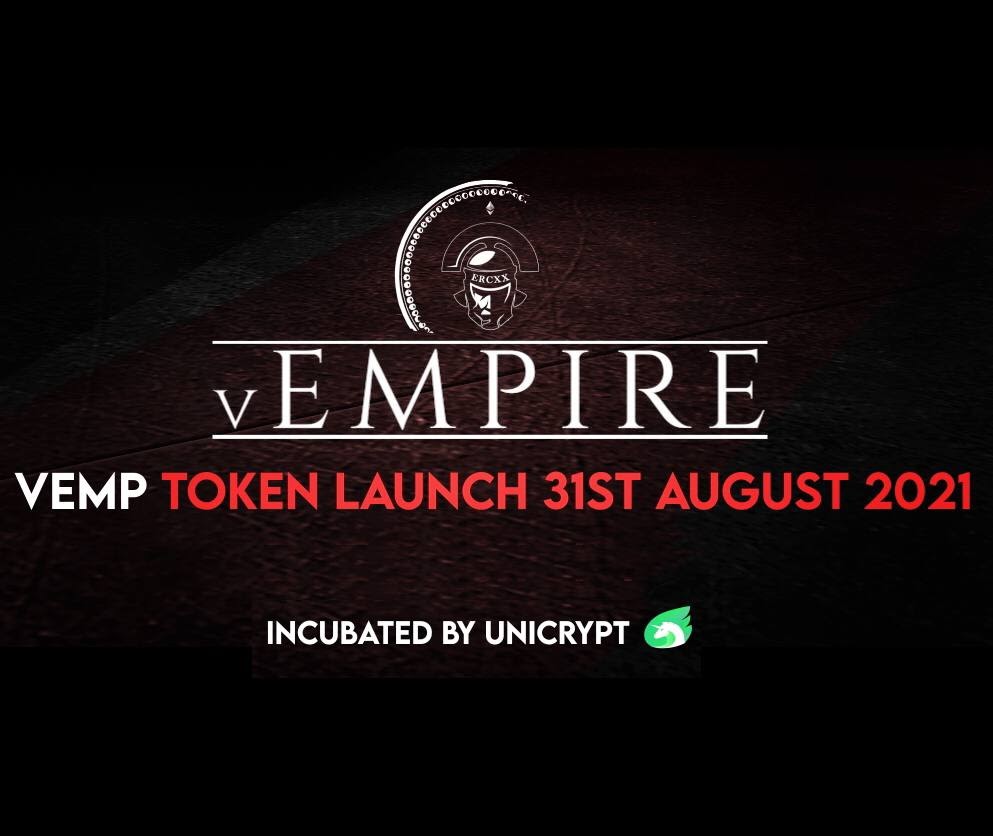
The journey begins as vEmpire stands as an incubated protocol on Unicrypt, a protocol that has hosted about 450 projects with only four of them passing the strict criteria to become incubated. Users can participate in the Public Sale of vEmpire’s Gamer Token VEMP on Unicrypt’s ILO scheduled on 31st August at 2000H BST.
The initial total supply of VEMP stands at 90M. Minting of VEMP tokens will then proceed as follows;
- After one to three years,VEMP will be minted at 20 per block
- In the next four to twelve years, the number comes down to 15 per block
- After that, in thirteen to nineteen years, it comes to 10 per block
- In 20 to 21 years, the minting will stand at 5 per block
With all parameters tallied in, the total supply stands at 810,720,000 VEMP.
xVEMP: Governance to the DDAO
Users can stake their VEMP tokens to earn xVEMP, which immediately enables them to earn rewards and hold voting rights positions. xVEMP holders earn the right to collect profits from card battles and monetized land. This subsequently and automatically should skyrocket the value of xVEMP tokens which can be redeemed for VEMP at any time.
The Empire’s voting involves each token holder having one vote, unlike most DAOs where big pockets equal more voting rights. However, to make decisions, the threshold for owning one vote stands at $1000 to send away bots and prevent Sybil attacks.
vEmpire’s goal is to reward its users with high profits by rerouting Land and NFT proceeds back to them instead of taking it to stakeholder’s pockets. All the Profits earned within the Empire are shared among all staked token holders. Furthermore, with the incentives given by the owners of xVEMP, voting rights belong to the community. For that reason, vEmpire is a democratic ecosystem, a DDAO, and not just any regular DAO.
Users can receive rewards from staking after unstaking from the DDAO as the profits received from battles and monetized land. Notably, the rewards come bearing a yield. Click here to find out more about yields from the VEMP and xVEMP tokens.
vEmpire NFTs Presale
The vEmpire platform is offering NFTs. They fuel the gaming community, specifically The Founding Soldiers. The NFT fee revenue, after initial development, will be collected and shared among users who stake their VEMP.
The project has already launched its first 100 NFTs, dubbed The Cataphracts, on 1st August at 9 PM BST the auction for vEmpire’s first ever NFT ends with the current bid at 1 Ethereum. The remaining number of NFTs are up for grabs on OpenSea.io at a fair price of 0.1ETH to benefit early supporters. Please take advantage of the sale as it is needless to say the prices are lucrative: you may not get a better signal to buy ever in your life that is as clear as this due to vEmpire stating that these will be the cheapest prices they ever list NFTs at.
Why You Should Join the vEmpire NFT Craze
vEmpire have found a way to make the experience exciting. Cataphracts, according to vEmpire, harbour 99 scrolls left by the Emperor, which carry clues to a quest whose end comes bearing gifts. The Empire hid these scrolls from the 2-100th NFTs in the Presale.
For those die-hard puzzle game lovers, each of the 99 NFTs(Cataphracts) on the Presale has distinct letters and numbers that lead players to influencers on social media. These influencers carry with them clues that show users a pathway to another clue. The first clue has already been released by @CathyHackl with only six left with; @intocryptoverse @Jihoz_Axie @DCLblogger @SpartanBlack_1 @themooncarl @DENTOSHI
The cycle continues until one captures all the clues, and the winner gets 1% of VEMP’s total supply. If VEMP’s total supply nears even half that of MANA, you are looking at a prize of $5M. That sounds interesting, right? CEO Dominic Ryder(Romulus) assures you it may very well take years to solve.
About vEMPIRE DDAO LTD
vEmpire DDAO Ltd is a UK-based entity that focuses on the true decentralization of Decentralized Autonomous Organizations. The startup, whose leader is Dominic Ryder as the CEO (Romulus), aims to wage war on DAOs that have decided to fixate centralization back into decentralized communities. Please read the story behind vEmpire on its whitepaper here. You can also get the latest updates from various vEmpire social handles such as;
Twitter – Click Here
Instagram – Click Here
Telegram – Click Here
Medium – Click Here
Website – Click Here


GEORGETOWN, Cayman Islands, November 16, 2026, lockchain network Kava has published an incident report following a security incident involving its decentralised lending platform, HARD Lend, on November 14. The network said a confirmed attack targeting a vulnerability was blocked and that Kava’s underlying blockchain infrastructure was not compromised.
The incident has drawn attention to the risks facing decentralised finance applications, where vulnerabilities in lending markets and collateral calculations can expose deposited assets to losses even when the underlying blockchain continues operating normally.
Background
HARD Lend is a decentralised lending protocol within the Kava ecosystem. Such platforms allow users to deposit digital assets and borrow against collateral without relying on a conventional bank or centralised lender.
Their operation depends on smart contracts that calculate collateral values, borrowing limits and repayment obligations. If a contract uses incorrect pricing information or handles unusual market conditions poorly, an attacker may be able to borrow more than the value of the assets deposited.
Security incidents involving lending protocols can therefore affect users and liquidity providers even when the wider blockchain network remains operational.
Key Developments
The incident occurred on November 14 and involved Kava Lend’s lending infrastructure. The Block reported that approximately 55.2 million KAVA tokens, worth about $3.76 million at pre-incident prices, were borrowed out of the protocol following manipulation involving a dormant BUSD lending market.
According to the publication’s on-chain analysis, the attacker exploited an extremely small market supply to inflate the calculated value of deposits. The inflated collateral was then used to borrow KAVA through repeated transactions.
The Block reported that approximately 49.2 million KAVA was transferred to BNB Chain through LayerZero and sold for around $2.09 million in BNB and USDT.
Kava’s subsequent position was that the attack was contained within HARD Lend and did not compromise the core Kava chain. The network’s statement and the on-chain figures reported by The Block describe different parts of the incident: the former addresses the wider network’s security, while the latter examines activity and asset movements involving the lending protocol.
Industry Implications
The incident highlights the importance of testing smart contracts against unusual conditions, including dormant markets with very low liquidity. Protocols must account for edge cases that may not appear during ordinary market activity.
For users, the event is a reminder that depositing assets into a decentralised lending platform carries risks beyond the security of the underlying blockchain. Smart contract design, price calculations, collateral rules and emergency controls can all affect the safety of funds.
For developers, detailed incident reporting can help identify weaknesses and provide information that other protocols may use to review their own systems.
What’s Next
Kava has released an official incident report, and the next important developments will concern any additional technical findings, recovery measures and the status of affected lending markets.
Users should rely on official Kava and HARD Lend announcements for information about service availability and asset recovery. The precise financial impact and any final resolution should be assessed using confirmed updates rather than estimates alone.

SINGAPORE, November 16, 2026, DBS Bank and JPMorgan’s blockchain business, Kinexys, have launched a system that allows institutional clients to transfer tokenised US dollar deposits between blockchain-based banking networks in Singapore and the United States around the clock.
The service connects DBS Token Services with Kinexys’ permissioned blockchain deposit network. Ant International is the first client to use the arrangement, applying it to treasury and liquidity management across its operations in both markets.
Background
Traditional international bank transfers often depend on operating hours, intermediary institutions and settlement processes that can delay access to funds. These limitations can be particularly challenging for companies with operations across several time zones.
Tokenised deposits are digital representations of money held in conventional bank accounts. They allow banks to record and transfer deposit value using blockchain infrastructure while retaining the underlying relationship with the regulated banking institution.
They should not be confused with privately issued cryptocurrencies or public stablecoins. The funds involved in this service remain bank deposits, represented through digital tokens on networks accessible to approved participants.
Key Developments
The new service enables participating institutional clients to move US dollar liquidity between DBS and Kinexys blockchain accounts outside conventional banking hours, including weekends.
The system uses Partior for settlement orchestration. It also builds on an interoperability framework announced by DBS and JPMorgan in November 2025, which was designed to connect their respective tokenised deposit ecosystems.
Ant International is the first client to adopt the service. The company will use it to manage liquidity and treasury requirements across its entities in Singapore and the United States.
The banks say the development addresses growing demand for cross-border payments in Asia. Their announcement cites projections that outbound cross-border payments in the region could reach $24 trillion by 2033, compared with $13.5 trillion in 2025.
There is an important operating limitation. Transfers within the Kinexys blockchain deposit network are available around the clock, but moving funds between traditional demand deposit accounts and blockchain deposit accounts still has a three-hour weekend downtime, from 3 p.m. to 6 p.m. Eastern Time on Saturdays.
Industry Implications
The launch gives businesses another option for managing liquidity across international operations. Companies that need to settle payments outside normal banking hours may benefit from having access to funds through connected digital deposit networks.
For the wider financial sector, interoperability is a key issue. Individual banks can develop their own tokenised money systems, but their usefulness is limited if those networks cannot communicate with one another.
The DBS and JPMorgan arrangement is an example of two established financial institutions connecting separate permissioned blockchain systems for a commercial use case. It also demonstrates that blockchain adoption in banking is not limited to cryptocurrency trading.
What’s Next
The service is commercially available to eligible institutional clients, with Ant International acting as its first user. DBS and Kinexys have also indicated that improvements to the weekend connection between traditional accounts and blockchain deposit accounts are under development.
Further adoption by corporate clients will help show whether the system can support wider cross-border treasury operations.
Press Release
Brazil Central Bank Warns Certain Stablecoin Transfers Could Create Money Laundering Risks


BRASILIA, Brazil, November 16, 2026, A senior official at Brazil’s central bank has warned that certain stablecoin-based international payment arrangements could expose financial institutions to money laundering risks, even when the funds involved originally come from legitimate sources.
Gerson Romantini, head of the central bank’s foreign exchange department, raised the issue at a private industry event. His remarks focused on how money is converted into stablecoins, transferred overseas and exchanged into another currency. The comments have renewed attention on Brazil’s rules for cryptocurrency-related foreign exchange services and the responsibilities of fintech companies operating in the payments market.
Background
Stablecoins are widely used for cryptocurrency trading, international transfers and digital payments because their value is generally linked to currencies such as the US dollar or euro.
In Brazil, regulators have been examining how these assets interact with conventional foreign exchange services. The central bank is particularly concerned about arrangements that allow money to move between countries through multiple conversion stages without following the controls normally associated with regulated currency transactions.
Resolution BCB No. 561, which took effect on October 1, 2026, introduced restrictions affecting the use of virtual assets in certain settlements between regulated electronic foreign exchange providers and their overseas counterparties. It did not create a blanket prohibition on all cryptocurrency transfers.
Key Developments
Romantini discussed a structure described as a stablecoin sandwich. In this arrangement, a company receives Brazilian reais, converts the funds into a dollar or euro-backed stablecoin, transfers the tokens overseas and converts them into local currency for the recipient.
The central bank distinguishes between different ways this structure can operate. A regulated financial institution may use virtual assets as part of the infrastructure supporting a conventional foreign exchange transaction. However, the regulator considers a different arrangement problematic when a company directly sells stablecoins to customers as part of a structured service designed to move reais into foreign currency through an overseas conversion.
This distinction is important because the central bank’s concerns relate to the structure and ownership of the transaction, not simply the use of stablecoins.
The reporting also points to additional compliance requirements. Covered institutions must report qualifying self-custody transfers of at least $10,000 to Brazil’s financial intelligence authority, Coaf, under the rules that took effect in October.
Industry Implications
The comments could affect payment providers and fintech companies that use stablecoins for international transfers. Businesses may need to review how they receive customer funds, convert currencies and transfer digital assets between jurisdictions.
For users, tighter oversight could influence which services remain available and how quickly cross-border payments can be processed. For the wider cryptocurrency industry, Brazil’s approach illustrates the difficulty regulators face in distinguishing legitimate blockchain-based payment infrastructure from arrangements that may bypass established foreign exchange controls.
Importantly, the central bank has not announced a general ban on stablecoins. The current distinction between permitted and restricted transaction structures remains central to understanding the policy.
What’s Next
An industry source cited in the reporting indicated that a meeting expected on November 19 could bring further discussion of restrictions affecting fintech stablecoin services. The possibility of reserving certain activities for banks has been raised, but no formal decision has been confirmed.
Market participants will also watch for further guidance from the central bank on how the existing rules apply to international transfers and digital asset intermediaries.

Kava Publishes HARD Lend Security Report After Exploit Attempt

DBS and JPMorgan Connect Blockchain Deposit Networks for 24/7 US Dollar Transfers

Brazil Central Bank Warns Certain Stablecoin Transfers Could Create Money Laundering Risks

Japan’s Three Largest Banks Target Yen Stablecoin Transactions by March 2027

Germany Advances Bill Allowing Authorities to Seize Crypto Assets of Unclear Origin

Bittensor introduces Gamma Tokens as payment layer

Cardalonia Aiming To Become The Biggest Metaverse Project On Cardano

P2P2C BREAKTHROUGH CREATES A CONNECTION BETWEEN ETM TOKEN AND THE SUPER PROFITABLE MARKET

WOM Protocol partners with CoinPayments, the world’s largest cryptocurrency payments processor

ETHERSMART DEVELOPER’S VISION MADE FINTECH COMPANY BECOME DUBAI’S TOP DIGITAL BANK

Project Quantum – Decentralised AAA Gaming

WOM Protocol Recommended by Premier Crypto Analyst as only full featured project for August
-
 Crypto4 years ago
Cardalonia Aiming To Become The Biggest Metaverse Project On Cardano
-
 Press Release6 years ago
P2P2C BREAKTHROUGH CREATES A CONNECTION BETWEEN ETM TOKEN AND THE SUPER PROFITABLE MARKET
-
 Blockchain6 years ago
WOM Protocol partners with CoinPayments, the world’s largest cryptocurrency payments processor
-
 Press Release6 years ago
ETHERSMART DEVELOPER’S VISION MADE FINTECH COMPANY BECOME DUBAI’S TOP DIGITAL BANK
-
 Press Release5 years ago
Project Quantum – Decentralised AAA Gaming
-
 Blockchain6 years ago
WOM Protocol Recommended by Premier Crypto Analyst as only full featured project for August
-

 Press Release6 years ago
ETHERSMART DEVELOPER’S VISION MADE FINTECH COMPANY BECOME DUBAI’S TOP DIGITAL BANK
-
 Blockchain6 years ago
1.5 Times More Bitcoin is purchased by Grayscale Than Daily Mined Coins