
Press Release
Mdex adopts a new IMO mechanism to launch Demeter: empower MDX to be the cradle of quality assets

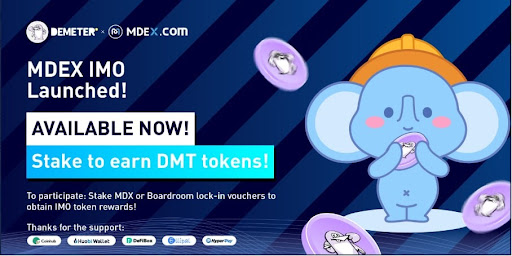
On September 13, Mdex launched the IMO for Demeter tokens and attracted over $350 million in participation.
At present, many projects on DApps are choosing to issue their initial tokens and establish liquidity in a decentralized way as it is more in line with the characteristics of the blockchain field. As a consequence, many blockchain entrepreneurs are looking for a launchpad that excels in issuing tokens and offering sufficient liquidity. This makes the competition for IDO functions enter a more refined stage: competitiveness and data playing the decisive factors.
Staking to earn new tokens: innovative IMO mechanism
IMO (Initial Mdex Offering) is an initial decentralized online exchange mechanism based on MDEX. The mechanism provides sufficient liquidity for projects while allowing users to participate more fairly.
By launching IMO under a new mechanism, MDEX not only finds more quality assets for users and but also empowers MDX. The first project under the innovative IMO mechanism is Demeter, a market protocol of decentralized cryptocurrency. DMT, the governance token of Demeter, is also issued through IMO with a liquidity pool created on Mdex.
The latest round of IMO on September 13 attracted 6,500 participants and raised a total of $350 million funds, on par with the achievements of Coinwind’s public offering in May. The highlight of this public offering is the rule of “staking to earn new tokens” in the new IMO mechanism, with a total of over 1 billion MDXs participating in it.
The new mechanism allows users to participate in IMO with either MDX or xMDX, the Boardroom lock-in voucher. This rule frees up the liquidity of the MDXes locked in the board and provides all MDX holders with a fair opportunity to participate in the IMO. Lock-in voucher xMDX can receive different shares of tokens in the IMO, based on their different durations. Shares of tokens increase with the duration of the lock-in, i.e., the longer the lock-in period, the more tokens to be received for participating in the IMO.
For MDX holders, what’s even more exciting is that they are able to gain new tokens just by staking MDX, without losing their MDX or lock-in voucher xMDX positions.
Under the new IMO mechanism, participants can convert their lock-in profits into the platform tokens, which makes MDX “a gold shovel” for users. By exchanging the profits from lock-in revenue with new tokens, the platform introduces the compound interest method of investment, so that users can gain new opportunities with zero loss in their accounts.
Millions of active users: Mdex being “the first choice to launch projects”
IDO is a primary market which has always generated impressive yields. With the support of Mdex, however, it is even more valuable for investors to focus on IMO.
On May 25, Mdex conducted its first IMO, during which the Coinwind project attracted $380 million in participation, ending with a surprising number of 257 times the expectation. Meanwhile, 8,874 addresses participated in the IMO, with an exchange surpassing the expectation by over 25,726% and a token price increase by 500%, making it one of the most attractive projects. Such a heat and achievement made it impossible to even believe that it occurred right after the market crash on May 19.
After the launch of Mdex, it has quickly captured a large number of users, gathered super high liquidity, and became the headline DEX as well as the ideal IDO platform. Completing token issuance on Mdex not only ensures a large amount of active users of the platform, but also is an excellent publicity for the project itself, in terms of the promotion of its product and the building of its community.
User-friendly and community-oriented: Mdex being the cradle for high-quality assets
For entrepreneurs, Mdex is “the first choice for project launch”; in the eyes of investors, Mdex has an additional property of “the origin of multiple tokens”. Because of this expectation, Mdex has made the best professional judgment in project selection.
As the first project launched under the new IMO mechanism, Demeter is a protocol of decentralized lending and stablecoins based on Heco. It is now expected to become the MakerDao on HECO.
Demeter has introduced over-collateralization for lending. The innovation lies in that user’s credit limit will be generated according to their asset factor, which is based on their assets collateralized. The amount that users can borrow and mint stablecoins is restricted by the credit limit, so as to ensure the safety of the user’s property and that of the whole system.
Unlike traditional decentralized lending protocols, Demeter has optimized the interest rate model and collateral coefficient of its DeFi lending protocol. Demeter assets are more diversified, with the introduction of richer crypto asset types such as LP assets, collateral assets, NFT-fi assets, etc. This optimization breaks the restrictions of decentralized lending on collateral. As credit ratings have been conducted with these assets, the lending model between currencies is highly matched, while the algorithm of interest rate adjustment is more reasonable under the premise of ensuring security.
With the more diverse and secure lending service, DUSD, Demeter’s stablecoins demonstrate the same feature. Since DUSD is generated through multi-asset collaterals, it is much less risky and more stable than tokens generated based on single-asset collaterals.
Demeter has demonstrate its farsightness and practicality in innovatively breaking the ceiling of DeFi lending collateral asset, resisting the price volatility of decentralized stablecoins, and liquidation.
The new IMO mechanism brings fair opportunities to all MDX holders. The recently released Hunter program, which provides a total of $10 million to support quality projects, will further lift the competitiveness and attractiveness of Mdex in terms of IMOs. This will help build a new business ecology that covers more application scenarios and is deployed on more chains, providing global users with more convenient, high-performance, low cost and undifferentiated financial services.
Important Links –
Official website link: Click Here
Alternative websites: Click Here and Click Here
Ann Channel: Click Here
Telegram Chinese: Click Here
Telegram English: Click Here
Telegram Russian: Click Here
Discord: Click Here
Twitter: Click Here
Medium: Click Here
Youtube: Click Here


Hong Kong, 4th April 2026 — Hong Kong Web3 Festival 2026 is proud to announce Bitfire Group as a Diamond Sponsor.
Under a high-standard regulatory framework, Bitfire Group has established a globalized Web3 ecosystem centered in Hong Kong with an expanding international footprint. Its core business pillars include Bitfire Premium, a world-leading private banking-grade digital wealth steward, and BitTrade, a licensed digital asset exchange in Japan.
Dedicated to the advancement of digital financial infrastructure, Bitfire Group provides one-stop, private banking-grade, and full-lifecycle digital asset wealth management services to high-net-worth individuals (HNWIs), family offices, and institutional clients. The Group is committed to becoming a preeminent global leader in the digital asset industry. More information: https://bitfire.com/
Hong Kong Web3 Festival (“Web3 Festival”), co-hosted by Wanxiang Blockchain Labs and HashKey Group, is Asia’s premiere crypto conference since 2023. The previous editions brought together over 350 exhibitors and more than 1,200 speakers for in-depth discussions, attracted a cumulative total of 100,000 visitors, and saw over 400 diverse side events. It has solidified its status as a leading crypto event, influencing Hong Kong’s Web3 landscape.
Following the sellout success of its previous editions, Hong Kong Web3 Festival has announced its return on 20–23 April at HKCEC. Now in its 4th year, this four-day event will once again bring tens of thousands of Web3 professionals, investors, and enthusiasts across the globe to connect, learn and be inspired.
Web3 Festival 2026 has set the agenda for Web3 growth and innovation, focusing mainly on traditional finance and crypto finance, AI + Web3, and RWAs.
The conference will also convene top experts and leading Web3 projects to exchange ideas, share best practices and gain perspectives on today’s evolving Web3 landscape.
Featured speakers include:
Paul CHAN Mo-po, GBM, GBS, MH, JP, Financial Secretary of the Government of the Hong Kong Special Administrative Region
Dr. YIP Chee Hang, Executive Director of Intermediaries, Securities and Futures Commission
Xiao Feng, Chairman of Wanxiang Blockchain, Chairman and CEO of HashKey Group
Duncan Chiu, Legislative Council Member (Technology & Innovation Constituency), Hong Kong
Adeniyi Abiodun, Co-Founder & Chief Product Officer, Mysten Labs
Lily Liu, President, Solana Foundation
Joseph Chalom, CEO, Sharplink
Francis B. Zhou, CEO, Quantum Solutions
Abdelhamid Bizid, Managing Director, BlackRock
Phil Kang, CEO, ZR Financial Group
Yat Siu, Co-Founder and Chairman, Animoca Brands
Bugra Celik, Head of Digital Assets and Currencies at Global Macro, HSBC
Robert Lui, Deloitte China Hong Kong Digital Asset Leader; Member of Task Force on Promoting Web3 Development
DIAO Zhihai, Head of International Business of Wealth Management, CICC
Gavin Wang, Managing Partner & Chief Investment Officer, SNZ Holding & SNZ Capital
David Lee, Chairman, Global FinTech Institute
Min Lin, Managing Director, Head of Global Business Development at Ondo Finance
……
Join Hong Kong Web3 Festival on April 20–23 and be part of an epic Web3 journey: https://luma.com/hkweb3festival_2026
Hong Kong, 4th April 2026 — Hong Kong Web3 Festival 2026 is proud to announce ZA Bank as a Diamond Sponsor.
ZA Bank is Hong Kong’s №1 Digital Bank. More information: https://bank.za.group
Hong Kong Web3 Festival (“Web3 Festival”), co-hosted by Wanxiang Blockchain Labs and HashKey Group, is Asia’s premiere crypto conference since 2023. The previous editions brought together over 350 exhibitors and more than 1,200 speakers for in-depth discussions, attracted a cumulative total of 100,000 visitors, and saw over 400 diverse side events. It has solidified its status as a leading crypto event, influencing Hong Kong’s Web3 landscape.
Following the sellout success of its previous editions, Hong Kong Web3 Festival has announced its return on 20–23 April at HKCEC. Now in its 4th year, this four-day event will once again bring tens of thousands of Web3 professionals, investors, and enthusiasts across the globe to connect, learn and be inspired.
Web3 Festival 2026 has set the agenda for Web3 growth and innovation, focusing mainly on traditional finance and crypto finance, AI + Web3, and RWAs.
The conference will also convene top experts and leading Web3 projects to exchange ideas, share best practices and gain perspectives on today’s evolving Web3 landscape.
Join Hong Kong Web3 Festival on April 20–23 and be part of an epic Web3 journey: https://luma.com/hkweb3festival_2026
Hong Kong Web3 Festival 2026 is honored to welcome AltLayer as a Gold Sponsor.
AltLayer builds infrastructure and autonomous agents for interacting with on-chain systems. Explore blockchain data, automate workflows, and build intelligent applications on decentralized networks: https://altlayer.io
Hong Kong Web3 Festival (“Web3 Festival”), co-hosted by Wanxiang Blockchain Labs and HashKey Group, is Asia’s premiere crypto conference since 2023. The previous editions brought together over 350 exhibitors and more than 1,200 speakers for in-depth discussions, attracted a cumulative total of 100,000 visitors, and saw over 400 diverse side events. It has solidified its status as a leading crypto event, influencing Hong Kong’s Web3 landscape.
Following the sellout success of its previous editions, Hong Kong Web3 Festival has announced its return on 20–23 April at HKCEC. Now in its 4th year, this four-day event will once again bring tens of thousands of Web3 professionals, investors, and enthusiasts across the globe to connect, learn and be inspired.
Web3 Festival 2026 has set the agenda for Web3 growth and innovation, focusing mainly on traditional finance and crypto finance, AI + Web3, and RWAs.
The conference will also convene top experts and leading Web3 projects to exchange ideas, share best practices and gain perspectives on today’s evolving Web3 landscape.
Join Hong Kong Web3 Festival on April 20–23 and be part of an epic Web3 journey: https://luma.com/hkweb3festival_2026

Bitfire Group Joins Hong Kong Web3 Festival as Diamond Sponsor

ZA Bank Confirms Participation at Hong Kong Web3 Festival

AltLayer Announced as Gold Sponsor for Hong Kong Web3 Festival 2026

Conflux Joins Hong Kong Web3 Festival as Secondary Exhibition Sponsor

Web3 Leader Programme is an official Platinum Sponsor at Hong Kong Web3 Festival 2026

WEEX Labs Announced as Primary Exhibition Sponsor at Hong Kong Web3 Festival

Cardalonia Aiming To Become The Biggest Metaverse Project On Cardano

P2P2C BREAKTHROUGH CREATES A CONNECTION BETWEEN ETM TOKEN AND THE SUPER PROFITABLE MARKET

WOM Protocol partners with CoinPayments, the world’s largest cryptocurrency payments processor

ETHERSMART DEVELOPER’S VISION MADE FINTECH COMPANY BECOME DUBAI’S TOP DIGITAL BANK

Project Quantum – Decentralised AAA Gaming

WOM Protocol Recommended by Premier Crypto Analyst as only full featured project for August
-
 Crypto4 years ago
Cardalonia Aiming To Become The Biggest Metaverse Project On Cardano
-
 Press Release5 years ago
P2P2C BREAKTHROUGH CREATES A CONNECTION BETWEEN ETM TOKEN AND THE SUPER PROFITABLE MARKET
-
 Blockchain6 years ago
WOM Protocol partners with CoinPayments, the world’s largest cryptocurrency payments processor
-
 Press Release5 years ago
ETHERSMART DEVELOPER’S VISION MADE FINTECH COMPANY BECOME DUBAI’S TOP DIGITAL BANK
-
 Press Release5 years ago
Project Quantum – Decentralised AAA Gaming
-
 Blockchain6 years ago
WOM Protocol Recommended by Premier Crypto Analyst as only full featured project for August
-
 Press Release5 years ago
ETHERSMART DEVELOPER’S VISION MADE FINTECH COMPANY BECOME DUBAI’S TOP DIGITAL BANK
-
 Blockchain6 years ago
1.5 Times More Bitcoin is purchased by Grayscale Than Daily Mined Coins