Uncategorized
CardanoCodex 2024: Year 2 of India’s Premier Hackathon Series

India’s first Cardano Hackathon CardanoCodex returns with a renewed vision and expanded scope for 2024. Following a highly successful debut, the Hackathon has evolved from a small competition to an expansive platform for developer engagement within the Indian Web3 landscape.. This year’s event is set to build upon its strong foundation, fostering extensive partnerships and collaborative efforts to further drive the development of Cardano in India.
About CardanoCodex
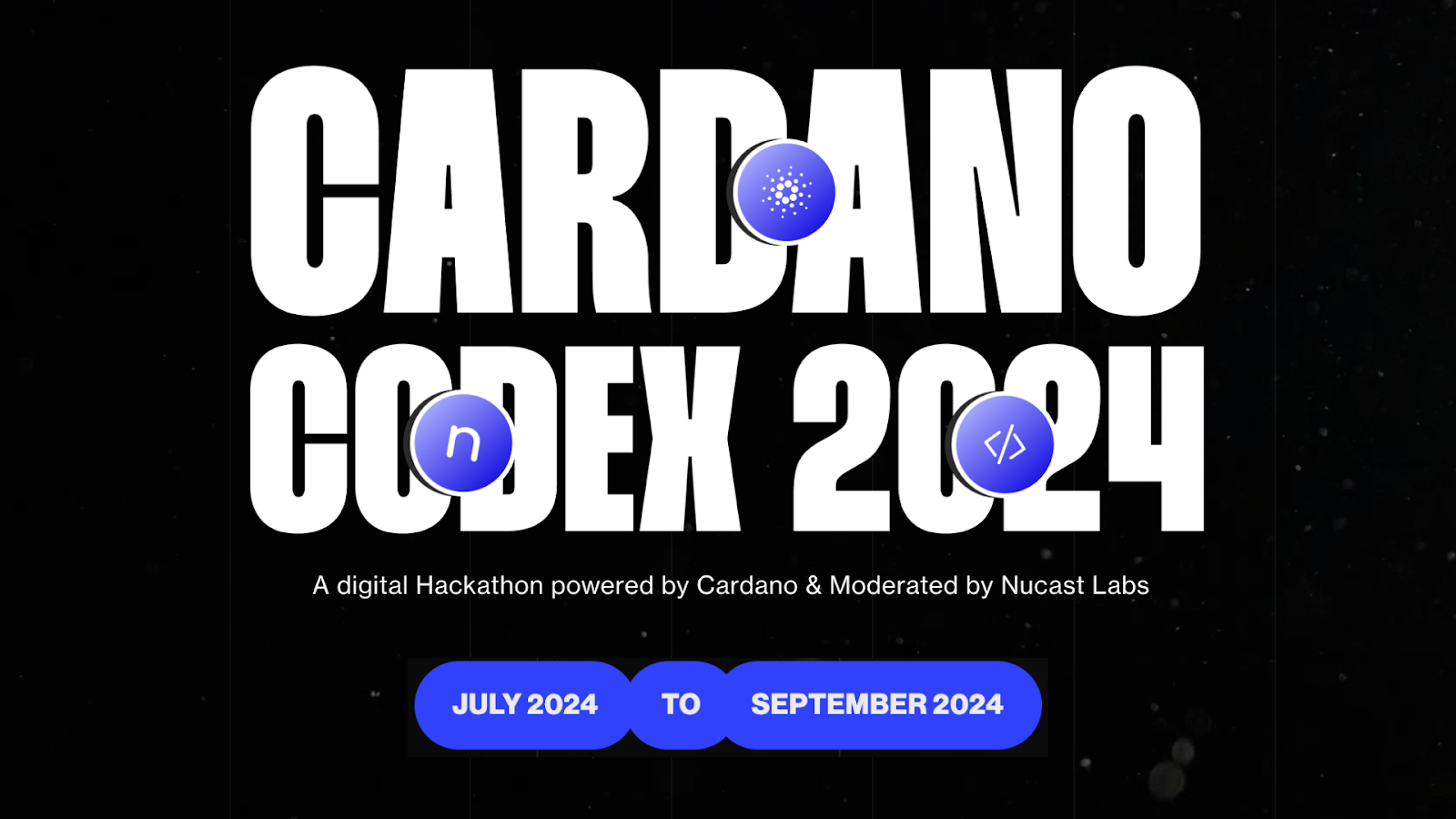
CardanoCodex began last year as a three-month initiative aimed at uplifting and engaging India’s vast and diverse developer community. The inaugural event successfully engaged over 2,000 students and 800 developers. Building on this success, the 2024 edition aims to reach even more minds and nurture groundbreaking ideas, furthering Cardano’s adoption and development in India’s web3 sector.
Vision for CardanoCodex 2024
Powered by Cardano funding engine Project Catalyst and moderated by Nucast Labs, CardanoCodex 2024 is set to run from July to September. The event invites developers across India to get engaged with Cardano, to innovate and to showcase their development skills to help drive the Cardano ecosystem forward.
Despite being one of the largest developer bases globally, the Cardano ecosystem in India was still in its early stages until last year. We saw a significant level of interest in last year’s Hackathon. The ultimate vision is to propel Cardano to the forefront of this rapidly growing developer community, establishing it as a key player in the Indian tech landscape.
New Opportunities for Web3 Developers
The Indian web3 developer community is growing at a rapid pace. Competition in the EVM space is increasing and developers in India are not getting the opportunities they deserve. Cardano introduces a new alternative with an evolving landscape. The ongoing introduction of comprehensive developer tooling is simplifying the process of building in the ecosystem which makes it attractive to developers looking for a new environment. Additionally, Cardano’s governance phase, Voltaire, is about to unlock a $1.5 billion ADA treasury which will foster even more growth and innovation within the ecosystem. Furthermore, developers can code in any major language such as Python, JavaScript, TypeScript, Rust, etc., removing any major learning curve hurdles.
What’s New This Year?
This year’s expanded Hackathon will encompass an ambitious India-wide tour featuring partnerships with some of the prominent Cardano companies, developer guilds such as Google developer groups, India’s leading exchanges and DAOs in 5 cities to host events, workshops, and networking sessions. Roadshows will be hosted in five major cities: Chennai, Hyderabad, Mumbai, Delhi, and Bangalore. The event will culminate in Bangalore with the presence of some of India’s leading Web3 Venture Capital firms

Prizes and Opportunities
Participants have much to look forward to, with attractive prizes for the top three teams:
- 1st Place: 8 Lakhs INR
- 2nd Place: 3 Lakhs INR
- 3rd Place: 1.5 Lakhs INR
*Prizes will be distributed in ADA, the below conversion is based on an average rate of 0.40 USD
Additionally, the top 10 teams will have opportunities for mentorship and potential funding from the $15 million USD Project Catalyst Fund, The largest decentralized innovation funds in the world.
Mentor Network and Partners
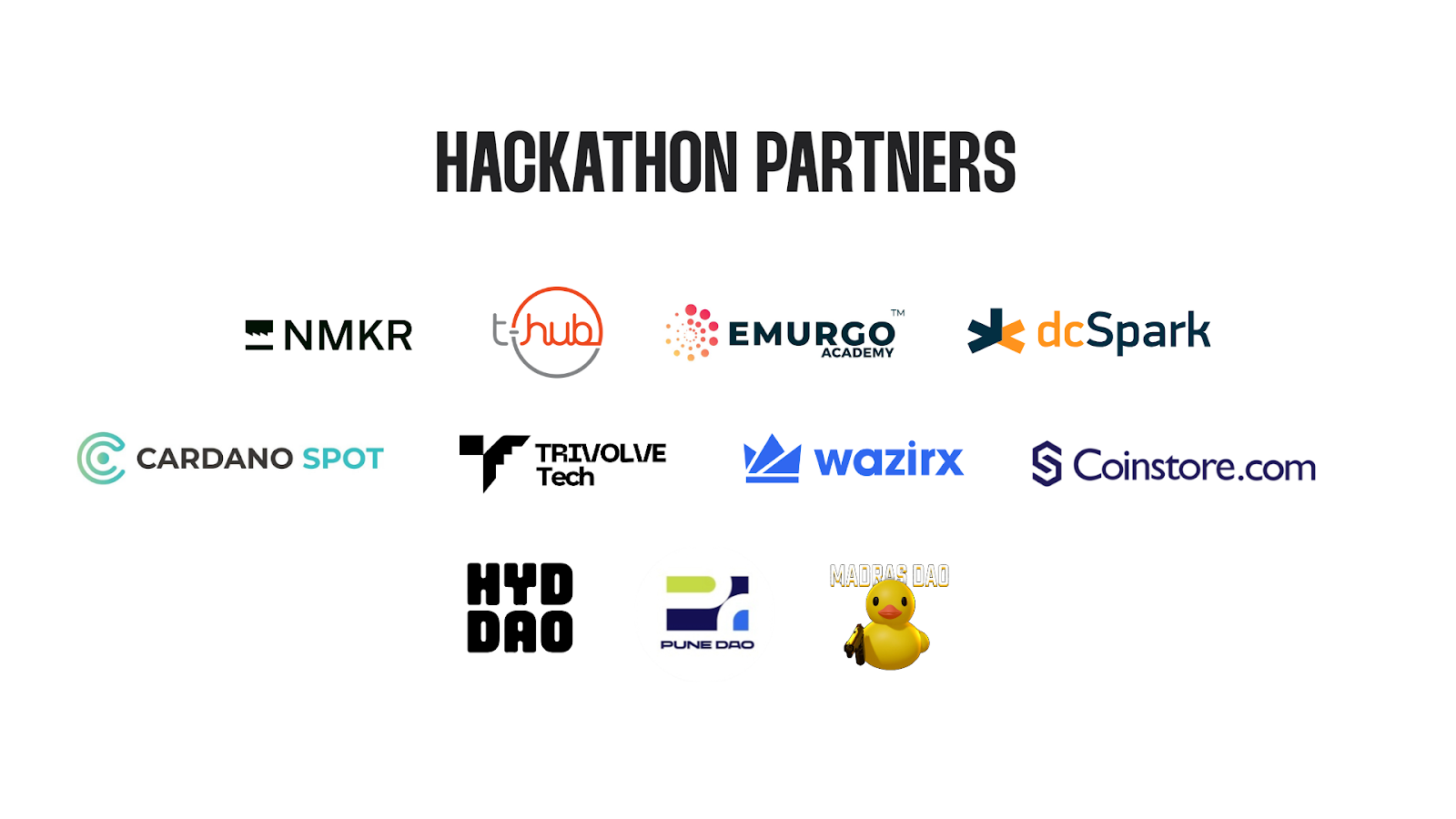
Participants will benefit from a vast network of strong Cardano mentors such as IOG, Emurgo Academy, NMKR, CardanoSpot, TrivolveTech and DCSpark. These mentors will bring extensive knowledge and experience to support developers throughout the Hackathon. We are also collaborating with leading Indian cryptocurrency exchanges like WazirX, CoinDCX, Coinstore, and more than six local Web3 DAOs across India. CardanoCodex 2024 will be one of the most impactful Cardano events and it’s being made possible thanks to the vision and support from some of the most key businesses within the Cardano Ecosystem and the Indian Web3 Community.
“Cardano Codex Hackathon aims to support Indian developer communities through workshops across various cities. EMURGO remains committed to growing Cardano adoption within India through robust infrastructure, engaging hackathons, comprehensive education, and strategic investments.”, stated Nikhil Joshi, COO, EMURGO.
“We are excited to partner with Cardano to support the next wave of web3 developers in India. As firm believers of educational initiatives and experiential learning, we are looking forward to the event and the ideas of potential developers.” – Rajagopal Menon, VP, WazirX
Sricharan G., Founder and CEO of Nucast Labs, remarked, “We are thrilled to bring Cardano to the forefront of the Indian Web3 ecosystem. Our goal is to empower developers and startups to create groundbreaking solutions leveraging Cardano that can revolutionize industries and improve lives. This Hackathon is a testament to our commitment to fostering innovation and entrepreneurship in the Indian Web3 space.”
Timeline and Registration
The Hackathon timeline is structured to maximize engagement and productivity, moving from the application stage to submission, workshops, mentorship, and culminating with the announcement of results. Innovators are invited to register now to be part of Cardano Community. For registration and more information, visit cardanocodex.xyz.


Uncategorized
Terra Classic (LUNC) Surges 34% as Community Burns Accelerate and Network Upgrade Clears

Terra Classic has had a quietly eventful few weeks. LUNC defied a broader Bitcoin downtrend on June 14, surging 34% from a key support level with analysts eyeing a move toward $0.0001 — a modest target in absolute terms, but a meaningful one for a token that has spent most of 2026 grinding along the bottom of its range.
The move didn’t come out of nowhere. A combination of technical maintenance, accelerating burn activity, and community-driven governance has been quietly building a foundation that the market is now beginning to price in.
The v4.0.1 Upgrade That Went Under the Radar
On May 6, 2026, the Terra Classic community approved and implemented the v4.0.1 network upgrade, pausing the blockchain at block 20,464,200 to apply a set of targeted fixes — patching blockchain vulnerabilities, correcting errors in historical staking data, and adjusting the Inter-Blockchain Communication system and API.
The proposal passed with 99.95% of votes in favor — a near-unanimous mandate that reflects how coordinated the Terra Classic validator set has become since the network’s turbulent early days post-collapse. Successful technical maintenance of this kind doesn’t generate headlines the way price moves do, but it matters for long-term network health in ways that eventually show up in market confidence.
The next major development on the governance roadmap is the reactivation of Market Module 2.0, which aims to improve control over token issuance and combat inflation through on-chain mechanisms. If implemented, it would add a structural deflationary layer beyond the existing transaction tax.
Burns Are Adding Up — But the Math Is Still Sobering
The burn narrative remains central to how the Terra Classic community frames its recovery thesis. As of June 1, 2026, cumulative burns across the network have exceeded 448 billion LUNC, driven by the 1.2% on-chain transaction tax and voluntary exchange burns — most notably from Binance.
That number sounds significant until you measure it against the total supply. LUNC’s total circulating supply still sits at approximately 6.46 trillion tokens, and at current daily burn rates of 300 million to 1.2 billion tokens, analysts note it would take years for supply reduction to fundamentally shift the price equation on its own.
What is providing more immediate support is validator network growth locking supply through staking, combined with ongoing Binance transaction fee burns — a combination that has been enough to keep ecosystem activity moving in the right direction even without a dramatic acceleration in burn pace.
What the Community Is Building Toward
The mid-2026 roadmap outlined by the Terra Classic community focuses on launching new DeFi platforms, staking upgrades, and cross-chain bridges, alongside the longer-term goal of exploring USTC utility and a phased plan to restore its peg to $1. The USTC re-peg remains a long-term ambition rather than a near-term catalyst, but its inclusion in official roadmap discussions signals that the community hasn’t abandoned the original vision entirely.
Legal developments around Terraform Labs and ongoing lawsuits have also contributed to the current environment by providing clarity on the events leading to the 2022 collapse — clarity that, while painful, reduces the uncertainty overhang that had weighed on sentiment.
The structural challenges facing LUNC aren’t going away quickly. Governance remains concentrated, with the top 10 validators holding over 55% of bonded stake — a centralization risk that continues to give institutional investors pause. Reputational damage from the 2022 collapse also lingers in ways that no upgrade cycle fully erases.
What Terra Classic does have is one of the most persistent and active community bases in crypto — one that has kept a network alive and developing long after most observers had written it off. Whether that community effort translates into sustained price recovery depends on burn acceleration, Market Module 2.0 delivery, and broader altcoin sentiment cooperating at the same time.
Ethereum has just completed one of the most active months in its history, delivering 29 launches, upgrades, policy shifts, and ecosystem milestones. The surge began with the Fusaka upgrade on December 3, introducing 13 new Ethereum Improvement Proposals (EIPs) that improved blob capacity, enhanced user experience, and activated data-availability sampling. With these updates now live, Ethereum’s roadmap toward more efficient Layer-1 scaling looks more achievable than ever.
The Fusaka upgrade set the tone for a month driven by rapid technical improvements and ecosystem expansion. Aave introduced its redesigned Aave App, offering a cleaner interface and simpler access to DeFi. Meanwhile, Devconnect Buenos Aires became Ethereum’s largest event to date, drawing over 20,000 attendees and hosting more than 75 project demos—many participants described it as Ethereum’s first true “World’s Fair.”
Real-world finance continued to integrate with Ethereum as Amundi, Europe’s largest asset manager, launched the first tokenized share class of a euro-denominated money market fund directly onchain. Disney also entered the Ethereum ecosystem via Cryptoys on Abstract, bringing globally recognized IP into Ethereum’s digital economy. Institutional interest climbed further when JPMorgan’s USD deposit token, JPMD, went live on Base, signaling a broader shift toward settling traditional finance transactions on public blockchain infrastructure. The AI-focused Eliza EcoFund also migrated its ELIZAOS token to Ethereum, naming it the preferred base layer for AI-agent development. The Ethereum Foundation later confirmed Mumbai as the host city for Devcon 2026, expanding its engagement in India’s fast-growing developer landscape.
Regulatory coordination strengthened with the creation of the Ethereum Protocol Advocacy Alliance, combining leading protocols—including Aave, Aragon, Curve, Lido, Spark, The Graph, and Uniswap—under a unified mission to defend Ethereum’s neutrality and promote permissionless innovation worldwide.
Rollup and privacy technology also made major strides. Starknet activated S-two, a high-speed prover securing every block, reinforcing its role in Ethereum’s ZK-rollup future. Aztec introduced Ignition, a decentralized Layer-2 consensus system enabling private, programmable onchain activity. The Ethereum Foundation also announced the Ethereum Interop Layer, a new initiative that aims to make Ethereum’s multi-rollup environment feel like a unified chain.
Stablecoin innovation accelerated as USX Capital deployed a privacy-preserving stablecoin on Scroll and LayerZero, enabling gasless private transfers. Aplus launched an issuance framework allowing smaller banks to offer GENIUS-compliant stablecoins. Nillion expanded its Blind Computer technology to Ethereum, unlocking decentralized computation without exposing user data.
Consumer adoption also accelerated across emerging markets. The Startale App for Soneium gained traction, supporting over 10 million weekly transactions. Argentina saw the introduction of wARS, a peso-pegged stablecoin available on Ethereum, Base, and World Chain. Liquidity and trading infrastructure improved as 1inch launched Aqua for liquidity defragmentation, and Renegade went live on Arbitrum with privacy-first, MEV-resistant trading. Tokenization gained momentum when Robinhood’s EU division tokenized nearly 1,000 stocks on Arbitrum for onchain settlement. Japan’s largest idol and fashion festival also moved onchain using the IRC App, powered by Record Protocol on Soneium.
Ethereum’s broader scaling ecosystem reached new highs this month, surpassing 34,000 transactions per second through rollup activity—its highest throughput ever recorded. The network also expanded user-facing infrastructure with multiple tools designed to increase safety, transparency, and usability, including social-driven activity apps, MEV-protected RPC endpoints, enhanced naming services, developer analytics platforms, and new fair-launch mechanisms.
Altogether, these developments illustrate a network accelerating on every front—scalability, institutional adoption, cultural integration, AI, tokenization, and global financial infrastructure. Ethereum’s record month signals a clear shift toward its next major era of growth.
Cross River Bank has launched a stablecoin payment infrastructure integrated directly into its core banking system, marking a major milestone for blockchain-powered finance in 2025. Led by CEO Gilles Gade, the initiative enhances interoperability between fiat banking rails and blockchain networks while ensuring compliance and enterprise-grade security.
This upgrade bridges the gap between stablecoins and traditional banking, offering businesses a faster settlement environment and stimulating market interest through improved payment efficiency and regulatory alignment.
Cross River Bank’s new platform enables seamless interaction between stablecoin transactions and traditional accounts. By embedding the technology into its core system, the bank removes friction typically associated with blockchain payments, creating a unified and compliant framework for real-time transactions. CEO Gilles Gade emphasized the significance of this shift, stating, “We’re building the future of finance… reimagining every corner of banking—from BaaS to lending—to deliver a faster, more connected financial world grounded in safety and trust.” The platform, developed under the leadership of Luca Cosentino, strengthens financial networks through automation, transparency, and speed.
The launch is expected to accelerate stablecoin adoption across business payments and treasury operations. Enterprises seeking secure, blockchain-based financial tools now gain access to a regulated platform capable of handling real-time settlements without compromising compliance. This positions Cross River as one of the first banks to deliver a stablecoin-integrated environment for fintechs, payment processors, and corporate clients.
Industry analysts view this as a pioneering shift. Previous attempts at stablecoin integration often relied on external platforms or fragmented systems. Cross River’s unified ledger approach resolves these issues by offering interoperability, strict compliance, and direct banking support. The move could reshape how enterprises interact with digital assets, enhancing operational efficiency as regulatory clarity around stablecoins continues to evolve globally.
With this step, Cross River Bank moves into a leadership role in the adoption of programmable money, setting the stage for broader integration of blockchain tools within traditional financial services.

RWA WEEK Singapore Announces New Wave of Institutional Speakers as October Event Draws Closer

Bittensor SN10 Work Tied to Pareto AI and Engy AI at Exploit Summit

BNB Chain Agent Studio v4 adds NodeOpsHQ for prompt-to-agent deployment

BNB Chain releases Agent Studio v4 with simplified AI agent deployment and stablecoin support

ChainUp Brings The Institutional Ark to TOKEN2049 Singapore, Focusing on Digital Asset Infrastructure and High-Value Deal Flow

NEAR AI Cloud API Adds OpenAI Compatibility and Tiered Privacy

Cardalonia Aiming To Become The Biggest Metaverse Project On Cardano

P2P2C BREAKTHROUGH CREATES A CONNECTION BETWEEN ETM TOKEN AND THE SUPER PROFITABLE MARKET

WOM Protocol partners with CoinPayments, the world’s largest cryptocurrency payments processor

ETHERSMART DEVELOPER’S VISION MADE FINTECH COMPANY BECOME DUBAI’S TOP DIGITAL BANK

Project Quantum – Decentralised AAA Gaming

WOM Protocol Recommended by Premier Crypto Analyst as only full featured project for August
-
 Crypto4 years ago
Cardalonia Aiming To Become The Biggest Metaverse Project On Cardano
-
 Press Release6 years ago
P2P2C BREAKTHROUGH CREATES A CONNECTION BETWEEN ETM TOKEN AND THE SUPER PROFITABLE MARKET
-
 Blockchain6 years ago
WOM Protocol partners with CoinPayments, the world’s largest cryptocurrency payments processor
-
 Press Release6 years ago
ETHERSMART DEVELOPER’S VISION MADE FINTECH COMPANY BECOME DUBAI’S TOP DIGITAL BANK
-
 Press Release5 years ago
Project Quantum – Decentralised AAA Gaming
-
 Blockchain6 years ago
WOM Protocol Recommended by Premier Crypto Analyst as only full featured project for August
-
 Press Release6 years ago
ETHERSMART DEVELOPER’S VISION MADE FINTECH COMPANY BECOME DUBAI’S TOP DIGITAL BANK
-
 Blockchain6 years ago
1.5 Times More Bitcoin is purchased by Grayscale Than Daily Mined Coins