
Tech
BNB Chain releases Agent Studio v4 with simplified AI agent deployment and stablecoin support


BNB Chain has released Agent Studio v4, updating its AI agent builder with a simpler deployment path, automatic wallet setup and broader stablecoin payment support.
In its announcement, BNB Chain said developers can now deploy through NodeOps without setting up cloud infrastructure themselves. The company also said the updated flow reduces manual steps between creating an agent and getting it running.
The release adds support for USDT, USDC, USD1 and $U as payment options for agents, expanding the stablecoin set available inside the studio. BNB Chain said the change is meant to let developers use the assets they already hold without an extra conversion step.
Agent Studio v4 also automates parts of wallet setup that previously required more manual work. According to the company, TWAK wallet creation now runs in the background, new wallets are funded automatically with test BNB and a test stablecoin, and local wallets receive generated passwords instead of requiring manual setup.
BNB Chain framed the update as part of a broader effort to reduce the friction between prompting an agent and having it live. The company described NodeOps as one of three deployment paths now available in the studio, alongside options for developers using their own cloud accounts.
For teams building on BNB Chain, the main change is practical rather than theoretical: fewer setup steps, more deployment options and a wider choice of stablecoins for agent transactions.
The post BNB Chain releases Agent Studio v4 with simplified AI agent deployment and stablecoin support appeared first on The Cryptocurrency Post.







An official Exploit Summit post said @ExploitSummit that @xavi3rlu announced a partnership between pareton_ai and @engyai aimed at optimizing Engy inference latency and throughput using SN10 work.
@xavi3rlu announces a partnership between @pareton_ai and @engyai at Exploit Summit.
The goal: optimise Engy’s inference setup for lower latency and higher throughput, bringing Bittensor’s SN10 optimisation work to another provider’s customers. pic.twitter.com/id3V8uWUUy
— Exploit Summit (@ExploitSummit) September 29, 2026
The announcement frames the collaboration as a technical optimization effort rather than a broader product launch. According to the conference account, the work is intended to improve Engy’s inference performance through SN10-related optimization, with the stated goal of supporting Engy customers.
That is the clearest confirmed detail currently available: the partnership was presented publicly at the event, and the stated focus was on latency and throughput. No additional operational specifics were included in the post, such as implementation timing, deployment scope or whether the optimization is already live for users.
SN10’s role in the announcement
The mention of SN10 places Bittensor-related optimization work at the center of the update, but the announcement does not spell out technical mechanics beyond performance improvements for inference workloads. The post does not describe any token, market or governance implications, and it does not indicate whether the collaboration changes access, pricing or product availability.
For readers following AI-linked crypto projects, the update is best understood as a partnership claim around infrastructure performance. It signals that Pareto AI and Engy AI are positioning SN10 work as part of an effort to make inference more efficient, but the announcement itself stays narrow in scope.
The post Bittensor SN10 Work Tied to Pareto AI and Engy AI at Exploit Summit appeared first on The Cryptocurrency Post.

BNB Chain said NodeOps is now a deployment option in BNB Agent Studio v4, allowing builders to move from a prompt to a running agent without creating a cloud account or configuring infrastructure.
The update is part of a broader v4 release for BNB Agent Studio, which BNB Chain described as aimed at reducing the manual steps between writing a prompt and getting an agent live. In the company’s framing, the new NodeOps path removes a setup layer that would normally sit between development and deployment.
NodeOps also said agents can go live in BNB Agent Studio v4 using its infrastructure without manual setup. BNB Chain’s blog post described NodeOps alongside AWS and Azure as live deployment options.
The same release also adds stablecoin payment support for agents, with USDT, USDC and USD1 now working alongside $U. BNB Chain said wallet setup, funding and password handling are now automatic, while documentation, error messages and feedback tools have been improved to reduce friction for developers.
The changes make the studio feel more like a streamlined build environment than a setup-heavy toolchain, but the announcement remains centered on deployment convenience rather than a broader shift in the agent market. For developers using the platform, the practical change is that the path from prompt to live agent now appears to involve fewer manual steps.
The post BNB Chain Agent Studio v4 adds NodeOpsHQ for prompt-to-agent deployment appeared first on The Cryptocurrency Post.

NEAR AI said its Cloud API is now OpenAI-compatible, allowing developers to point existing clients at a new base URL while keeping the rest of their code unchanged. The company also said requests are proxied through NEAR AI, so the model provider sees NEAR AI as the source rather than the end user or the workload owner.
The launch was outlined in NEAR AI’s announcement post, which describes the API as private-chat focused and says the privacy level depends on the model selected. According to the post, third-party models are proxied through NEAR AI, while models marked TEE are designed to keep prompts and outputs unreadable to anyone else, including NEAR.
Compatibility is the main change; privacy depends on the route
For developers, the practical change is that an OpenAI-style integration can be redirected to NEAR AI without rewriting the application logic. NEAR AI said the same API surface can be used while the underlying model choice determines how the request is handled and how much of the data remains visible outside the secure environment.
The company’s description suggests two layers of privacy handling. In the proxy setup, the lab receives the request from NEAR AI rather than from the original user. In the TEE path, NEAR AI said the prompt and output remain unreadable to anyone else, including NEAR itself.
The announcement does not change the basic fact that this is still a cloud API service, but it does position the product as a compatibility layer for teams that want to move existing OpenAI-based workflows without changing the client code structure.
The post NEAR AI Cloud API Adds OpenAI Compatibility and Tiered Privacy appeared first on The Cryptocurrency Post.

RWA WEEK Singapore Announces New Wave of Institutional Speakers as October Event Draws Closer

Bittensor SN10 Work Tied to Pareto AI and Engy AI at Exploit Summit

BNB Chain Agent Studio v4 adds NodeOpsHQ for prompt-to-agent deployment

BNB Chain releases Agent Studio v4 with simplified AI agent deployment and stablecoin support

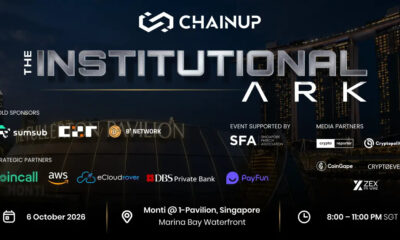
ChainUp Brings The Institutional Ark to TOKEN2049 Singapore, Focusing on Digital Asset Infrastructure and High-Value Deal Flow

NEAR AI Cloud API Adds OpenAI Compatibility and Tiered Privacy

Cardalonia Aiming To Become The Biggest Metaverse Project On Cardano

P2P2C BREAKTHROUGH CREATES A CONNECTION BETWEEN ETM TOKEN AND THE SUPER PROFITABLE MARKET

WOM Protocol partners with CoinPayments, the world’s largest cryptocurrency payments processor

ETHERSMART DEVELOPER’S VISION MADE FINTECH COMPANY BECOME DUBAI’S TOP DIGITAL BANK

Project Quantum – Decentralised AAA Gaming

WOM Protocol Recommended by Premier Crypto Analyst as only full featured project for August
-
 Crypto4 years ago
Cardalonia Aiming To Become The Biggest Metaverse Project On Cardano
-
 Press Release6 years ago
P2P2C BREAKTHROUGH CREATES A CONNECTION BETWEEN ETM TOKEN AND THE SUPER PROFITABLE MARKET
-
 Blockchain6 years ago
WOM Protocol partners with CoinPayments, the world’s largest cryptocurrency payments processor
-
 Press Release6 years ago
ETHERSMART DEVELOPER’S VISION MADE FINTECH COMPANY BECOME DUBAI’S TOP DIGITAL BANK
-
 Press Release5 years ago
Project Quantum – Decentralised AAA Gaming
-
 Blockchain6 years ago
WOM Protocol Recommended by Premier Crypto Analyst as only full featured project for August
-

 Press Release6 years ago
ETHERSMART DEVELOPER’S VISION MADE FINTECH COMPANY BECOME DUBAI’S TOP DIGITAL BANK
-
 Blockchain6 years ago
1.5 Times More Bitcoin is purchased by Grayscale Than Daily Mined Coins