
Press Release
ABC Conclave Bangkok 2024: A Groundbreaking Nexus of AI, Web3, and Gaming!

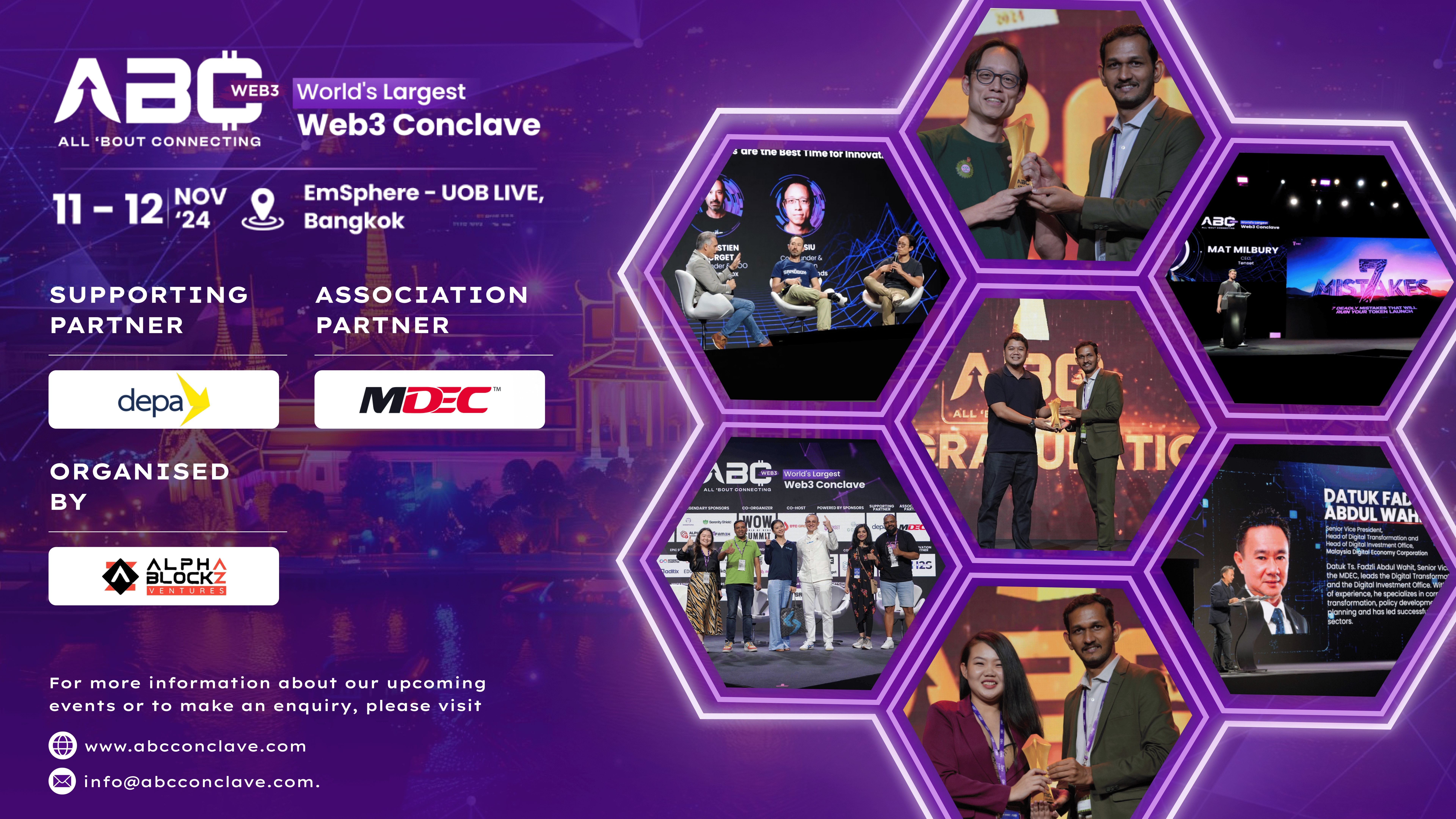
The ABC Conclave Bangkok ‘24, one of the most anticipated Web3 and AI summits, concluded with resounding success, bringing together visionaries, industry leaders, and global pioneers to shape the future of decentralized technologies. Held on 11- 12, Nov, ‘24, at Southeast Asia’s new world-class Entertainment Venue Emsphere – UOB LIVE, Bangkok, Supported by the Digital Economy Promotion Agency (DEPA), Associated with the Malaysia Digital Economy Corporation (MDEC), and hosted by AlphablockZ, the conclave showcased cutting-edge discussions, groundbreaking innovations, and strategic collaborations in AI, Web3, and Gaming.
Bangkok edition of ABC Conclave witnessed 5,500+ attendees, 100+ expert speakers, 1000+ blockchain developers, and 500+ innovators exploring the cutting-edge convergence of AI, Web3, and Gaming under the theme “Next-Gen Nexus: Uniting AI, Web3, and Gaming.” The event was a powerhouse of insightful panel discussions, fireside chats, groundbreaking tech talks, and exclusive networking opportunities, setting the stage for Thailand’s emergence as a Web3 leader in Southeast Asia.
With 30+ insightful seminars and unparalleled networking opportunities, the conclave fostered meaningful connections and ignited ideas shaping the future of digital assets. Bangkok solidified its position as a global hub for the blockchain and crypto communities through this impactful event.
Bangkok ‘24 edition brought together global leaders in AI, Web3, and gaming to shape the future of decentralized technologies. The event featured expert-led panels, interactive tech talks, and in-depth discussions on blockchain gaming, DeFi, AI-driven transformation, and digital asset tokenization. Industry pioneers shared insights on Southeast Asia’s expanding role in Web3 adoption and the latest advancements in decentralized ecosystems.
The conclave culminated in the prestigious ABC Awards Night, recognizing innovators in blockchain, AI, and fintech. With its thought-provoking discussions, expert insights, and unparalleled networking opportunities, ABC Conclave Bangkok 2024 reaffirmed its status as a premier hub for industry innovation and the decentralized future.
Key Highlights from ABC Conclave Bangkok 2024:
Ravindra Kumar, Founder & CEO, Self Chain; ‘’Web3 has been technical for a lot of folks, its not straightforward to work with web3, for it’s too technical for the retail users.’’
Datuk Fadzli Abdul Wahit, Senior Vice President, Head of Digital Transformation and Head of Digital Investment Office, Malaysia Digital Economy Corporation; ‘’ I represent the MDEC which is an agency under the purview of the Ministry of Digital which is spearheading Malaysia’s Digital Transformation journey forward and our participation today holds a very special significance as Malaysia prepares to take the helms of ASEAN Leadership in 2025 and we are excited to share our vision for digital innovation across the region.’’
Saen Witthayaphatthanaphorn, Policy Manager, British Chamber of Commerce Thailand
“In today’s world, Digital Transformation is powerful for us shaping of how we work and communicate to how we innovate and solve global challenges.’’
Wiroon Siewsirithaworn, Project Manager of Digital Platform and Service Promotion Department, DEPA; ‘’We plan to be half of digital economy in Asia and lets give a bit of background- the EEC Thailand was initiated by Thai Government and the goal is to position Thailand to center player of the ASEAN.’’
Vandad Hatefi, Head of Business Development, Serenity Shield; ‘’I think in Web3, Data Storage & Security will play a significant role and even more than Web2 because blockchain is still a young technology and we are in an early stage of this technology and we have to build a strong foundation, right?’’
Yat Siu, Co-founder & Chairman, Animoca Brands; ‘’Why gaming is important for us in space- First of all, All Gamers virtually use Digital Assets, they are already familiar with things like virtual currency and of course with digital assets. There are 3.4 Billion people who play games today which is more than than about 60-65% of the World’s Internet.’’
Abdul Osman, Ceo, Gora; ‘’If anybody can run a node, that means, the more nodes that are running, the more secure the network is, and that’s why we (Gora) focused on nodes being able to deploy at a single click.’’
Web3 leaders Sebastien Borget and Yat Siu delivered an inspiring fireside chat on why bear markets are the best time for innovation moderated by Ken Rutkowski. They emphasized sustainable development, community building, and creating long-term value in decentralized ecosystems rather than chasing short-term hype.
The event also focused on other key topics such as:
● Thailand’s Path to Global Web3 Leadership
● The Future of Blockchain Gaming & User-Generated Content
● Real-World Asset Tokenization & The Future of Finance
● The Builders’ Mindset: Thriving in a Bear Market
● AI & Web3: A New Era of Innovation
● The Future of Web3 Gaming: From Play-to-Earn to Community-Driven Models
● Convergence of TradFi and DeFi
● Security in a Trustless Ecosystem
ABC Conclave Bangkok edition featured an exceptional lineup of speakers who delivered groundbreaking insights during the event on 11 -12, Nov ‘24:
● Yat Siu, Co-Founder & Chairman, Animoca Brands
● Sebastien Borget, Co-Founder & COO, The Sandbox
● Gabby Dizon, Co-Founder, Yield Guild Games
● Sergej Kunz, Co-Founder, 1inch
● Datuk Fadzli Abdul Wahit, Senior Vice President, Head of Digital Transformation and Head of Digital Investment Office, Malaysia Digital Economy Corporation
● Danesh Jothiprahasam, Head, Emerging Tech & GBS, Digital Investment Office, Malaysia Digital Investment Office
● Wiroon Siewsirithaworn, Project Manager of Digital Platform and Service Promotion Department, DEPA
● Saen Witthayaphatthanaphorn, Policy Manager, British Chamber of Commerce
● Pawee Jenweeranon, Digital Consultant, The World Bank Group
● Ravikant Agrawal, Director of Growth, Privado ID
● Sheldon Hunt, Head of the Cardano Ecosystem, Emurgo
● Iana Pugachova, Co-founder, SynergyLabs / ICP Hub
● Andrew Azarias, Regional Marketing – SEA, Trust Wallet
● Gracy Chen, CEO, Bitget
● Ken Rutkowski, Founder, METAL
● Funsho Ajibade, Founder & CEO, Sheertopia
● Abdul Osman, CEO, Gora
● Tobias Bauer, Partner & Co-Founder, TBV
● Belinda Lim, Country Manager (SG), Sandbox
● Dyma Budorin, Co-Founder & CEO, Hacken
● Coach K Crypto, CEO, Coach K Productions Ltd
● Shawn Tan, General Partner, Trive Digital
● Faraj Abutalibov, Co-Founder & CBDO, CrossCurve by EYWA
● Ramani Ramachandran, CEO, Router Protocol
● Steve Good, CEO, Dreams Quest
● Kevin Soltani, CEO, GIMA Group
● Matthias Sheikh Mende, Founder and Co-Founder, Bonuz / Dubai Blockchain Center
● Stefano Virgilli, Business Partner, Technology and Communication, DWF Labs
● Brent Fulfer, General Partner, TBV
● Arpit Sharma, COO, PWR Labs
● Alex Latour, Content Creator, The Thaiger
● Herbert Sim, Founder, The BitcoinMan
● Elliana Jin, Principal, TBV
● Ken Tanaka, CMO / KOL, Tenset CATAMOTO
● Jirayu Charoenyos, Core Team, Thammasat Blockchain Community
● Panai Charoensuk, Ex-President, Chulalongkorn Blockchain Society
● Nichanun Thongprasert, President, Thammasat Blockchain
- Kirubakaran Reddy, Founder, ABC Conclave & AlphaBlockZ
● Preetam Rao, CEO, QuillAI
● Mayur Relekar, Founder & CEO, Arcana Network
● Corey Wilton, CEO, Mirai Labs
● Amar Bedi, CEO, Tashi Networks Pie Ltd
● Mark Rydon, CSO, Aethir
● Tatsuya Kohrogi, Head of APAC, Ginco SG
● Mary Pedler, Founder, Input Comms
● Ahmed Salama, Founder / CGO, Adltix / Emerge
● Kazama Vanichjakvong, Co-Founder & CXO, DTC Group
● Geoff McAlister, Chief Risk Officer, M2
● Barami Rai, Co-Founder & CEO, DTC Group
● Alex Fazel, Chief Partnership Officer, SwissBorg
● Alnura Belyalova, Director of PR, Input Comms
● Mustafa Guler, CEO and Founder, Edu3Labs
● Vandad Hatefi, Lead – Business Development, Serenity Shield
● Mat Milbury, CEO, Tenset
● Kanji Low, COO and Founder, Presence
● Harrison Goldsmith, Business Development Lead, Owl Protocol
● Bruno Calabretta, Hub Manager, ICP Hub ID – Disruptives
● Moe Iman, Founder and CEO, Founders Hub Network
● Nick Garvin, Growth & Comms, Founders Hub Network
● Arravind Prabu, CEO, Cryptobilis
● Ken Nizam, Founder & CEO, AsiaTokenFund Group
● Cecilia Wong, Founder & CEO, yourPRstrategist
● Wanrob Boontham, Head of Investment Banking & Tokenization, Token X Company Limited
● Hira Siddiqui, Co-Founder & CEO, Plurality Network
● Harpreet Singh Maan, Founder, Ikka.IO
● Arseny Klekovkin, Managing Partner, G1 Ventures
● Bob Sachathamakul, CEO, PSP Innovations
● Akkaraphol Raebankoh, CEO, Blockly Thailand
● Tao Santimakorn, Chief Business Development Officer, Translucia
● Dmitry Chirun, CTO, Chateau Capital
● Renz Chong, Co-founder & CEO, BreederDAO
● Leah Callon-Butler, Director, Emfarsis
● Yura Mizin, Founder & CEO, Cryfi
● Subash Sukhdeo, CMO, TaskOn
● Nares Laopannarai, Founder, Ricco
● To Madeira, Co-founder, Matr1x
● Vikram Bhushan, Co-Founder, EIKO
● David Nikzad, CEO, Orthogonal Thinker
● Anthurine Xiang, Co-founder/CMO, EthStorage & QuarkChain
● Hao Jun Tan, CEO, Chateau
● James Lucas, Managing Partner, GC Capital
● Andrey Kuznetsov, Chief Tech, Haqq
● Vaibhavv Ali, Founder | Host, CryptoniteUAE | Roadcast
● Agastya Samat, Founder, Universal Health Token
● Hardiyanto Gunawan, Global Partnership Manager, BeInCrypto
● Max Andonov, Business Development Associate, Cointelegraph
● David Rutkovsky, Director of Global Business Development, Bitlayer Labs Ltd.
● Keith Dawson, Founder & CEO, Qualoo
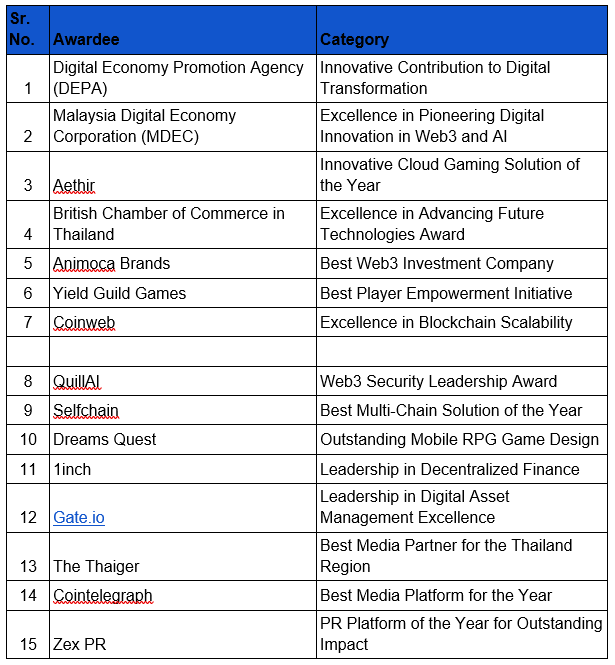
ABC Conclave Awards – Honoring Industry Pioneers
The much-anticipated ABC Awards Night celebrated trailblazers in AI, Web3, and gaming. Some of the prestigious winners included:
“We are thrilled with the overwhelming success of ABC Conclave Bangkok 2024,” said Kirubakaran Reddy, Founder of ABC Conclave & AlphaBlockZ. “This event is a testament to the power of collaboration, innovation, and vision. Thailand is poised to become a leader in Web3, and ABC Conclave is committed to fostering this transformation by bringing together the brightest minds in the industry.”
The Bangkok edition of the ABC Conclave ‘24 was supported and sponsored by:
- Supporting Partner: DEPA
- Association Partner: MDEC
- Organized by: AlphaBlockz
- Title Sponsor: Self Chain
- Powered By : Tenset & Gora
- Legendary Sponsors: Sersh, Atc, Famex, Serenityshield, Sheertopia
- Epic Sponsors: Dreamsquest, Icp, Lore, Ozone, Cros, Adltix, Edu3labs, Eiko
- Rare Sponsors: Qoal, Memeprof, Victor Games, Kix Digital, Arcana
- Prime Media Partner: The Thaiger
- Official Media Partner: Coin Telegraph
- Official Pr Partner: Zex Pr Wire
- Exclusive Talkshow Partner : Dx Talks
- Innovation Partner: Hack2skill
With its unparalleled thought leadership, pioneering discussions, and strategic collaborations, ABC Conclave Bangkok 2024 set the stage for the next era of AI, Web3, and gaming innovations.
About ABC Conclave
ABC Conclave 2024, hosted by AlphablockZ, aims to reach a global audience within the crypto community through dynamic social interactions. It promises an exceptional lineup of esteemed Speakers, cutting-edge Projects, and esteemed Partners.
The event, hosted in Dubai and Bangkok, brings together visionaries, industry leaders, and entrepreneurs to discuss blockchain, cryptocurrency, and fintech. The Conclave serves as a catalyst for change, fostering knowledge exchange, debate, and shaping the future of cryptocurrencies. The primary goal is to ignite conversations about the potential of cryptocurrencies and accelerate their adoption worldwide. The event will be promoted through various platforms and influencer collaborations.
Stay tuned for the next edition of ABC Conclave!
For more details, visit www.abcconclave.com
For further details about the announcement, please contact:
Jagriti Jaiswal
CGO & Head of Partnerships | ABC Conclave
info@abcconclave.com

Press Release
RWA WEEK Singapore Announces New Wave of Institutional Speakers as October Event Draws Closer
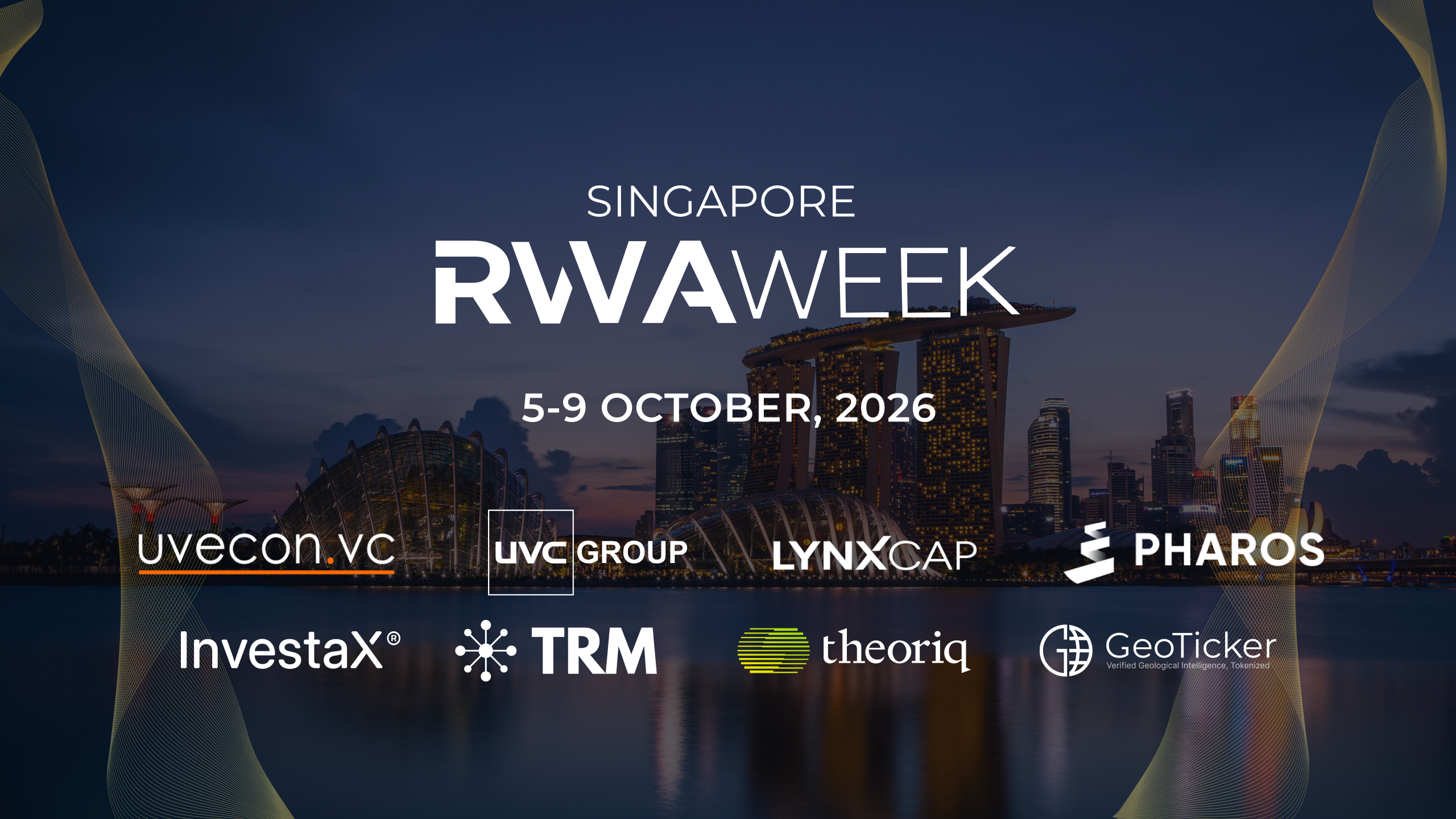
Singapore, October 6, 2026 — With less than a month to go until RWA WEEK Singapore, the organizers have announced a new wave of confirmed speakers and further details of the week-long program, which will bring together leading institutional investors, regulators, financial infrastructure providers, asset managers, family offices, blockchain founders, and Web3 companies in Singapore from October 5–9, 2026.
RWA WEEK Singapore is set to become one of the region’s key gatherings focused on the rapidly developing real-world asset tokenization economy, bringing together the traditional financial sector and the global digital asset industry at a time when institutional interest in tokenized assets continues to accelerate. The five-day program will feature a series of high-level events, curated investor meetings, private networking opportunities, and institutional discussions culminating in the flagship RWA Summit Singapore on October 9 at Marina One West Tower.
The RWA WEEK program will open on October 5 with THE DEALFLOW, a dedicated gathering for investors, asset managers, family offices, and capital allocators focused on curated networking, investment opportunities, and deal-making. The event is co-hosted by KundaBox. On October 6, TOKENISED VIP Singapore will bring together a highly curated group of institutional investors, RWA SUMMIT speakers, financial institutions, asset managers, family offices, founders, and senior digital asset executives for discussions around real-world tokenization use cases and institutional blockchain adoption. The week will culminate with RWA Summit Singapore on October 9, bringing together the wider RWA ecosystem for a full day of discussions, insights, networking, and business opportunities. The flagship summit is expected to attract more than 1,500 attendees, over 70 speakers, and upwards of 200 investors shaping the future of asset tokenization.
The organizers have also announced a new group of confirmed speakers who will join the previously revealed lineup. The latest additions include Adriel Wong, Head of Private Sector – APAC at TRM Labs; Yalini Isweran, Executive Director, Innovation Strategy at DTCC Digital Assets; Huong T Tran, Founder & Managing Partner at 6igma Ventures; and Melody He, Co-Founder & Partner at Spartan Group; Charles d’Haussy, CEO at dYdX Foundation; Pei Chen, CEO of Theoriq; Peter Kadish, Managing Director at LynxCap Investments.
The new speakers bring together expertise spanning financial regulation, institutional policy, financial market infrastructure, blockchain intelligence, investment, venture capital, decentralized infrastructure, and digital asset adoption. Their participation further strengthens the institutional focus of the Singapore edition as the RWA sector moves from early experimentation toward practical implementation across global financial markets.
They join an already strong lineup of confirmed speakers, including Yat Siu, Executive Chairman of Animoca Brands; Viv Diwakar, Head of Foundation at Canton; Edwin Mata, Co-Founder & CEO at Brickken; Julian Kwan, Co-Founder & CRO at IXS;
The growing speaker lineup reflects the broader evolution of the RWA market, where conversations are increasingly moving beyond the concept of tokenization itself toward the infrastructure, regulation, compliance, liquidity, custody, investment structures, and institutional frameworks required for tokenized assets to scale. The presence of senior representatives from organizations such as the Monetary Authority of Singapore, DTCC Digital Assets, and TRM Labs highlights the growing intersection between traditional financial infrastructure and the digital asset ecosystem.
RWA WEEK has also continued to expand its network of strategic partners supporting the Singapore edition. LYNXCAP Investments, dYdX, InvestaX, GeoTicker, Pharos and Theoriq are among the strategic partners of RWA WEEK Singapore, while TRM Labs joins the program specifically as Co-Host of TOKENISED VIP Singapore. The event is produced by UVECON.VC, a company of UVC GROUP.
RWA WEEK has established a growing international presence across major financial and digital asset hubs including Hong Kong, Dubai, Abu Dhabi, Seoul, and Singapore. Previous editions of RWA Summit have attracted hundreds of participants and leading voices from finance, digital assets, investment, and regulation. The Hong Kong edition welcomed more than 750 attendees and over 50 speakers, while the Dubai edition brought together representatives from leading Web3 companies, investment funds, exchanges, and regulatory organizations.
Singapore represents a particularly important destination for the next edition of RWA WEEK given the city’s position as a global financial center and its role in the development of digital asset regulation, financial innovation, and institutional blockchain infrastructure. As banks, asset managers, investment firms, and technology companies increasingly explore tokenized funds, securities, private credit, real estate, and other real-world assets, Singapore is emerging as one of the key markets where traditional finance and blockchain-based infrastructure are converging.
“We are witnessing the RWA market transition from experimentation to real institutional integration,” said Ivan V. Ivanov, Co-Founder of UVECON.VC, UVC GROUP and RWA WEEK. “RWA WEEK is designed to bring together the different sides of this market — institutional capital, financial infrastructure, regulators, technology providers, and Web3 innovators — and create an environment where meaningful partnerships, capital allocation, and real-world tokenization use cases can emerge. The strength of the Singapore lineup demonstrates how quickly this sector is developing.”
With only weeks remaining before RWA WEEK Singapore, preparations for the event are now entering their final stage. Interest from institutional participants, investors, founders, and industry professionals continues to build as the October program approaches, with attendees encouraged to secure their access ahead of the event.
RWA WEEK Singapore will take place October 5–9, 2026, with RWA Summit Singapore taking place on October 9 at Marina One West Tower.
More information:
Press Release
ChainUp Brings The Institutional Ark to TOKEN2049 Singapore, Focusing on Digital Asset Infrastructure and High-Value Deal Flow
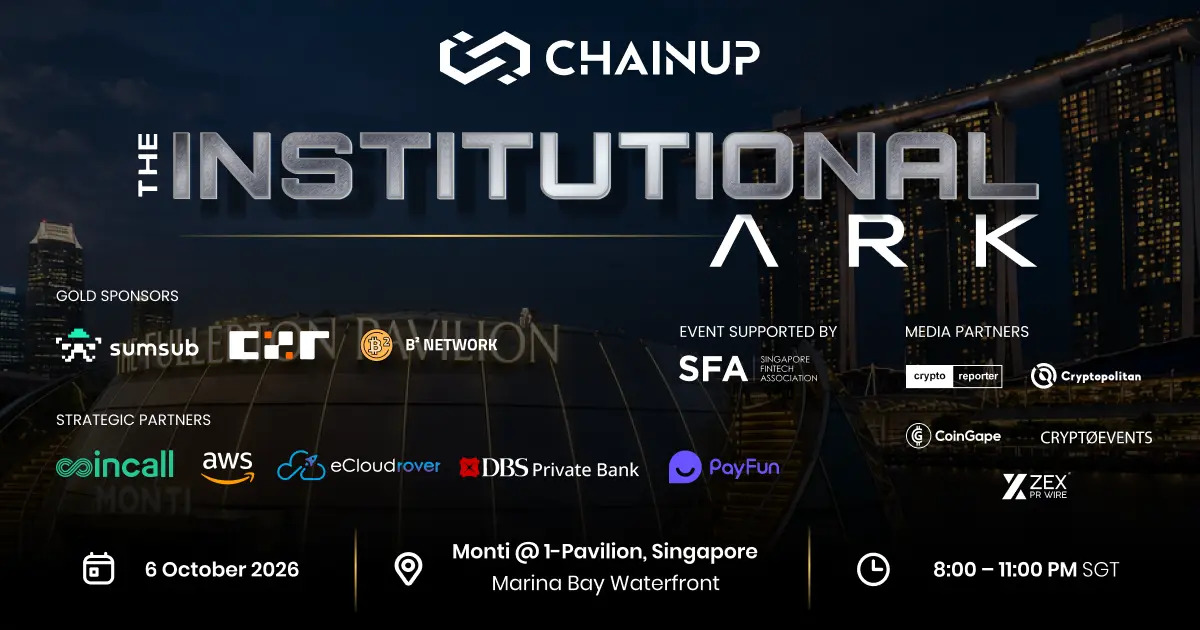
Singapore, Sep 17, 2026 — ChainUp announces the return of its flagship pre-TOKEN2049 event, focusing on institutional infrastructure, enterprise scale, and direct dealmaking.
- ChainUp‘s exclusive pre-TOKEN2049 event, The Institutional Ark, returns on October 6, 2026, at Monti at 1-Pavilion for C-suite leaders, capital allocators, and fintech builders.
- Backed by award-winning event execution recognized at the Marketing Events Awards, the evening provides a closed-door, high-signal setting away from conference hall noise.
- Designed for direct commercial outcomes, the gathering connects institutional peers over drinks, canapés, and panoramic Marina Bay views.
As institutional crypto shifts from hype to execution, ChainUp’s exclusive pre-TOKEN2049 gathering, The Institutional Ark, returns on October 6, 2026, at Monti at 1-Pavilion.
Bypassing public panels for a closed-door, high-signal setting, this invite-only evening brings together a handpicked room of senior executives, capital allocators, and infrastructure builders for real deal flow, drinks, canapés, and panoramic Marina Bay views
Addressing the Digital Asset Infrastructure Gap
Amid surging demand for compliant, scalable digital asset architecture, ChainUp highlights its core enterprise blockchain solutions:
- Scalable Trading Infrastructure: High-performance matching engines and unified liquidity management for high-throughput institutional trading.
- Institutional Custody: Advanced Multi-Party Computation (MPC) and Hardware Security Module (HSM) frameworks to secure large-scale asset management.
- Automated Compliance Suites: Real-time KYC and AML transaction monitoring built for tightening global crypto regulations.
- Real-World Asset Tokenization Architecture: Secure enterprise platforms facilitating the full lifecycle of real-world asset tokenization.
The Institutional Ark (Pre-TOKEN2049 Executive Networking Party)
- Date/Time: October 6, 2026 | 8:00 PM – 11:00 PM SGT
- Venue: Monti at 1-Pavilion, Marina Bay Waterfront, Singapore
- Registration Link: https://luma.com/xn1chytf
Strategic Partnership Opportunities
Limited partnership slots are open for brands looking to connect with global infrastructure buyers and capital allocators. To request the partnership deck or press credentials, contact marketing@chainup.com.
About ChainUp
Founded in 2019 and headquartered in Singapore, ChainUp is the industry’s sole comprehensive provider of compliant digital asset SaaS infrastructure. Serving 700+ enterprise clients globally, ChainUp provides SOC 2-certified turnkey and white-label software for crypto exchanges, stablecoin payment systems, tokenization exchanges, prediction markets, and institutional MPC custody. Learn more at www.chainup.com.
For media queries, please contact:
Yeo Xue Zhen
Senior Marketing Manager, ChainUp
xuezhen@chainup.com
+65 9325 6483
Blockchain
Orochi Network (ON) Builds the Verifiable Data Layer for Web3 as zkPass Partnership and 49-Chain Expansion Signal Growing Infrastructure Reach


Orochi Network has been doing one of the harder things in crypto: building serious cryptographic infrastructure and waiting for the market to care. The wait is beginning to pay off. ON is currently trading around $0.119, up 96.24% from its all-time low of $0.06074 reached on February 10, 2026, with a market cap of approximately $17.2 million and a 24-hour trading volume of $6.7 million. The token sits 72.6% below its all-time high of $0.416 from October 2025 — but the direction of travel over the past five months has been consistently upward from the February floor.
Orochi Network operates as a blockchain-agnostic and proof-system-agnostic Verifiable Data Infrastructure, using three core cryptographic primitives — Zero-Knowledge Proofs, Fully Homomorphic Encryption, and Trusted Execution Environments — to make data operations trustless, provable, and private. That three-layer cryptographic stack is what separates Orochi from single-mechanism privacy protocols — it doesn’t bet on one cryptographic approach, it deploys all three depending on what each specific use case requires.
The Product Suite That’s Already Running
Orochi’s flagship product, zkDatabase, is the world’s first provable NoSQL database. Every data query generates a Zero-Knowledge Proof automatically, enabling auditors, regulators, and smart contracts to verify data correctness without ever accessing sensitive content. For enterprise and institutional use cases — financial compliance, healthcare data, government records — the ability to prove data integrity without revealing the underlying data is the precise capability that has prevented blockchain adoption in regulated industries. zkDatabase solves that at the infrastructure level.
Orand provides a Verifiable Random Function for trustless randomness, while Orocle delivers verifiable oracle feeds without relying on trusted nodes. The oracle market is dominated by Chainlink, but Orochi’s verifiable oracle approach — where every feed is accompanied by a cryptographic proof of origin rather than relying on a reputation-based trusted node network — offers a technically differentiated alternative that’s gaining traction in ZK-native ecosystems where proof composability matters.
Orand and Orocle services are integrated across 49-plus blockchains, while zkDatabase has been adopted by 20-plus blockchains. Cross-chain infrastructure that runs on 49 networks without being tied to any single chain’s success or failure is a meaningful structural advantage — especially as the multi-chain landscape continues to fragment.
The zkPass Partnership and Verifiable Identity
The collaboration with zkPass — building a new foundation for verifiable, privacy-protected data in Web3 — is among the more strategically aligned partnerships in Orochi’s ecosystem. zkPass handles identity verification through zero-knowledge proofs, allowing users to prove attributes about themselves without revealing underlying credentials. Orochi’s verifiable data infrastructure is the natural complement — once identity is verified, every subsequent data interaction that user has on-chain can be provably correct through Orochi’s zkDatabase layer.
That combination of verifiable identity and verifiable data integrity represents the foundational stack that regulated Web3 applications — particularly in RWA tokenization, DeFi compliance, and institutional finance — have been waiting for.
Backed by over $20 million in funding from the Ethereum Foundation, Mina Protocol, Web3 Foundation, and BNB Chain alongside leading venture capital firms, Orochi has grown to support 145-plus partners with more than 160 million transactions processed to date. Grants from protocol foundations rather than purely venture capital is a meaningful signal — it indicates that other blockchain ecosystems view Orochi’s infrastructure as genuinely valuable to their own development rather than simply making a financial bet.
The Supply Structure Worth Understanding
Only 14.4% of the 1 billion maximum ON supply is currently circulating — 144.28 million tokens — with a fully diluted valuation of approximately $81.3 million against the current $17.2 million market cap. With 85.6% of total supply still locked, ON is operating in a very early distribution phase. The gap between FDV and market cap implies either that the market believes the supply will create significant dilution pressure as it unlocks, or that adoption hasn’t yet reached the scale needed to justify the full supply value.
The Binance Alpha and Binance Alpha Airdrops tags on CoinMarketCap reflect a listing pathway that has brought broader retail attention to ON beyond its core technical audience. A trading call citing 25x leverage entry zones on KCEX reflects the speculative layer that sits above the infrastructure fundamentals — ON attracts both audiences simultaneously, which amplifies volatility in both directions.
Orochi’s 2026 goal is to solidify its position as the foundational verifiable data layer for Web3 and institutional finance, scaling zkDatabase, zkDA Layer, Orocle, and Orand modules across global markets to enable secure, auditable data infrastructure for RWA, stablecoins, AI, DeFi, and more. That ambition is coherent and directionally aligned with where institutional Web3 capital is flowing. A $17 million market cap for infrastructure already running on 49 chains with Ethereum Foundation backing is either a significant market oversight or a fair reflection of how early the verifiable data layer category still is.

RWA WEEK Singapore Announces New Wave of Institutional Speakers as October Event Draws Closer

Bittensor SN10 Work Tied to Pareto AI and Engy AI at Exploit Summit

BNB Chain Agent Studio v4 adds NodeOpsHQ for prompt-to-agent deployment

BNB Chain releases Agent Studio v4 with simplified AI agent deployment and stablecoin support

ChainUp Brings The Institutional Ark to TOKEN2049 Singapore, Focusing on Digital Asset Infrastructure and High-Value Deal Flow

NEAR AI Cloud API Adds OpenAI Compatibility and Tiered Privacy

Cardalonia Aiming To Become The Biggest Metaverse Project On Cardano

P2P2C BREAKTHROUGH CREATES A CONNECTION BETWEEN ETM TOKEN AND THE SUPER PROFITABLE MARKET

WOM Protocol partners with CoinPayments, the world’s largest cryptocurrency payments processor

ETHERSMART DEVELOPER’S VISION MADE FINTECH COMPANY BECOME DUBAI’S TOP DIGITAL BANK

Project Quantum – Decentralised AAA Gaming

WOM Protocol Recommended by Premier Crypto Analyst as only full featured project for August
-
 Crypto4 years ago
Cardalonia Aiming To Become The Biggest Metaverse Project On Cardano
-
 Press Release6 years ago
P2P2C BREAKTHROUGH CREATES A CONNECTION BETWEEN ETM TOKEN AND THE SUPER PROFITABLE MARKET
-
 Blockchain6 years ago
WOM Protocol partners with CoinPayments, the world’s largest cryptocurrency payments processor
-
 Press Release6 years ago
ETHERSMART DEVELOPER’S VISION MADE FINTECH COMPANY BECOME DUBAI’S TOP DIGITAL BANK
-
 Press Release5 years ago
Project Quantum – Decentralised AAA Gaming
-
 Blockchain6 years ago
WOM Protocol Recommended by Premier Crypto Analyst as only full featured project for August
-
 Press Release6 years ago
ETHERSMART DEVELOPER’S VISION MADE FINTECH COMPANY BECOME DUBAI’S TOP DIGITAL BANK
-
 Blockchain6 years ago
1.5 Times More Bitcoin is purchased by Grayscale Than Daily Mined Coins