
Crypto
A47 Confirms Daman Investments as Institutional Whale — Holding 64.3M $A47 in Strategic Bet on AI-Powered News Infrastructure


A47, the world’s first decentralized, AI-driven news network, has officially confirmed that the wallet address 3xyBK3SjbufX7qDBuTXkohTSrGVToTyRTWAdFanoejrZ — previously observed aggressively accumulating $A47 tokens — is owned by Daman Investments, one of the most respected and long-standing investment institutions in the UAE.
As reported by blockchain analytics platform Lookonchain, Daman’s wallet now holds 64.3 million $A47 (valued at approximately $1.44 million) — making it the largest single holder of $A47 outside of exchanges.
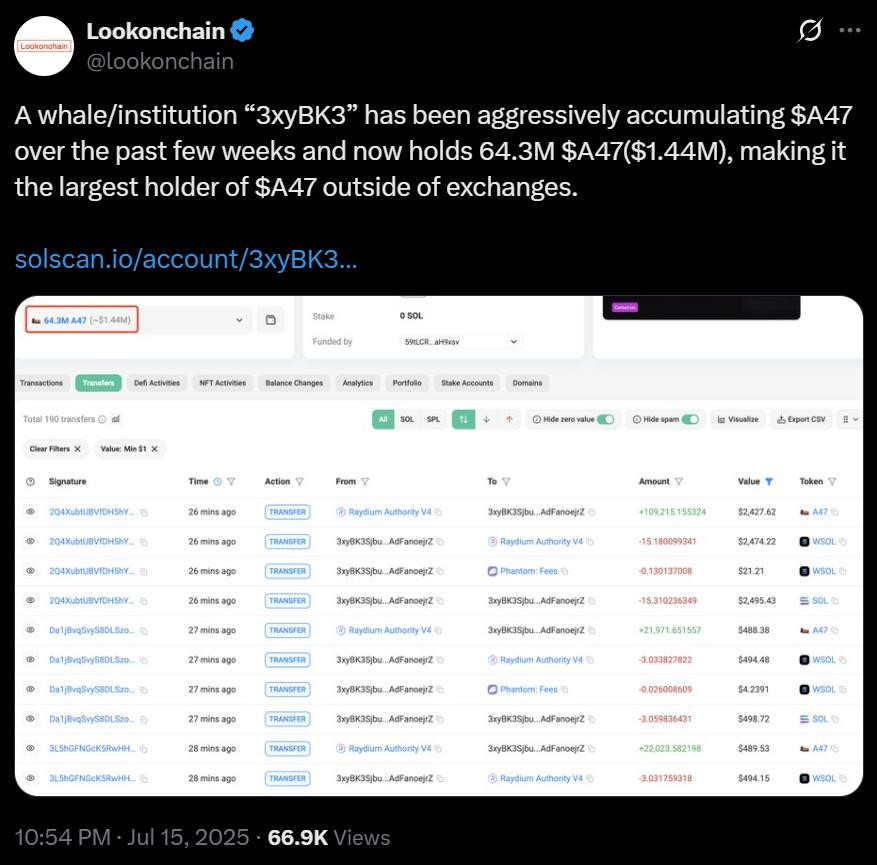
The holding represents a commanding 6% of the total token supply, and marks one of the earliest and most significant institutional entries into the emerging AI x NewsFi sector.
Who Is Daman Investments — And Why This Matters
Established in 1GG8, Daman Investments is a licensed, regulated asset management firm headquartered in the UAE with over two decades of operational excellence. Known for its deep experience across public markets, real estate, fixed income, and private equity, Daman has built a reputation of trust, governance, and disciplined investing.
Their recent announcement — outlining a focused Web3 strategy across four verticals (AI, Media, Tokenized Infrastructure, and Layer 1/2 ecosystems) — signals a paradigm shift in how traditional institutions are now approaching the decentralized economy.
For crypto natives who may be unfamiliar with the name, Daman is not a hype fund or retail syndicate — it is a legacy finance institution entering Web3 with surgical precision. And their public alignment with A47 sends a strong message to both investors and builders: AI-powered, decentralized news has institutional legs.
A47: From Meme Experiment to Media Infrastructure
What began as a proof-of-concept around meme intelligence and real-time news synthesis has now evolved into a serious mission to build global, decentralized media infrastructure.
“This is not a narrative play — it’s infrastructure,” said Saqib Pathan, Project Lead at A47. “We are building the backbone for intelligent, trustless, real-time news distribution. Daman’s backing
confirms what we have believed from day one: the next CNN won’t be a cable channel — it will be an autonomous AI-powered protocol running on-chain.”
A47 operates a network of 47 AI Agents trained to digest real-time market events, regulatory updates, geopolitical shifts, and global news feeds. These agents dynamically generate breaking news videos, data-rich visuals, and synthesized reports — all in real time.
The platform’s long-term vision includes:
- 24/7 AI News Transmission, delivered globally in multiple languages
- Tokenized engagement mechanisms to incentivize participation and accuracy
- Trustless content verification, leveraging blockchain for timestamping and attribution
- Interactive Agents that can answer user queries, verify claims, and reference sources in real time
A Historic Signal for AI x NewsFi
With institutional capital like Daman now on board, A47 believes this marks a turning point for
decentralized news platforms — shifting from community-driven narratives to serious, venture- backed, protocol-driven media infrastructure.
“This isn’t just another altcoin partnership. It’s a bet on a new information economy — one that is
automated, transparent, and built for a post-trust media era,” addedPathan.
About A47
A47 is building the world’s first AI-powered decentralized news network — a 24/7 stream of verified, autonomous, real-time news built on blockchain rails. At the intersection of AI, media, and tokenomics, A47 aims to become the foundational infrastructure for how news is created, validated, and consumed in the digital age.

Crypto
ChimpX AI Announces Final Pre-Sale of SuperApp on BNB Chain: Grab $CHIMP at $0.25 Before February Listing
As the broader cryptocurrency market begins its much-anticipated structural recovery, the window is rapidly closing for investors to gain early-stage exposure to one of the year’s most significant “DefAI” projects. ChimpX AI has officially entered its final pre-sale phase on the AlphaMind launchpad, offering the global community a final chance to acquire the $CHIMP token at a strategic valuation before it transitions to public trading on PancakeSwap later this month.
The timing of this launch is critical. Following a turbulent start to 2026, Bitcoin and BNB are signaling a definitive reversal. As capital rotates back into utility-driven ecosystems, ChimpX AI is positioning itself as the premier “SuperApp” for the BNB Chain. This final pre-sale round on AlphaMind is not merely a fundraising event; it is the final gate before the protocol enters the open market with a functional product and a rapidly growing user base.
The AlphaMind Advantage: A Strategic Entry Point
The AlphaMind round is specifically structured to reward early conviction. Following sold-out IDOs on premier platforms like SPORES and Poolz Finance, ChimpX AI has reserved this final allocation for retail participants at a price point of $0.25 per token. With a $4 million Fully Diluted Valuation (FDV) at the pre-sale level, $CHIMP represents a rare opportunity to enter a high-utility infrastructure project before the typical “listing volatility” associated with top-tier DEX launches.
Furthermore, the round features a 25% unlock at the Token Generation Event (TGE). For participants, this provides a significant liquidity advantage, allowing them to benefit from the initial market momentum immediately upon the PancakeSwap listing.
Mojo: The Tech Driving the Hype
The frenzy surrounding the $CHIMP pre-sale is driven by the successful launch of the Mojo SuperApp (available at app.chimpx.ai). Unlike many speculative AI projects that offer “vaporware,” ChimpX AI has delivered a working product that addresses the biggest barrier to DeFi: Gas Fees.
By integrating Account Abstraction on the BNB Chain, Mojo allows users to trade, lend, and manage assets without ever needing to hold gas tokens. This “invisible blockchain” experience—where the complexity of Gwei and gas limits is abstracted away by AI—is widely considered the “Holy Grail” for retail onboarding in 2026.
Countdown to PancakeSwap
The urgency for the AlphaMind round is high, as the project prepares for its primary listing on PancakeSwap in February. Market analysts note that similar AI-driven DeFi projects on the BNB Chain have seen massive price discovery post-listing, especially when backed by a functional product.
Investors can participate by visiting https://app.alphamind.co/ido/6989a7df51f2ab92207ec335?invite=rmzD-2dY
The process is streamlined to allow for quick commitments with a maximum ticket size of $15,000 per wallet.
Official Ecosystem Links:
- SuperApp: app.chimpx.ai
- Website: www.chimpx.ai
- Telegram: https://t.me/chimpxofficial.

Greg Kidd, an early executive at Ripple and a long-time figure in the cryptocurrency space, has shared fresh insights into what truly drives XRP’s long-term relevance. Rather than focusing on short-term price fluctuations, Kidd argues that liquidity and supply dynamics are the most critical factors determining XRP’s role and sustainability within the global financial system.
According to Kidd, XRP’s value proposition lies in its ability to function efficiently within payment infrastructure, not in speculative price movements. He believes that without deep and reliable liquidity, XRP cannot fully perform its intended purpose, regardless of how high its market price may rise.
Early XRP Investment Reflects Long-Term Conviction
Kidd revealed in a past interview that he still holds a substantial XRP position, having acquired roughly 1% of the total XRP supply more than five years ago. This investment predates the wave of institutional adoption and modern crypto market infrastructure, underscoring his long-standing confidence in XRP as a financial utility rather than a speculative asset.
His early involvement gives him a rare, long-term perspective on how real value is created within blockchain ecosystems. Kidd views XRP as a tool designed to solve liquidity challenges in global finance, not simply as a vehicle for price appreciation.
XRP’s Role as a Bridge Asset in Ripple’s Ecosystem
Kidd emphasized that XRP’s primary function is to act as a bridge asset within Ripple’s payment network. While Ripple builds enterprise-grade systems for cross-border transfers, XRP enables seamless movement of value between different fiat currencies.
He noted that XRP’s effectiveness is independent of Ripple’s corporate performance. Instead, the token’s strength lies in its ability to provide fast, cost-efficient liquidity across markets, making it suitable for large-scale transactional use.
Liquidity Matters More Than Price
A key takeaway from Kidd’s commentary is that liquidity outweighs price when it comes to XRP’s utility. High liquidity allows participants to move in and out of positions quickly, with minimal slippage—an essential requirement for institutional and cross-border payment use cases.
Kidd explained that even if XRP’s price increases, a lack of deep and efficient markets would limit its usefulness. In contrast, strong liquidity enables XRP to function as a reliable transactional instrument within the global payments ecosystem.
Supply, Demand, and Long-Term Price Potential
While liquidity is central to XRP’s role, Kidd acknowledged that supply constraints and rising demand naturally influence price over time. As adoption grows and markets mature, increased demand relative to available supply could support long-term price appreciation.
However, he stressed that any meaningful upside would be driven by real usage and sustained participation rather than speculation. In his view, price growth should be a byproduct of utility, not the primary objective.
Ripple’s Vision for Blockchain-Based Banking
Beyond XRP, Kidd has shared a broader vision for Ripple’s role in transforming traditional finance. Speaking at the XRP Las Vegas conference in June 2025, he suggested that blockchain technology could modernize legacy banking systems and integrate traditional institutions into decentralized networks.
In his current role as CEO of Vast Bank, Kidd is working on issuing FDIC-insured U.S. dollar tokens on the XRP Ledger. These tokens operate under a fractional-reserve model and aim to deliver capital efficiency, interest generation, regulatory protection, and 24/7 cross-border payment capabilities. He also plans to expand this framework to other currencies, including the British pound and the euro.
Conclusion
Greg Kidd’s perspective reinforces the idea that XRP’s long-term success depends far more on liquidity, structured adoption, and real-world utility than on short-term price action. While price appreciation may follow as markets deepen, Kidd believes XRP’s true value lies in its ability to function as a reliable bridge asset within a modernized global financial system.

South Korea’s Supreme Court has delivered a landmark ruling that significantly reshapes how cryptocurrency is treated under criminal law. In a historic decision dated December 11, 2025, and made public in early 2026, the court ruled that Bitcoin held on domestic cryptocurrency exchanges can be legally seized during criminal investigations under the Criminal Procedure Act.
The ruling brings long-awaited clarity after years of legal uncertainty surrounding whether digital assets qualify as seizable property in criminal cases. The case stemmed from a police investigation into alleged money laundering, during which authorities seized 55.6 Bitcoin from an individual’s account on a local cryptocurrency exchange. The defense argued that Bitcoin, being intangible, could not be classified as property subject to seizure. However, the Supreme Court firmly rejected this argument.
In its reasoning, the court explained that “seizable property” under the Criminal Procedure Act is not limited to physical assets. Instead, it also includes electronic data and other forms of property that hold economic value. The justices concluded that Bitcoin meets these criteria, describing it as an electronic asset that can be independently managed, traded, and economically controlled. As a result, it can be confiscated when legal conditions are satisfied.
The ruling further confirmed that digital assets stored in custodial exchange wallets—such as those operated by major Korean platforms—fall within the scope of lawful seizure. This interpretation aligns with previous judicial views in South Korea, which have already recognized virtual assets as non-tangible property with real economic value.
Implications for Law Enforcement and Crypto Exchanges
This decision is expected to significantly strengthen prosecutorial powers in crypto-related criminal cases, particularly those involving money laundering, fraud, or the concealment of illegal proceeds through digital assets. By resolving a long-standing legal debate, the ruling removes a major obstacle that previously complicated enforcement actions involving exchange-held cryptocurrencies.
Legal experts note that the decision is consistent with South Korea’s broader regulatory stance on digital assets. Over the past year, authorities have increased scrutiny of the crypto sector and imposed penalties on several exchanges for violations related to anti-money laundering compliance.
While the ruling does not directly impact lawful users of cryptocurrency, it is likely to encourage exchanges to enhance their cooperation with law enforcement agencies. This may include faster response mechanisms, improved asset-freezing procedures, and stronger internal compliance systems to meet legal obligations.
Overall, the Supreme Court’s decision marks a major step forward in the legal treatment of virtual assets in South Korea. By clearly stating that Bitcoin held on exchanges is subject to seizure under criminal law, the ruling provides much-needed guidance for investigators and prosecutors. As the crypto landscape continues to evolve, this precedent is expected to play a critical role in shaping future enforcement practices within South Korea’s digital asset ecosystem.

Bitfire Group Joins Hong Kong Web3 Festival as Diamond Sponsor

ZA Bank Confirms Participation at Hong Kong Web3 Festival

AltLayer Announced as Gold Sponsor for Hong Kong Web3 Festival 2026

Conflux Joins Hong Kong Web3 Festival as Secondary Exhibition Sponsor

Web3 Leader Programme is an official Platinum Sponsor at Hong Kong Web3 Festival 2026

WEEX Labs Announced as Primary Exhibition Sponsor at Hong Kong Web3 Festival

Cardalonia Aiming To Become The Biggest Metaverse Project On Cardano

P2P2C BREAKTHROUGH CREATES A CONNECTION BETWEEN ETM TOKEN AND THE SUPER PROFITABLE MARKET

WOM Protocol partners with CoinPayments, the world’s largest cryptocurrency payments processor

ETHERSMART DEVELOPER’S VISION MADE FINTECH COMPANY BECOME DUBAI’S TOP DIGITAL BANK

Project Quantum – Decentralised AAA Gaming

WOM Protocol Recommended by Premier Crypto Analyst as only full featured project for August
-
 Crypto4 years ago
Cardalonia Aiming To Become The Biggest Metaverse Project On Cardano
-
 Press Release5 years ago
P2P2C BREAKTHROUGH CREATES A CONNECTION BETWEEN ETM TOKEN AND THE SUPER PROFITABLE MARKET
-
 Blockchain6 years ago
WOM Protocol partners with CoinPayments, the world’s largest cryptocurrency payments processor
-
 Press Release5 years ago
ETHERSMART DEVELOPER’S VISION MADE FINTECH COMPANY BECOME DUBAI’S TOP DIGITAL BANK
-
 Press Release5 years ago
Project Quantum – Decentralised AAA Gaming
-
 Blockchain6 years ago
WOM Protocol Recommended by Premier Crypto Analyst as only full featured project for August
-
 Press Release5 years ago
ETHERSMART DEVELOPER’S VISION MADE FINTECH COMPANY BECOME DUBAI’S TOP DIGITAL BANK
-
 Blockchain6 years ago
1.5 Times More Bitcoin is purchased by Grayscale Than Daily Mined Coins