
Blockchain
Why Now is the Perfect Time for Alephium’s Phase 2

Alephium recently declared a strategic addition, introducing aligned economics through a protocol-owned Core dApp with staking opportunities for its native coin, $ALPH. The announcement was both timely and exciting.
The Swiss-based Proof-of-Work Layer-1 blockchain is led by Founder and Core Developer Cheng Wang. His team has spent years meticulously engineering a Proof-of-Work L1 that is robust, scalable, secure, and even offers a native smart contract environment.
Innovate in haste, or build sustainably on proven foundations. This was a major issue faced by many Layer-1 blockchains. For them, the challenge of solving the trilemma of scalability, security, and decentralization simultaneously almost always led to compromises.
This isn’t the case with Alephium’s “no tradeoffs” approach. First, they solved the trilemma, now they’re going even further, building out a Core “killer” dApp.
Why not two years ago? Why not five years from now? It’s hard to argue that there’s ever a perfect time for innovation, but in Alephium’s case, the decision to launch Phase Two is a confluence of readiness and necessity.
Layer-1s Must Choose To Be Neutral Hosts or Catalysts
Three years ago, many Layer 1 blockchains agreed the best approach was actually to have no approach at all. They decided to be more hands-off than hands-on when it came to application development. Their objectives and mantras were to deliver secure, performant, and decentralized base layers.
A powerful foundation should essentially serve as the perfect tool to attract and acquire new builders. Then, after builders come dApps, after dApps comes an ecosystem, and after an ecosystem come grants, partnerships, DAOs, and UX gains.
The L1 acts as the top of the funnel. Logic suggests that with a solid and attractive base layer, third-party developer communities would then feel inclined to build a series of dApps, DEXs, and other liquidity protocols.
This was all sound in theory, but chains matured faster than adoption. Attracting significant institutional capital and DeFi builders became slow and complex even for EVM chains. This problem was further compounded for non-EVM chains. As others waited, Alephium continued engineering its trilemma-solving infrastructure.
Multiple network upgrades and innovations followed, driving massive performance gains, such as block times reducing from 64s to 16s, and then 8s. Usability also improved, through a combination of dexX, UX, speed, and scalability.
Network improvements all added on Alephium’s Proof-of-Less-Work (PoLW) consensus mechanism for energy efficiency (87% less than Bitcoin), native BlockFlow sharding for throughput, high-security stateful UTXO (sUTXO) model, and native smart contract environment (with custom VM+ language).
While Alephium was building and shipping, the DeFi industry largely defaulted to using EVM-compatible Layer-2 chains. Naturally, this meant new chains did not have to build everything from the ground up or experiment with novel technologies.
The lure of EVM chains, however, led countless new projects to build on the same, sub-optimal tech, inheriting the same vulnerabilities, security pitfalls, design and UX flaws, and tradeoffs as each other.
The Alephium team chose to press ahead, committed to their own vision and desired outcomes. They were justified, as being non-EVM allowed them to avoid many of the pitfalls that come with some EVM chains, such as high gas fees, reentrancy attacks, and the inability to easily upgrade or debug smart contracts.
So, as some chains choose EVM-compatibility, and other L1s opt to take the “hands off” approach, Alephium’s stance is refreshing. They join Hyperliquid and Injective, two projects that have also demonstrated the power of building a “killer dApp” to showcase their chain’s impressive capabilities and attract users.
“Build It And They Will Come” May Never Be Enough for Non-EVM Chains
Despite building a custom virtual machine (ALPHred) and its own high-performance programming language (Ralph), both of which prevent common reentrancy and approval exploits at the VM level, Alephium will still have to win over the EVM crowd.
A high level of innovation is now the L1’s biggest adoption challenge, as builders and institutions seek simplicity.
“They said Layer 1 blockchains had to compromise: performance for decentralization, usability for security. Alephium chose a different path.” – Alephium Spokesperson
On-chain hedge managers, capital firms, and other entities with substantial AUM operate on a well-established DeFi playbook, deploying capital and applications exclusively across EVM-compatible chains.
It’s plain to see why they’d take this route. Code written in Solidity can be easily duplicated, audited, and re-deployed with minimal re-engineering, giving institutions the “strong guarantees” and audit trails they require.
Since EVM has become the norm, getting partners and support is much harder for those outside the EVM circle. The problem, however, isn’t getting devs. It’s getting top-tier projects that will attract liquidity to the ecosystem. Many investors lack the confidence required to trust a 3rd party dApp or start their DeFi journey on it.
This led Alephium to start building a protocol-owned dApp, in-house. Some may feel a DEX and $ALPH staking are overdue. Others may appreciate Alephium’s focus on creating the “perfect” base layer first. Both may now be satisfied with the announcement.
Further community encouragement may also come from the news that the Research & Development team at Alephium continues to explore breakthrough innovations that could push the boundaries of scalable PoW even further.
Phase Two is Alephium’s Pivot Towards Self-Sustaining Growth
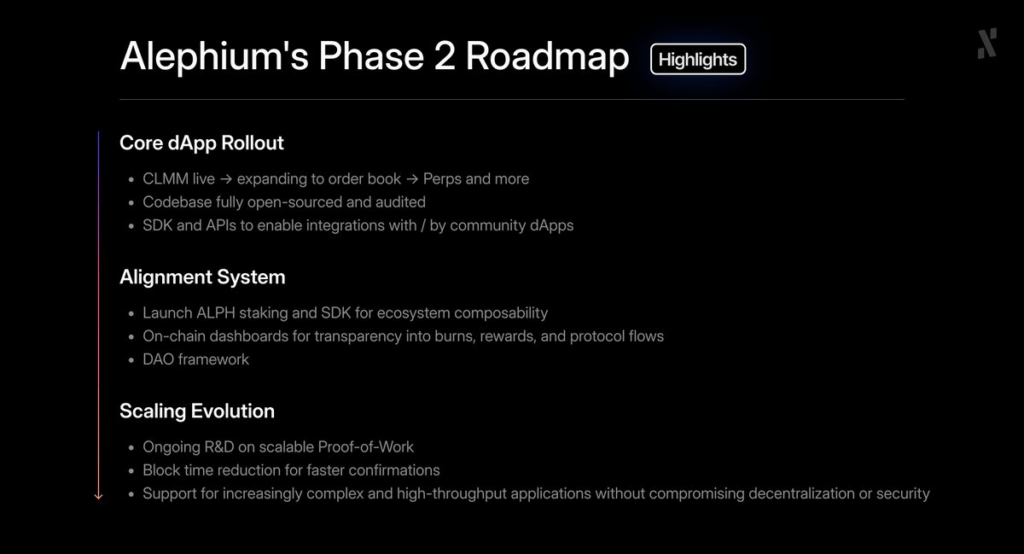
Recognizing the two-sided dynamic, Alephium shared its “Phase 2: Aligned Economics” article on X. Importantly, they’re not abandoning the “neutral host” philosophy of passive blockchains entirely, but instead aim to introduce a new catalyst for ecosystem growth.
The roadmap involves building out an essential “Core dApp” directly, starting with a Concentrated Liquidity Market Maker (CLMM) DEX.
Alephium’s Core dApp will be a protocol-owned, open-source benchmark, that claims to be robust, audited, and institution-ready. It addresses their stated need for “strong guarantees” from large AUM entities head-on, essentially becoming the necessary proof-of-concept.
As a critical piece of the puzzle, this development aims to remove friction for larger players. It also aims to encourage broader ecosystem involvement from DeFi builders, especially those looking to move away from EVM chains and find a new home with better security, developer experience, and longevity.
For a non-EVM chain like Alephium, which doesn’t have the luxury of duplicating existing EVM smart contracts, the outcome of this in-house development will be crucial.
Why “Aligned Economics” Activates a Self-Reinforcing Loop
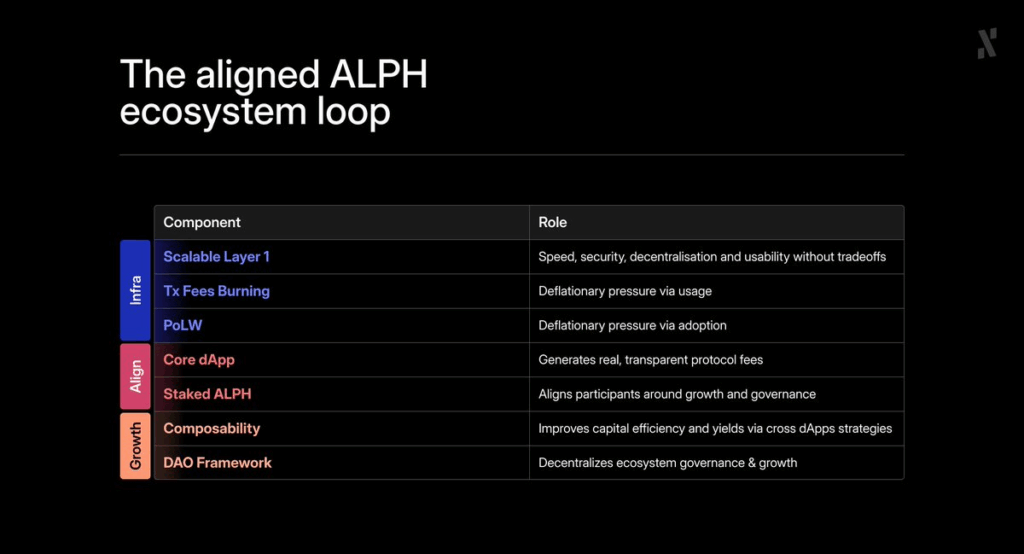
Phase 2 plans for aligned economics, connecting token utility directly to real usage and chain adoption. This is something missing with many inflationary Layer 1 models, which have struggled to make the leap from speculation and governance to tangible value and compounding utility.

“The problem L1s face is that in the past they were all about narrative and infrastructure. Right now, I think it’s more about utility. It’s about how the protocol can generate its own revenue. One of the best examples is Hyperliquid. It’s an L1, but one of the most profitable dApps in the space. That profit goes directly to the protocol to buy back the tokens and spin the flywheel.” – Alephium Founder, Cheng Wang
In addition, staking ALPH for xALPH will give participants access to composable DeFi strategies, more governance rights through DAO frameworks, and other ecosystem perks. As such, $ALPH should progress from a largely passive asset into an active component of Alephium’s yield-generating ecosystem.
The design is a self-reinforcing loop. Usage on the Core dApp will generate fees, while these fees will drive both burns (tightening supply) and rewards for ALPH stakers (incentivizing long-term holding). The L1 believes this will initiate a period of experimentation, adoption, and TVL growth.
“There’s a very big opportunity here that allows us to leverage ALPH as the token for the dApp and therefore bring utility and yield and serve as the cornerstone for the ecosystem to build on. In addition, of course, there’s an opportunity to develop primitives that really leverage Alephium’s unique design, ones that are open source and a great foundation for people to build on… The Core dApp will act as a bootstrap, magnet, and catalyst for the broader Alephium ecosystem, making us a more desirable prospect for users, liquidity providers, and builders, as well as institutions and large AUM entities.”” – Maud Bannwart, Alephium COO
The Perfect Storm of Readiness and Necessity
Firstly, Alephium is ready. It offers battle-tested optimizations for performance, security, and decentralization, with plans for ongoing major network upgrades. Secondly, the market has also matured. Now, Alephium’s Core dApp development reflects these dual realities.
Has Alephium’s moment to leverage its technical superiority for an aligned economic model finally arrived? The key message here appears to be “more utility, less dilution.” This is a practical and pragmatic approach to ecosystem growth and development.
The timing is ideal, as is to be expected of a Swiss blockchain. This is especially true as Circle, Google, and Stripe have all recently announced they are building L1s. We may well be entering “L1 Season” and the start of a new market trend. If that’s the case, Alephium is already one step ahead.

Twitter: https://twitter.com/alephium
Website: www.alephium.org
Telegram: https://t.me/alephiumgroup
Discord: https://discord.gg/XC5JaaDT7z
Docs: https://docs.alephium.org/
Wallets: https://alephium.org/#wallets

Blockchain
5 Reasons Why Delta Exchange is the Easiest Platform for Crypto Trading Strategies in the Indian Market

Crypto trading in India has grown exponentially in the last few years. In 2025, the market pulled in $258 million in revenue and is on track to hit nearly $732 million by 2033, growing at a 14.3% CAGR from 2026 onwards. That kind of money doesn’t come from people buying Bitcoin on a whim and hoping for a lucky spike. It comes from traders who plan entries, manage exits, build hedges, and run full-blown crypto trading setups.
This shift has created a new problem. Most Indian crypto exchange apps still feel built for basic spot buying without any advanced features to try. You open five tabs, check prices on one app, place orders on another, track risk on a third, and hope nothing slips through.
Delta Exchange transforms the story here. Instead of spots, Delta offers a safe trading platform to explore crypto derivatives (futures and options) across major currencies.
Let’s understand more about Delta Exchange and why so many Indian traders end up sticking with it once they try it.
Why Try Crypto Trading Strategies on Delta Exchange
Ranked among the top Indian crypto exchanges, Delta Exchange offers a range of features and analytics tools to simplify your crypto trading experience.
Here’s why many traders trust Delta Exchange:
- INR trading keeps things simple
If you’ve ever had to convert INR to USDT or USD just to trade Bitcoin, you know the hassle. Delta Exchange lets you deposit and withdraw in INR directly via UPI, IMPS, NEFT, and bank transfer, with your margin and profits shown in INR.
That means no awkward crypto conversions or extra wallets – you fund your account straight from your bank and start crypto trading like it’s normal money.
- Algo trading bots that actually work
Automation can save hours and reduce emotional stress and decisions, especially with fast moves in crypto F&O. Delta Exchange supports algo trading through APIs and bot integrations from platforms like TradingView and Tradetron.
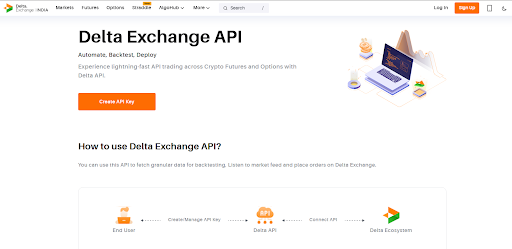
You can link your trading strategy to webhooks or APIs and let bots place trades for Bitcoin futures or other crypto options even when you’re away. If you want systematic, repeatable strategies with fewer missed opportunities, this setup feels practical and real.
And the best part? You don’t need to have any coding knowledge or degree – API Copilot does it all for you.
- Lower trading fees that don’t eat into your wins
Fees matter because every percentage point you pay is one less in your pocket after a winning trade. Delta Exchange offers competitive taker and maker fees, plus a fee cap on options that limits how much you pay on low premium trades.
This helps keep costs predictable, whether you’re trading Bitcoin or ETH futures and options. Traders who place frequent trades or use multi-leg strategies on the Indian crypto exchange can keep more of their gains, rather than having them eaten up by trading fees.
- Strategy Builder for practical trading plans
Strategy planning can get messy if the platform doesn’t help you visualize outcomes. Delta Exchange offers tools that let you craft crypto F&O setups with clear strike choices and expiries, plus daily, weekly, and monthly options for more precise timing. This helps you conveniently plan spreads, straddles, or hedges.
- Compliance and risk measures to know
It’s one thing to trade, another to trust the platform doing it. Delta Exchange is registered with India’s Financial Intelligence Unit (FIU) and follows local KYC and AML rules.
For risk management, the platform supports:
- Margin controls and stop-loss tools that help you manage positions while you trade Bitcoin or other crypto derivatives.
- Demo account to practice trades and understand the market without real money.
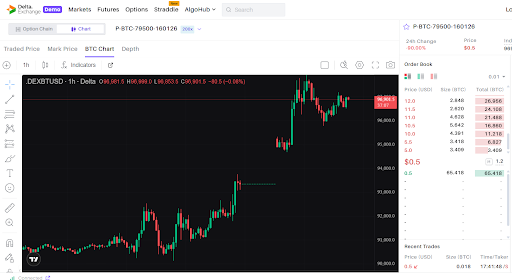
- Payoff charts show you how your trade will play out with breakeven points and maximum P&L.
This way, you can study your crypto trading strategy better before finalizing the trade.
Apart from these, Delta also offers leverage up to 200X – a good way to amplify your profits if the market moves in your favor.
The Bottomline
Indian crypto traders have moved far past the buy-and-hold phase. Spot crypto trading still has its place, yet most active users now want faster ways to make money from price swings, not wait months for a rally.
That’s where crypto F&O, spreads, and short-term setups step in. You want tools that let you react within minutes, control risk, and lock gains when the move shows up.
Platforms that only support basic coin buying just can’t keep up with that style of trading. Serious traders want flexibility, speed, and ways to work with volatility, not sit through it – and Delta Exchange caters to such traders well.
Disclaimer: Crypto trading carries inherent risks due to its high volatility. This article is for informational purposes only. Kindly do your own research before making any investment decisions.
Blockchain
MoonExe Aligns With the Next Phase of Stablecoin Payments as Global Regulation Accelerates
MoonExe today reaffirmed its strategic focus on stablecoin-powered payment infrastructure as global regulatory clarity continues to accelerate across major financial jurisdictions.
Regulators worldwide are advancing frameworks that formally recognize stablecoins as legitimate instruments for payment, settlement, and treasury operations. Legislative initiatives in the United States, expanded licensing regimes in Asia, and structured compliance approaches in other regions are collectively signaling a transition from experimental adoption to regulated, real-world deployment.
As stablecoins move deeper into mainstream financial infrastructure, demand is increasing for platforms capable of delivering real-time liquidity, transparent pricing, and verifiable settlement. MoonExe’s Exchange Finance (ExFi) model is designed to address these needs by enabling stablecoin-based currency conversions that operate continuously, without dependence on traditional banking cut-off times or geographic limitations.
The platform focuses on facilitating efficient value movement while maintaining transparency through public blockchain records. Transactions executed within the MoonExe ecosystem can be independently verified via standard blockchain explorers, reinforcing confidence through auditable, immutable data.
In parallel with regulatory progress, market participants are increasingly prioritizing infrastructure reliability over speculative activity. Stablecoins are being evaluated less as alternative assets and more as operational tools capable of supporting cross-border payments, digital commerce, and treasury flows.
MoonExe continues to expand its infrastructure and partnerships to support this evolution, positioning itself as part of the foundational layer required for stablecoins to function at global scale.
For more information about MoonExe and its stablecoin payment infrastructure, visit https://moonexe.com/
Blockchain
Playmaker to Launch in Q2 2026 as Midas Labs Expands Its AI-Powered Game Creation Ecosystem
Midas Labs, a UK-based Web3 technology company, has announced the upcoming launch of Playmaker, an AI-powered game creation and launchpad platform scheduled for Q2 2026. The platform is designed to lower barriers to game development and funding, operating as a core product within the UNIFI-powered Midas ecosystem.
Playmaker will provide creators, indie studios, and early-stage visionaries with an integrated environment to ideate, build, fund, and publish games without the traditional constraints of large teams or complex technical infrastructure. By combining AI-assisted creation tools with a structured launchpad and marketplace, the platform aims to streamline the path from concept to live product.
According to Jonathan Wheatley, Chief Marketing Officer of Midas Labs, Playmaker represents a natural progression of the company’s ecosystem strategy.
“Playmaker is about enabling participation at every level — from creators and developers to early supporters and players,” said Wheatley. “By integrating AI-driven creation with funding and publishing infrastructure, we’re building a system that allows ideas to move efficiently from concept to execution.”
The platform is powered by the $PLAY token, a fixed-supply utility asset used for project participation, creator payments, marketplace transactions, and ecosystem services. $PLAY operates within the broader UNIFI ecosystem, where UNIFI serves as the access and conversion layer, reinforcing liquidity and alignment across Midas Labs’ products.
Midas Labs has structured Playmaker’s token economy around a non-mintable, scarcity-driven model, designed to support long-term sustainability as platform adoption increases.
The Playmaker launch builds on recent Midas Labs milestones, including the expansion of the Midas Play Marketplace, multiple game releases, ecosystem partnerships, and the rollout of UNIFI staking infrastructure. Together, these components form a vertically integrated environment linking creation, funding, distribution, and participation.
Playmaker is scheduled to go live in Q2 2026, with phased ecosystem access beginning with early contributors before expanding globally.
About Midas Labs
Midas Labs is a United Kingdom–based Web3 technology company focused on building scalable digital ecosystems across gaming, AI, and creator-driven platforms. Powered by the UNIFI token, Midas Labs develops infrastructure designed for long-term participation, real utility, and sustainable growth.

Brazil Eyes $68B Bitcoin Reserve to Boost Economic Sovereignty

PlatON Announced as Secondary Exhibition Sponsor for Hong Kong Web3 Festival 2026

5 Reasons Why Delta Exchange is the Easiest Platform for Crypto Trading Strategies in the Indian Market

TokenPocket Announced as Platinum Sponsor for Hong Kong Web3 Festival 2026

MoonExe Aligns With the Next Phase of Stablecoin Payments as Global Regulation Accelerates

Sui Foundation Announced as Exclusive Dinner Sponsor for Hong Kong Web3 Festival 2026

Cardalonia Aiming To Become The Biggest Metaverse Project On Cardano

P2P2C BREAKTHROUGH CREATES A CONNECTION BETWEEN ETM TOKEN AND THE SUPER PROFITABLE MARKET

WOM Protocol partners with CoinPayments, the world’s largest cryptocurrency payments processor

ETHERSMART DEVELOPER’S VISION MADE FINTECH COMPANY BECOME DUBAI’S TOP DIGITAL BANK

Project Quantum – Decentralised AAA Gaming

WOM Protocol Recommended by Premier Crypto Analyst as only full featured project for August
-
 Crypto4 years ago
Cardalonia Aiming To Become The Biggest Metaverse Project On Cardano
-
 Press Release5 years ago
P2P2C BREAKTHROUGH CREATES A CONNECTION BETWEEN ETM TOKEN AND THE SUPER PROFITABLE MARKET
-
 Blockchain5 years ago
WOM Protocol partners with CoinPayments, the world’s largest cryptocurrency payments processor
-
 Press Release5 years ago
ETHERSMART DEVELOPER’S VISION MADE FINTECH COMPANY BECOME DUBAI’S TOP DIGITAL BANK
-
 Press Release5 years ago
Project Quantum – Decentralised AAA Gaming
-
 Blockchain5 years ago
WOM Protocol Recommended by Premier Crypto Analyst as only full featured project for August
-
 Press Release5 years ago
ETHERSMART DEVELOPER’S VISION MADE FINTECH COMPANY BECOME DUBAI’S TOP DIGITAL BANK
-
 Blockchain6 years ago
1.5 Times More Bitcoin is purchased by Grayscale Than Daily Mined Coins