
Press Release
Shibnobi Strengthens Itself – Announces Buyback and New Software Services

As the ecosystem that Shibnobi is creating grows and gains traction, the challenges that this brings are increasing as well. The team, led by Cliff is pleased to make the following announcement to tackle these challenges and to set new standards:
Buyback and Burn
Within the DeFi world, token liquidity – which is what DEXs use to enable trading of tokens, have pools which are represented as a 50/50 split between the token itself and its pegged counterpart. I.e.: SHINJA is pegged to ETH.
The Shibnobi team intends to withdraw $4.2M ($2.1M in ETH, $2.1M in SHINJA) from the liquidity pool and subsequently perform a $2.1M ETH buyback over the next three weeks ($700K each week).
At the end of the three weeks, Shibnobi would then burn all these purchased tokens. As liquidity continues to grow, the team will continue to implement this type of buybacks to reduce supply, increase price, and stabilize the liquidity pool.
Missing Tokens Resolved
Shibnobi is also pleased to inform the investing public that the issue of missing tokens that occurred a few days after the buyback has been resolved. It was reported in the community that some tokens were missing in every wallet. Cliff and his team swung into action, identified the cause of the incident, and aimed to resolve the issue as quickly as possible.
The team assured all community members that they won’t lose any dollar value in their tokens: the percentage of the supply, market cap, and holder positions remain the same after the incident. To build trust and investors’ confidence, the team has increased reflection tax to 8% from 6% and conduct the remaining $1.4M buyback in small increments over a few days rather than $700K each week.
Shibnobi Software
Shibnobi introduces Shibnobi Software, a new division that will offer different software services, including auditing, consulting, and software development. The new service will help promote other projects at a cost that will be paid in $SHINJA.
Shibnobi Dojoswap
Shibnobi’s Dojoswap is a multi-chain swap platform designed to resolve the lack of user-friendly tools for Ethereum Virtual Machine compatible chains. It was developed by the Shibnobi team on a decentralized automated market maker protocol and uses liquidity pools that guarantee smooth blockchain transactions.
Dojoswap is compatible with popular blockchains like Ethereum, Polygon and Binance Smart Chain, but plans to expand this to additional EVM-compatible chains over the short to mid-term.
Dojoswap only permits the listing of tokens or projects on its protocol that have undergone a precheck, as well as KYC verification by Certik. Visit the official website and click on the apply button to begin listing your project.
DojoSwap Weekly Listing Report
Here is a weekly recap of the DojoSwap listing.
Wolverinu: An ERC-20 token that entered into crypto space in October 2021. This project has broken several records with over 14,000 holders in a short amount of time.
Grifters: Another innovative project whose team is working round the clock to promote, where it is based on the concept and belief that all innovative concepts, projects, and missions deserve a chance to thrive. The coins are imagined reality.
Piccolo Inu: A decentralized multi-purpose token that gives holders the leverage to mint custom NFT masterpieces. Holders can buy, sell, or trade NFTs for profits.
Lucky Shinu: A blockchain-powered gaming project, promising to hold contests for users with prizes such as cars, money, gadgets, vacations, and NFTs.
Streamer Inu: A community-based token that gives holders the opportunity to be a shareholder of the Streamers United LLC shares.
About Shibnobi
Shibnobi was launched in November 2021 by a team of experienced blockchain experts led by Cliff. Shibnobi is the world’s most deadly Shiba. It aims to refine the decentralized finance space and create different streams of passive income through a reflection mechanism for users and community members. Its native token, $Shinja, is deflationary and built on Kusari Blockchain.
The token operates through the POS consensus. $Shinja has been listed on different exchanges, including Uniswap, BitMart, Fegex, Lbank, HotBit, and ProBit.
Website: https://shibnobi.com/
Socials
Twitter: https://twitter.com/Shib_nobi
Telegram: https://t.me/ShibnobiCommunity
Facebook: https://www.facebook.com/Shibnobi
Instagram: https://www.instagram.com/shibnobi/
Reddit: https://www.reddit.com/r/Shibnobi/
Discord: https://discord.com/invite/Shibnobi
YouTube: https://www.youtube.com/shibnobi

Press Release
ChainUp Brings The Institutional Ark to TOKEN2049 Singapore, Focusing on Digital Asset Infrastructure and High-Value Deal Flow
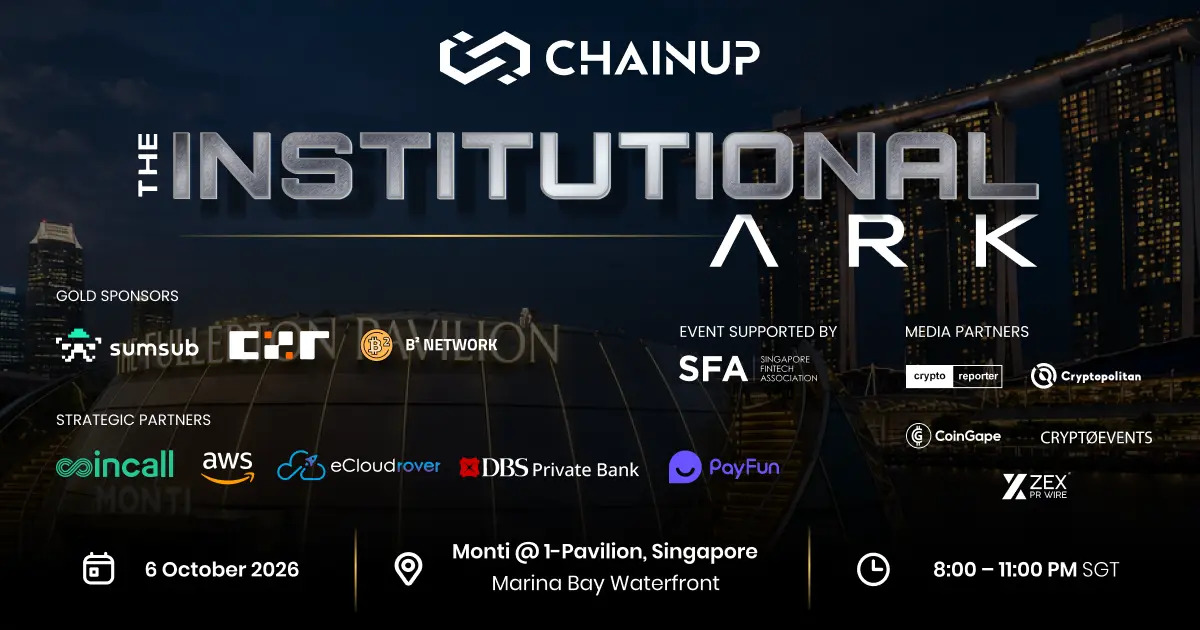
Singapore, Sep 17, 2026 — ChainUp announces the return of its flagship pre-TOKEN2049 event, focusing on institutional infrastructure, enterprise scale, and direct dealmaking.
- ChainUp‘s exclusive pre-TOKEN2049 event, The Institutional Ark, returns on October 6, 2026, at Monti at 1-Pavilion for C-suite leaders, capital allocators, and fintech builders.
- Backed by award-winning event execution recognized at the Marketing Events Awards, the evening provides a closed-door, high-signal setting away from conference hall noise.
- Designed for direct commercial outcomes, the gathering connects institutional peers over drinks, canapés, and panoramic Marina Bay views.
As institutional crypto shifts from hype to execution, ChainUp’s exclusive pre-TOKEN2049 gathering, The Institutional Ark, returns on October 6, 2026, at Monti at 1-Pavilion.
Bypassing public panels for a closed-door, high-signal setting, this invite-only evening brings together a handpicked room of senior executives, capital allocators, and infrastructure builders for real deal flow, drinks, canapés, and panoramic Marina Bay views
Addressing the Digital Asset Infrastructure Gap
Amid surging demand for compliant, scalable digital asset architecture, ChainUp highlights its core enterprise blockchain solutions:
- Scalable Trading Infrastructure: High-performance matching engines and unified liquidity management for high-throughput institutional trading.
- Institutional Custody: Advanced Multi-Party Computation (MPC) and Hardware Security Module (HSM) frameworks to secure large-scale asset management.
- Automated Compliance Suites: Real-time KYC and AML transaction monitoring built for tightening global crypto regulations.
- Real-World Asset Tokenization Architecture: Secure enterprise platforms facilitating the full lifecycle of real-world asset tokenization.
The Institutional Ark (Pre-TOKEN2049 Executive Networking Party)
- Date/Time: October 6, 2026 | 8:00 PM – 11:00 PM SGT
- Venue: Monti at 1-Pavilion, Marina Bay Waterfront, Singapore
- Registration Link: https://luma.com/xn1chytf
Strategic Partnership Opportunities
Limited partnership slots are open for brands looking to connect with global infrastructure buyers and capital allocators. To request the partnership deck or press credentials, contact marketing@chainup.com.
About ChainUp
Founded in 2019 and headquartered in Singapore, ChainUp is the industry’s sole comprehensive provider of compliant digital asset SaaS infrastructure. Serving 700+ enterprise clients globally, ChainUp provides SOC 2-certified turnkey and white-label software for crypto exchanges, stablecoin payment systems, tokenization exchanges, prediction markets, and institutional MPC custody. Learn more at www.chainup.com.
For media queries, please contact:
Yeo Xue Zhen
Senior Marketing Manager, ChainUp
xuezhen@chainup.com
+65 9325 6483
Blockchain
Orochi Network (ON) Builds the Verifiable Data Layer for Web3 as zkPass Partnership and 49-Chain Expansion Signal Growing Infrastructure Reach


Orochi Network has been doing one of the harder things in crypto: building serious cryptographic infrastructure and waiting for the market to care. The wait is beginning to pay off. ON is currently trading around $0.119, up 96.24% from its all-time low of $0.06074 reached on February 10, 2026, with a market cap of approximately $17.2 million and a 24-hour trading volume of $6.7 million. The token sits 72.6% below its all-time high of $0.416 from October 2025 — but the direction of travel over the past five months has been consistently upward from the February floor.
Orochi Network operates as a blockchain-agnostic and proof-system-agnostic Verifiable Data Infrastructure, using three core cryptographic primitives — Zero-Knowledge Proofs, Fully Homomorphic Encryption, and Trusted Execution Environments — to make data operations trustless, provable, and private. That three-layer cryptographic stack is what separates Orochi from single-mechanism privacy protocols — it doesn’t bet on one cryptographic approach, it deploys all three depending on what each specific use case requires.
The Product Suite That’s Already Running
Orochi’s flagship product, zkDatabase, is the world’s first provable NoSQL database. Every data query generates a Zero-Knowledge Proof automatically, enabling auditors, regulators, and smart contracts to verify data correctness without ever accessing sensitive content. For enterprise and institutional use cases — financial compliance, healthcare data, government records — the ability to prove data integrity without revealing the underlying data is the precise capability that has prevented blockchain adoption in regulated industries. zkDatabase solves that at the infrastructure level.
Orand provides a Verifiable Random Function for trustless randomness, while Orocle delivers verifiable oracle feeds without relying on trusted nodes. The oracle market is dominated by Chainlink, but Orochi’s verifiable oracle approach — where every feed is accompanied by a cryptographic proof of origin rather than relying on a reputation-based trusted node network — offers a technically differentiated alternative that’s gaining traction in ZK-native ecosystems where proof composability matters.
Orand and Orocle services are integrated across 49-plus blockchains, while zkDatabase has been adopted by 20-plus blockchains. Cross-chain infrastructure that runs on 49 networks without being tied to any single chain’s success or failure is a meaningful structural advantage — especially as the multi-chain landscape continues to fragment.
The zkPass Partnership and Verifiable Identity
The collaboration with zkPass — building a new foundation for verifiable, privacy-protected data in Web3 — is among the more strategically aligned partnerships in Orochi’s ecosystem. zkPass handles identity verification through zero-knowledge proofs, allowing users to prove attributes about themselves without revealing underlying credentials. Orochi’s verifiable data infrastructure is the natural complement — once identity is verified, every subsequent data interaction that user has on-chain can be provably correct through Orochi’s zkDatabase layer.
That combination of verifiable identity and verifiable data integrity represents the foundational stack that regulated Web3 applications — particularly in RWA tokenization, DeFi compliance, and institutional finance — have been waiting for.
Backed by over $20 million in funding from the Ethereum Foundation, Mina Protocol, Web3 Foundation, and BNB Chain alongside leading venture capital firms, Orochi has grown to support 145-plus partners with more than 160 million transactions processed to date. Grants from protocol foundations rather than purely venture capital is a meaningful signal — it indicates that other blockchain ecosystems view Orochi’s infrastructure as genuinely valuable to their own development rather than simply making a financial bet.
The Supply Structure Worth Understanding
Only 14.4% of the 1 billion maximum ON supply is currently circulating — 144.28 million tokens — with a fully diluted valuation of approximately $81.3 million against the current $17.2 million market cap. With 85.6% of total supply still locked, ON is operating in a very early distribution phase. The gap between FDV and market cap implies either that the market believes the supply will create significant dilution pressure as it unlocks, or that adoption hasn’t yet reached the scale needed to justify the full supply value.
The Binance Alpha and Binance Alpha Airdrops tags on CoinMarketCap reflect a listing pathway that has brought broader retail attention to ON beyond its core technical audience. A trading call citing 25x leverage entry zones on KCEX reflects the speculative layer that sits above the infrastructure fundamentals — ON attracts both audiences simultaneously, which amplifies volatility in both directions.
Orochi’s 2026 goal is to solidify its position as the foundational verifiable data layer for Web3 and institutional finance, scaling zkDatabase, zkDA Layer, Orocle, and Orand modules across global markets to enable secure, auditable data infrastructure for RWA, stablecoins, AI, DeFi, and more. That ambition is coherent and directionally aligned with where institutional Web3 capital is flowing. A $17 million market cap for infrastructure already running on 49 chains with Ethereum Foundation backing is either a significant market oversight or a fair reflection of how early the verifiable data layer category still is.
Blockchain
Mira Network (MIRA) Searches for a Floor as AI Verification Infrastructure Battles Relentless Supply Pressure

Mira Network launched on September 26, 2025, with a genuinely differentiated mission — building a decentralized verification layer for AI outputs, solving the hallucination and reliability problem that prevents truly autonomous AI deployment at scale. MIRA’s debut proved well received, starting at $1.25 before quickly doubling to around $1.40. Ten months later, the token is trading around $0.039 — down 97% from its launch price — with a market cap of approximately $7.53 million against a total supply of 1 billion tokens.
MIRA traded down 4% in the most recent 24-hour period with approximately $4.03 million in 24-hour volume — a volume-to-market-cap ratio that reflects still-active trading despite the dramatic price decline. The July 4 surge of 31.2% in a single day on $58 million volume showed the token retains the capacity for sharp moves when sentiment shifts — volume that day was five times the market cap, reflecting intense speculative activity on a thin float.
What Mira Network Actually Solves
Current AI systems produce hallucinations and unreliable outputs, requiring constant human oversight that prevents their deployment as truly autonomous agents. Mira’s verification layer addresses this at the infrastructure level — providing cryptographic verification of AI-generated outputs that allows applications to trust AI results without requiring a human to double-check every response.
The practical implication is significant. Every AI agent deployment in DeFi, enterprise workflows, or autonomous systems today requires a trust assumption about the AI’s output accuracy. Mira’s network creates a decentralized verification mechanism where multiple nodes independently validate AI outputs, enabling applications to deploy AI agents with mathematical confidence in their reliability rather than probabilistic hope.
The platform also allows apps built on its infrastructure to issue their own tokens, using MIRA to unify and convert liquidity — a tokenomics design that creates ecosystem demand for MIRA as the base liquidity layer for all applications built on the network.
The Backing That Validates the Thesis
Prior to launch, Mira Network raised about $10 million. Early angel investors included Balaji Srinivasan, Sandeep Nailwal, and Alex Svanevik, later joined by Framework Ventures, Bitkraft Ventures, and others. That investor roster is notable — Balaji Srinivasan and Sandeep Nailwal are two of the most respected technical investors in the crypto space, and Framework Ventures has a track record of backing protocols that achieve genuine adoption rather than pure speculation.
The Kaito AI Season 2 community campaign distributing $600,000 in MIRA tokens for completing tasks reflects the team’s continued investment in community building — though as CoinMarketCap’s analysis notes, the campaign introduces additional sellable tokens into a market where demand is already weak, making it a short-term supply headwind even as a long-term community growth initiative.
The Supply Structure Governing Everything
The tokenomics model includes a total supply of 1 billion tokens, with more than 191 million currently in circulation. Over the coming years, vested tokens held by early investors, the team, contributors, node operators, and others will gradually be released. Meanwhile, more than 40% of tokens are reserved by the DAO for ecosystem development, partner incentives, governance initiatives, and research efforts.
With only 19% to 28% of tokens currently circulating depending on the data source, MIRA faces one of the most challenging supply dynamics in the AI infrastructure category. Recurring monthly unlocks landing into a market with $4 million in daily volume creates structural downward pressure that product development alone struggles to offset at this stage.
MIRA formed a technical double bottom at $0.041 at the end of June, with trading volume increasing significantly and bullish momentum strengthening. That technical structure was the foundation for the July 4 surge before giving back gains in subsequent sessions. The Nigeria ecosystem expansion and enhanced developer SDK planned for 2026 represent the geographic and technical growth levers the team is pulling to drive organic demand — but adoption in emerging markets moves at a different pace than the unlock schedule.
The AI verification infrastructure thesis that Mira is built on is arguably more relevant in July 2026 than it was at the September 2025 launch — autonomous AI agents are now a mainstream topic rather than a niche discussion. Whether MIRA can attract enough developer adoption to generate genuine network activity before the remaining 80% of supply enters circulation is the question that will define the protocol’s trajectory through the rest of the year.

ChainUp Brings The Institutional Ark to TOKEN2049 Singapore, Focusing on Digital Asset Infrastructure and High-Value Deal Flow

NEAR AI Cloud API Adds OpenAI Compatibility and Tiered Privacy

Aptos research on quantum-resistant BFT consensus accepted to IEEE S&P ’27

NEAR AI says confidential inference is expanding across its cloud stack

Noos sets September 5 mainnet launch as it moves AI agent infrastructure on-chain

Algorand launches AC2 to let AI agents request user approvals without exposing private keys

Cardalonia Aiming To Become The Biggest Metaverse Project On Cardano

P2P2C BREAKTHROUGH CREATES A CONNECTION BETWEEN ETM TOKEN AND THE SUPER PROFITABLE MARKET

WOM Protocol partners with CoinPayments, the world’s largest cryptocurrency payments processor

ETHERSMART DEVELOPER’S VISION MADE FINTECH COMPANY BECOME DUBAI’S TOP DIGITAL BANK

Project Quantum – Decentralised AAA Gaming

WOM Protocol Recommended by Premier Crypto Analyst as only full featured project for August
-
 Crypto4 years ago
Cardalonia Aiming To Become The Biggest Metaverse Project On Cardano
-
 Press Release6 years ago
P2P2C BREAKTHROUGH CREATES A CONNECTION BETWEEN ETM TOKEN AND THE SUPER PROFITABLE MARKET
-
 Blockchain6 years ago
WOM Protocol partners with CoinPayments, the world’s largest cryptocurrency payments processor
-
 Press Release6 years ago
ETHERSMART DEVELOPER’S VISION MADE FINTECH COMPANY BECOME DUBAI’S TOP DIGITAL BANK
-
 Press Release5 years ago
Project Quantum – Decentralised AAA Gaming
-
 Blockchain6 years ago
WOM Protocol Recommended by Premier Crypto Analyst as only full featured project for August
-
 Press Release6 years ago
ETHERSMART DEVELOPER’S VISION MADE FINTECH COMPANY BECOME DUBAI’S TOP DIGITAL BANK
-
 Blockchain6 years ago
1.5 Times More Bitcoin is purchased by Grayscale Than Daily Mined Coins