
Press Release
Introducing YoCoin: The Safest Long-term Crypto Investment Opportunity in DeFi

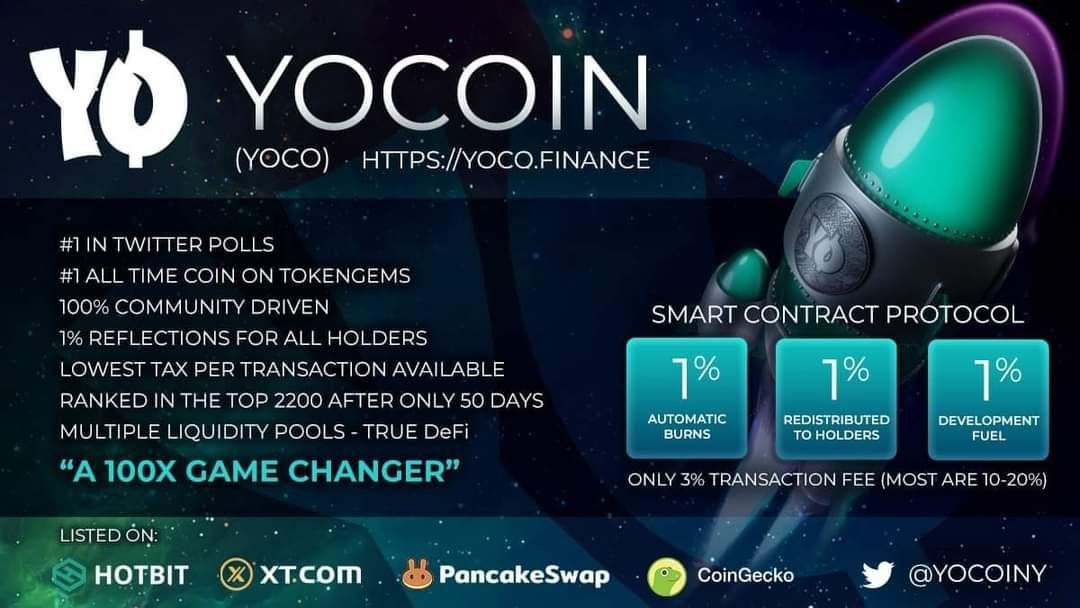
YoCoin (YOCO) isn’t your average altcoin! The new entrant to the crypto market is a 100% community-driven cryptocurrency that offers DeFi investors the most secure long-term investment opportunity in the sector.
YOCO is listed and available to buy on Pancakeswap, the top DEX on Binance Smart Chain. The fair launch cryptocurrency is also available on Hotbit and XT exchange.
YOCO is the native token of yoco.finance, a safe, eco-friendly crypto project introducing ultra-fast global payments. One of the distinct features that makes YoCoin stand out is its low trading fees that allow users to trade into and out of the ecosystem with 3% trading fees. In comparison, most rivals have hidden trading fees of 10-20% that they charge without informing users.
YoCoin is built for success and engineered to generate its own interest from these ultra-low fees to guarantee users automatic rewards for life. The project is backed by a diverse, forward-thinking team from across the globe.
The team has future-proofed the project for industry-leading security and as it works toward delivering the safest long-term store of value in DeFi. The project backers are currently developing some exciting new features to the ecosystem, including the YoWallet and an NTF platform. The upcoming NFT marketplace already offers exclusive digital artwork that users can hold, collect and trade within the network.
Plans are also underway to build YoCoin dApps, YoSwap, YoCard Visa, and the project’s own DEX dubbed YoEx.
YoCoin’s Dynamic Liquidity Pools and Robust Tokenomics
YoCoin is building an unstoppable YocoArmy that will serve as the cornerstone of the project’s future success. Users are guaranteed automatic and instant income simply for holding YOCO, with no staking required to earn protocol static rewards.
The revolutionary DeFi project charges a 3% fee on all transactions, which is transparently disbursed amongst the HODL community. Therefore, investors are guaranteed higher returns the more the network grows and attracts more active users. A further 1% goes directly to the developers’ wallet to finance project growth, development, and advertising.
As DeFi participants inject more capital in YoCoin, the protocol’s liquidity pools will expand, creating a solid price floor. Users can currently access liquidity from 22+ pools.
The project is creating a genuinely dynamic DeFi liquidity pool that cushions holders from price volatility if some early investors sell off their holdings.
To further bolster price stability and reward diamond hands for trusting in the project for the long haul, YoCoin implements automatic 1% burns on all YOCO transactions starting with the 100M total supply. The burn mechanism model makes each token deflationary and more valuable over time.
Join the YocoArmy Today!
YoCoin boasts the best Discord community, where members from across the world can hold discussions and share ideas about the protocol’s future.
The YoCoin team nurtures an environment of ingenuity and growth by allowing members to create remarkable content in the media of their choice. So far, the community of talented and creative members have come up with hundreds of unique expressions that raise awareness about the YoCoin project to the wider DeFi sphere.
The team also regularly organizes Trading Competitions, Airdrops Contests and other exciting events to encourage community participation and reward members. These efforts have resulted in a rapidly growing community of 5,000+ Holders in a relatively short time.
For DeFi investors interested in joining this vibrant community, now is the time to jump on the YoCoin train and accumulate coins on the cheap. Per the latest data from crypto ranking website coingecko, YOCO is trading for $0.02584458, giving early investors the perfect opportunity to buy the dip before the digital asset sets off for the moon.
The native coin recently surpassed a market cap of $2.79M and has a circulating supply of over 96M. So far, 3.47M+ YOCO have been burnt, meaning they have been permanently removed from the circulating supply.


SINGAPORE, November 16, 2026, DBS Bank and JPMorgan’s blockchain business, Kinexys, have launched a system that allows institutional clients to transfer tokenised US dollar deposits between blockchain-based banking networks in Singapore and the United States around the clock.
The service connects DBS Token Services with Kinexys’ permissioned blockchain deposit network. Ant International is the first client to use the arrangement, applying it to treasury and liquidity management across its operations in both markets.
Background
Traditional international bank transfers often depend on operating hours, intermediary institutions and settlement processes that can delay access to funds. These limitations can be particularly challenging for companies with operations across several time zones.
Tokenised deposits are digital representations of money held in conventional bank accounts. They allow banks to record and transfer deposit value using blockchain infrastructure while retaining the underlying relationship with the regulated banking institution.
They should not be confused with privately issued cryptocurrencies or public stablecoins. The funds involved in this service remain bank deposits, represented through digital tokens on networks accessible to approved participants.
Key Developments
The new service enables participating institutional clients to move US dollar liquidity between DBS and Kinexys blockchain accounts outside conventional banking hours, including weekends.
The system uses Partior for settlement orchestration. It also builds on an interoperability framework announced by DBS and JPMorgan in November 2025, which was designed to connect their respective tokenised deposit ecosystems.
Ant International is the first client to adopt the service. The company will use it to manage liquidity and treasury requirements across its entities in Singapore and the United States.
The banks say the development addresses growing demand for cross-border payments in Asia. Their announcement cites projections that outbound cross-border payments in the region could reach $24 trillion by 2033, compared with $13.5 trillion in 2025.
There is an important operating limitation. Transfers within the Kinexys blockchain deposit network are available around the clock, but moving funds between traditional demand deposit accounts and blockchain deposit accounts still has a three-hour weekend downtime, from 3 p.m. to 6 p.m. Eastern Time on Saturdays.
Industry Implications
The launch gives businesses another option for managing liquidity across international operations. Companies that need to settle payments outside normal banking hours may benefit from having access to funds through connected digital deposit networks.
For the wider financial sector, interoperability is a key issue. Individual banks can develop their own tokenised money systems, but their usefulness is limited if those networks cannot communicate with one another.
The DBS and JPMorgan arrangement is an example of two established financial institutions connecting separate permissioned blockchain systems for a commercial use case. It also demonstrates that blockchain adoption in banking is not limited to cryptocurrency trading.
What’s Next
The service is commercially available to eligible institutional clients, with Ant International acting as its first user. DBS and Kinexys have also indicated that improvements to the weekend connection between traditional accounts and blockchain deposit accounts are under development.
Further adoption by corporate clients will help show whether the system can support wider cross-border treasury operations.
Press Release
Brazil Central Bank Warns Certain Stablecoin Transfers Could Create Money Laundering Risks


BRASILIA, Brazil, November 16, 2026, A senior official at Brazil’s central bank has warned that certain stablecoin-based international payment arrangements could expose financial institutions to money laundering risks, even when the funds involved originally come from legitimate sources.
Gerson Romantini, head of the central bank’s foreign exchange department, raised the issue at a private industry event. His remarks focused on how money is converted into stablecoins, transferred overseas and exchanged into another currency. The comments have renewed attention on Brazil’s rules for cryptocurrency-related foreign exchange services and the responsibilities of fintech companies operating in the payments market.
Background
Stablecoins are widely used for cryptocurrency trading, international transfers and digital payments because their value is generally linked to currencies such as the US dollar or euro.
In Brazil, regulators have been examining how these assets interact with conventional foreign exchange services. The central bank is particularly concerned about arrangements that allow money to move between countries through multiple conversion stages without following the controls normally associated with regulated currency transactions.
Resolution BCB No. 561, which took effect on October 1, 2026, introduced restrictions affecting the use of virtual assets in certain settlements between regulated electronic foreign exchange providers and their overseas counterparties. It did not create a blanket prohibition on all cryptocurrency transfers.
Key Developments
Romantini discussed a structure described as a stablecoin sandwich. In this arrangement, a company receives Brazilian reais, converts the funds into a dollar or euro-backed stablecoin, transfers the tokens overseas and converts them into local currency for the recipient.
The central bank distinguishes between different ways this structure can operate. A regulated financial institution may use virtual assets as part of the infrastructure supporting a conventional foreign exchange transaction. However, the regulator considers a different arrangement problematic when a company directly sells stablecoins to customers as part of a structured service designed to move reais into foreign currency through an overseas conversion.
This distinction is important because the central bank’s concerns relate to the structure and ownership of the transaction, not simply the use of stablecoins.
The reporting also points to additional compliance requirements. Covered institutions must report qualifying self-custody transfers of at least $10,000 to Brazil’s financial intelligence authority, Coaf, under the rules that took effect in October.
Industry Implications
The comments could affect payment providers and fintech companies that use stablecoins for international transfers. Businesses may need to review how they receive customer funds, convert currencies and transfer digital assets between jurisdictions.
For users, tighter oversight could influence which services remain available and how quickly cross-border payments can be processed. For the wider cryptocurrency industry, Brazil’s approach illustrates the difficulty regulators face in distinguishing legitimate blockchain-based payment infrastructure from arrangements that may bypass established foreign exchange controls.
Importantly, the central bank has not announced a general ban on stablecoins. The current distinction between permitted and restricted transaction structures remains central to understanding the policy.
What’s Next
An industry source cited in the reporting indicated that a meeting expected on November 19 could bring further discussion of restrictions affecting fintech stablecoin services. The possibility of reserving certain activities for banks has been raised, but no formal decision has been confirmed.
Market participants will also watch for further guidance from the central bank on how the existing rules apply to international transfers and digital asset intermediaries.

TOKYO, Japan, November 16, 2026, Japan’s three largest banking groups are preparing to begin commercial transactions using a yen-pegged stablecoin by March 2027, according to comments from Sumitomo Mitsui Banking Corporation (SMBC) executive Tomoya Hasebe at a financial industry roundtable in Singapore on November 16.
The initiative involves SMBC, Mitsubishi UFJ Financial Group (MUFG) and Mizuho Financial Group. The banks are working towards a shared digital currency arrangement designed primarily for corporate payments, cross-border trade settlement and transfers between multinational companies.
Background
Stablecoins are digital tokens designed to maintain a relatively stable value by referencing a traditional currency or another asset. Yen-backed stablecoins are intended to represent the value of the Japanese currency on blockchain networks, allowing businesses to use digital infrastructure for transfers and settlement.
Japan has been developing its regulatory approach to digital assets and payment services, with the Financial Services Agency playing a role in the country’s stablecoin framework. The participation of major banking groups reflects an effort to bring digital currency services into established financial structures rather than relying exclusively on cryptocurrency-native issuers.
The three banking groups have been working together on the operational and governance arrangements required for the proposed token.
Key Developments
The banks established a joint issuance governance committee in June 2026 and completed a proof of concept in July. The testing covered the main stages of the stablecoin process, including issuance, transfers and redemption under Japan’s Payment Services Act.
The planned token is designed to maintain a value of one yen per unit. Its backing is expected to be held in a trust structure legally separated from the banks’ own corporate assets. This arrangement is intended to distinguish the reserves supporting the token from the banks’ proprietary funds.
The primary use case is business payments rather than everyday retail cryptocurrency trading. Companies operating across different countries could use the system to move funds between subsidiaries, settle trade obligations and manage internal liquidity.
At the November 16 roundtable, SMBC’s Tomoya Hasebe described competition between currencies as increasingly connected to software and digital infrastructure. His comments reflect the banks’ interest in the role that programmable financial systems could play in future payment services.
Industry Implications
The involvement of Japan’s three largest banking groups could give yen-denominated digital payments a stronger institutional foundation. It also creates a potential alternative to relying entirely on dollar-linked stablecoins for certain international business transactions.
For Japanese companies, a regulated yen stablecoin could offer another way to manage payments across borders and time zones. However, its usefulness will depend on the number of participating businesses, the systems that support transfers and the ease with which tokens can be converted back into conventional money.
The initiative also places Japan within a wider competition among financial institutions and payment providers developing tokenised money services.
What’s Next
The banks are targeting commercial use by March 2027, the end of Japan’s fiscal year. The remaining work includes preparing the issuance and operating framework and ensuring that the system meets applicable legal and regulatory requirements.
Further information about the token’s distribution, participating companies and commercial operating arrangements will help establish how widely it can be used.

DBS and JPMorgan Connect Blockchain Deposit Networks for 24/7 US Dollar Transfers

Brazil Central Bank Warns Certain Stablecoin Transfers Could Create Money Laundering Risks

Japan’s Three Largest Banks Target Yen Stablecoin Transactions by March 2027

Germany Advances Bill Allowing Authorities to Seize Crypto Assets of Unclear Origin

Bittensor introduces Gamma Tokens as payment layer

io.net highlights idle GPU supply as AI compute demand grows

Cardalonia Aiming To Become The Biggest Metaverse Project On Cardano

P2P2C BREAKTHROUGH CREATES A CONNECTION BETWEEN ETM TOKEN AND THE SUPER PROFITABLE MARKET

WOM Protocol partners with CoinPayments, the world’s largest cryptocurrency payments processor

ETHERSMART DEVELOPER’S VISION MADE FINTECH COMPANY BECOME DUBAI’S TOP DIGITAL BANK

Project Quantum – Decentralised AAA Gaming

WOM Protocol Recommended by Premier Crypto Analyst as only full featured project for August
-
 Crypto4 years ago
Cardalonia Aiming To Become The Biggest Metaverse Project On Cardano
-
 Press Release6 years ago
P2P2C BREAKTHROUGH CREATES A CONNECTION BETWEEN ETM TOKEN AND THE SUPER PROFITABLE MARKET
-
 Blockchain6 years ago
WOM Protocol partners with CoinPayments, the world’s largest cryptocurrency payments processor
-
 Press Release6 years ago
ETHERSMART DEVELOPER’S VISION MADE FINTECH COMPANY BECOME DUBAI’S TOP DIGITAL BANK
-
 Press Release5 years ago
Project Quantum – Decentralised AAA Gaming
-
 Blockchain6 years ago
WOM Protocol Recommended by Premier Crypto Analyst as only full featured project for August
-

 Press Release6 years ago
ETHERSMART DEVELOPER’S VISION MADE FINTECH COMPANY BECOME DUBAI’S TOP DIGITAL BANK
-
 Blockchain6 years ago
1.5 Times More Bitcoin is purchased by Grayscale Than Daily Mined Coins