
Press Release
10X in 24 Hours, How BT.Finance Brings the Best and Sustainable Yield for Tokens


The crypto market has been extremely hot recently, especially the price of DeFi tokens have been pumping every day. Did you also get a good harvest?
In the past few days, $BT token has been becoming a new star in DeFi with it’s 10X rising in 24 hours. However many people may not be familiar with it, so what is BT.Finance?
BT.Finance is a smart DeFi yield aggregator based on the ethereum ecosystem, targeting the best and sustainable yield for tokens.
Compared with YFI or many other aggregators, what are the advantages of BT.Finance?
How does it bring the best and sustainable yield for tokens?
Here we can find some hints:
1.Audited by @peckshield.
2.@CoverProtocol Insurance, Insurance fund for users besides audit.
3.Gnosis safe multi-sig governance.
4.Set Timelock.
5.Auto harvest from other excellent DeFi yield aggregators and platforms.
6.Blockchain and securities industry senior experts serve as project consultants and strategists
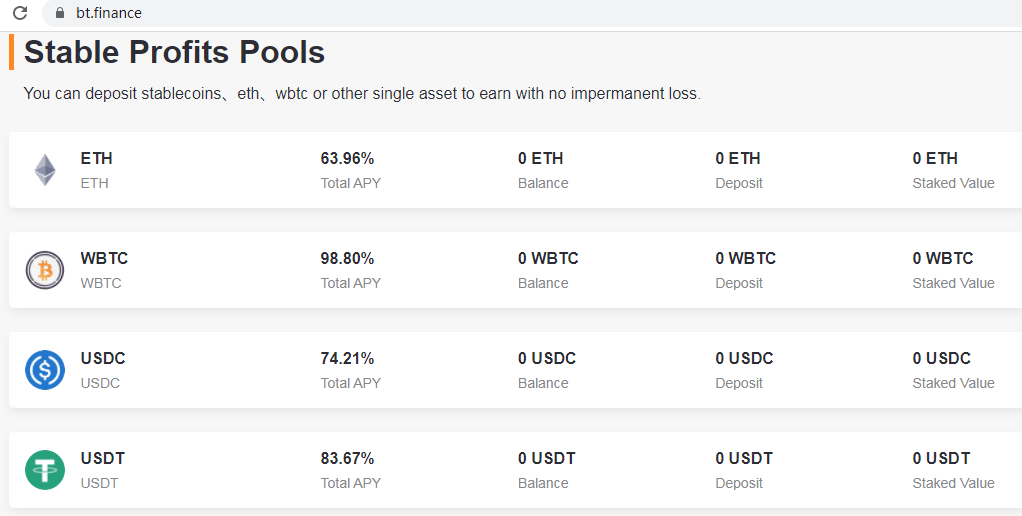
The Vault is divided into 3 pools as Stable Profits Pools, High Yield Pools and Smart Hybrid Pools to all users with various risk tolerances.
The BT Vault v1 is to earn $CRV $Sushi $BAS $MIS $pickle tokens from Pickle.finance. Earn $CRV $1INCH $SUSHI $BADGER $LDO from other Platforms, Meanwhile all yields are long-term and sustainable.
The below is its Stable Profits Pool overview:
What is the economic model of BT tokens?
BT token is the governance token for BT.Finance. 20% of yield farming revenue will be used to buy back $BT.
The max supply of 270,000 BT tokens will be completely distributed with no pre-mining, no pre-sale, and no mint.
- 210,000 Yield Farming
- 40,000 Dev Fund(Simultaneously Releasing with Minning)
- 10,000 Gov Fund ( Security Audit, Insurance Fund, And Others)
- 10,000 Operations

Emission: with a 2.7% reduction from the prior week until week 105. Here we can check the emission table for details.

So now, do you think BT is underestimated?
How to start your earning in BT Finance?
There are 2 types of staking pools you can choose – Stable Profits Pools and High Yield Pools.
Stable Profits Pools

Take USDC for example.
- Choose USDC and choose the amount you want to transfer, and then click the approve button.

- Choose the amount you want to stake and click the Deposit & Stake Button.

- Go through the steps in your wallet
- Staked successfully
- You can find your real-time staking rewards in the dashboard

- You can claim rewards, or you can withdraw your assets anytime, just click the Unstake button.

What about Staking in High Yield Pools?
- First, you need to get your SLP in Sushiswap or Zapper first. Search SUSHI and choose the USDC/ETH, and click Add Liquidity.

- Connect your wallet and then add the amount you wanted in the blank and confirm.

- Farm On BT.Finance. Now back to the BT. Finance, you can check the balance of the USDC-ETH SLP on the homepage.

- Choose your wanted amount to deposit and stake.

- Then you can check your rewards in the dashboard.
Thousands of $BT will be airdropped to its farmers in March!
More info from Click Here
BT Token Contract: 0x76c5449F4950f6338A393F53CdA8b53B0cd3Ca3a
Join: BT.Finance
Twitter: Click Here
Telegram: Click Here
Discord: Click Here

Press Release
Bitcoin Liquidations Reach $146 Million as Whale Transfers Exceed 100,000 BTC in 24 Hours

Global, November 27, 2026, Cryptocurrency derivatives markets recorded approximately $146 million in liquidations over a recent 24-hour period as Bitcoin continued trading through a volatile recovery. At the same time, blockchain monitoring services identified more than 100,000 BTC in whale-sized transaction volume, bringing renewed attention to large-wallet activity and exchange movements.
Blockmetric’s November 27 market snapshot showed approximately $146 million in total liquidations across the markets it tracks. Short positions accounted for around $99 million, while long positions represented approximately $46.9 million. The data covered 43,877 liquidation events during the reported period.
Short Positions Face the Larger Losses
The imbalance between short and long liquidations suggests that traders betting on falling prices experienced greater forced closures during the reporting period.
A liquidation occurs when an exchange automatically closes a leveraged position after its margin becomes insufficient to support the trade. When prices move sharply against leveraged positions, forced closures can add to market activity and increase short-term volatility.
Bitcoin accounted for approximately $49.4 million of the reported liquidations, while Ethereum represented around $31.4 million. Binance recorded the largest exchange-level total in Blockmetric’s snapshot, at approximately $93.6 million.
These figures cover the platforms and positions tracked by the provider. They should not be treated as a complete measurement of every derivatives market.
Large Bitcoin Transfers Draw Attention
Separate monitoring data from Swiss Whale Intelligence recorded 232 Bitcoin transactions involving at least 100 BTC during its reported 24-hour period. The tracker estimated total whale transaction volume at approximately 100,620 BTC, worth around $6.21 billion at the snapshot’s price.
CoinGlass also identified several large transfers on November 27, including movements of approximately 1,000 BTC and 1,015 BTC between wallets that were not publicly attributed to named entities. Another transaction involving approximately 215 BTC was identified as moving into a Coinbase-linked wallet.
These transactions are worth monitoring, but wallet movements do not automatically indicate buying or selling. Large holders may transfer assets between personal wallets, exchange custody systems or institutional storage arrangements.
Why Traders Monitor Liquidations and Whale Activity Together
Liquidation data provides insight into leveraged positioning, while blockchain transfers can help identify changes in how large holders move their assets. Examining both can offer a broader view of market activity than relying on price movements alone.
However, neither metric independently predicts Bitcoin’s next direction.
What to Watch Next
Market participants will be monitoring whether short liquidations continue, whether large exchange-directed transfers increase and whether Bitcoin can maintain its recent recovery. A change in these indicators may provide additional context about market positioning and potential volatility.
Global, November 27, 2026, Cryptocurrency exchange KuCoin is preparing to remove Monero (XMR) from its spot trading platform on November 30, following a decision announced on November 26. The move will affect four XMR trading pairs and several additional services, including automated trading products, flexible savings and loan collateral support.
The exchange attributed the decision to its platform policies but did not provide a more specific explanation in its announcement. The development adds another exchange-access restriction for Monero, a privacy-focused cryptocurrency designed to make transaction details more difficult to trace publicly.
Which Monero Services Will Be Removed?
KuCoin confirmed that the XMR/USDT, XMR/USDC, XMR/ETH and XMR/BTC spot trading pairs will be delisted at 08:00 UTC on November 30.
The exchange has also outlined separate deadlines for other services. XMR deposits have already been suspended and will not resume. KuCoin Earn’s XMR Flexible Savings product is scheduled to be removed at 12:00 UTC on November 27, with users’ principal and accrued earnings transferred automatically to their Funding Accounts.
The exchange’s trading bots supporting XMR will be discontinued at 06:00 UTC on November 30. XMR will also stop being accepted as collateral for KuCoin VIP Loan products from November 30.
Withdrawals are currently scheduled to remain available until 08:00 UTC on December 31, although KuCoin warned that the service could close earlier under certain project-related circumstances.
Monero Faces Another Exchange-Access Challenge
Monero’s privacy features have made it a subject of continuing regulatory and compliance scrutiny. Financial authorities in several jurisdictions have increased their attention to transaction transparency, anti-money-laundering controls and the ability of exchanges to monitor customer activity.
However, KuCoin’s announcement does not identify a specific regulator, legal order or government directive as the reason for this decision. It would therefore be inaccurate to describe the delisting as a government-imposed ban.
The distinction matters because exchange listing policies and statutory restrictions are separate forms of market access control.
What XMR Holders Should Know
Users holding Monero on KuCoin should review the official schedule, cancel relevant orders and assess their withdrawal arrangements before the stated deadlines. They should also check the supported withdrawal network and destination details before transferring funds.
The decision may affect liquidity on a major trading venue, but it does not mean that the Monero network itself is shutting down. The wider impact will depend on how other exchanges and market participants respond.

Sui records 110.5 million weekly transactions as Samsung Wallet integration and Hashi mainnet go live

Bitcoin Liquidations Reach $146 Million as Whale Transfers Exceed 100,000 BTC in 24 Hours

KuCoin to Delist Monero on November 30, Ending XMR Trading Across Four Spot Pairs

KuCoin to Delist Monero on November 30, Ending XMR Trading Across Four Spot Pairs

Bitcoin Reclaims $62,000 as BTC Extends Recovery From November’s Sharp Sell-Off

US Spot Bitcoin ETFs Lose $453 Million as BlackRock’s IBIT Leads November 25 Outflows

Cardalonia Aiming To Become The Biggest Metaverse Project On Cardano

P2P2C BREAKTHROUGH CREATES A CONNECTION BETWEEN ETM TOKEN AND THE SUPER PROFITABLE MARKET

WOM Protocol partners with CoinPayments, the world’s largest cryptocurrency payments processor

ETHERSMART DEVELOPER’S VISION MADE FINTECH COMPANY BECOME DUBAI’S TOP DIGITAL BANK

Project Quantum – Decentralised AAA Gaming

WOM Protocol Recommended by Premier Crypto Analyst as only full featured project for August
-
 Crypto4 years ago
Cardalonia Aiming To Become The Biggest Metaverse Project On Cardano
-
 Press Release6 years ago
P2P2C BREAKTHROUGH CREATES A CONNECTION BETWEEN ETM TOKEN AND THE SUPER PROFITABLE MARKET
-
 Blockchain6 years ago
WOM Protocol partners with CoinPayments, the world’s largest cryptocurrency payments processor
-
 Press Release6 years ago
ETHERSMART DEVELOPER’S VISION MADE FINTECH COMPANY BECOME DUBAI’S TOP DIGITAL BANK
-
 Press Release5 years ago
Project Quantum – Decentralised AAA Gaming
-
 Blockchain6 years ago
WOM Protocol Recommended by Premier Crypto Analyst as only full featured project for August
-

 Press Release6 years ago
ETHERSMART DEVELOPER’S VISION MADE FINTECH COMPANY BECOME DUBAI’S TOP DIGITAL BANK
-
 Blockchain6 years ago
1.5 Times More Bitcoin is purchased by Grayscale Than Daily Mined Coins